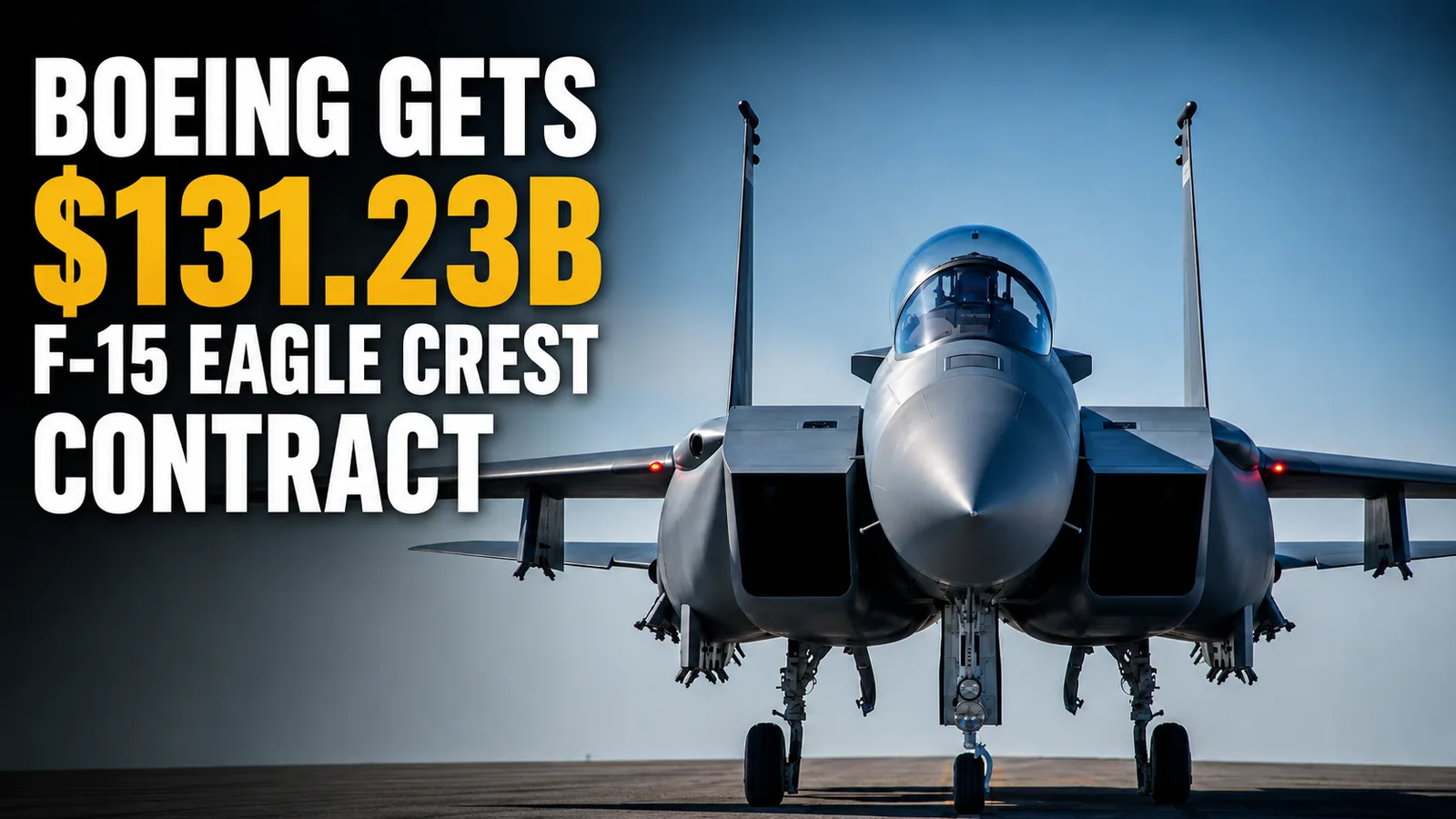
Boeing Gets $131.23B F-15 Eagle Crest Contract
The F-15 Eagle Crest contract gives Boeing a new $131.23 billion ceiling indefinite-delivery/indefinite-quantity framework supporting the US Air Force F-15 Program Office, with scope spanning aircraft production, systems integration, modernisation, upgrades, retrofits, sustainment and depot-level maintenance capability.
The size of the ceiling makes the award strategically significant for the global F-15 enterprise, but it should not be read as an immediate $131.23 billion purchase. The US Department of War said only $343,740 in fiscal 2026 research, development, test and evaluation funding was obligated at award. Individual orders will determine how much of the ceiling is ultimately used.
Key Facts
- Award date: 24 August 2026.
- Prime cowntractor: The Boeing Co., St. Louis, Missouri.
- Ceiling value: $131.23 billion.
- Contract type: Indefinite-delivery/indefinite-quantity (IDIQ), sole-source.
- Contract number: FA8634-26-D-B001.
- Ordering period: Through 24 August 2031, with an option to extend through 24 August 2036.
- FMS scope: Japan, Israel, Saudi Arabia, South Korea, Singapore, Indonesia and Poland.
F-15 Eagle Crest Creates a Broad Enterprise Contract
According to the US Department of War contract notice published on 24 August 2026, Boeing received the $131.23 billion ceiling award to support the F-15 Program Office. Work will be performed in St. Louis, Missouri, and the overall contract is expected to run through August 2037.
The scope is wider than an aircraft-production lot. The award explicitly covers production, systems integration, modernisation, upgrades, retrofits, sustainment and the establishment of organic depot maintenance capabilities for the Air Force, Air National Guard and other Department of War customers.
That breadth is central to understanding the headline value. An IDIQ establishes a contracting vehicle and maximum ceiling from which specific delivery or task orders may later be placed. It does not mean that $131.23 billion was obligated on 24 August. The award notice identifies only $343,740 in fiscal 2026 RDT&E funding as obligated at the time of award.
The $131.23B Ceiling Is Not an Aircraft Order Value
The Eagle Crest award should therefore not be converted into an implied number of F-15EX aircraft or treated as a single production buy. The contract covers multiple types of activity across the wider F-15 weapon-system lifecycle and potentially across multiple customers.
This distinction is reinforced by the way the US Air Force separately budgets F-15EX production. The service's fiscal 2027 aircraft procurement justification documents identify dedicated F-15EX production quantities and cost elements by lot, including airframes, engines, mission equipment and modification requirements. Those programme-line items are a different accounting mechanism from the new enterprise IDIQ ceiling.
The Department of War notice also does not define “Eagle Crest” as a newly disclosed F-15 aircraft variant. Defence Agenda therefore treats Eagle Crest as the name of the contract framework described in the award notice, rather than as a new fighter designation.
FMS Scope Extends Across Seven Countries
The contract notice states that the award involves Foreign Military Sales to Japan, Israel, Saudi Arabia, South Korea, Singapore, Indonesia and Poland. The list gives the contract a significant international dimension because it combines established F-15 operators with countries associated with potential future F-15 procurement.
However, inclusion in the FMS scope should not be interpreted as confirmation that every listed country has placed a new aircraft order under Eagle Crest. The contract notice does not identify quantities, delivery orders or country-specific values.
Indonesia illustrates the distinction. In February 2022, the US State Department approved a possible Foreign Military Sale of up to 36 F-15ID aircraft and related equipment with an estimated value of $13.9 billion. A DSCA notification represents US approval for a possible sale; it is not by itself evidence that the full package was subsequently contracted.
Poland is similarly notable. Boeing has actively positioned the F-15EX for Poland and in September 2025 described the industrial footprint of its “Team Eagle” offer. Defence Agenda also covered Boeing's effort to pair the F-15EX with the MQ-28 Ghost Bat collaborative combat aircraft in its Polish market proposition. The 24 August 2026 award notice names Poland within the FMS scope but does not disclose a Polish F-15 aircraft order.
US F-15EX Fielding Continues Alongside the New Contract
The wider F-15 enterprise is simultaneously moving through a new phase of US Air Force fielding. On 29 June 2026, F-15EX test aircraft returned to Kadena Air Base in Japan to support integration and familiarisation ahead of the type's planned operational arrival. The Air Force identified the 67th Fighter Squadron as Kadena's first operational F-15EX unit.
Boeing describes the F-15EX as the latest F-15 configuration, with digital fly-by-wire controls, an open mission systems architecture, AESA radar, the Eagle Passive Active Warning Survivability System and a maximum stated payload of 29,500 lb (13,381 kg). The company also positions the aircraft for long-range strike, air-dominance and future crewed-uncrewed teaming missions.
These capabilities are relevant to the Eagle Crest framework because the new IDIQ is designed to cover not only production but also the integration and upgrade work needed to keep different F-15 configurations aligned with changing mission systems, sensors, weapons and sustainment requirements.
Industrial and Sustainment Effects Could Outlast Production Lots
The depot-maintenance language may be as strategically important as aircraft production. Establishing organic depot capability shifts part of long-term readiness from contractor-only support toward customer-controlled maintenance capacity. For large fighter fleets, that can affect availability, turnaround time, sovereign sustainment and lifecycle cost over decades.
The structure also gives the F-15 Program Office a long-duration mechanism for ordering modifications and support without negotiating an entirely new overarching contract for each requirement. The base ordering period runs to 24 August 2031 and can be extended to 24 August 2036, while performance is expected to continue through August 2037.
For Boeing's St. Louis combat-aircraft industrial base, the award provides a potential umbrella for production and sustainment demand extending well into the next decade. Actual industrial impact will depend on the delivery orders placed against the IDIQ, not the ceiling alone.
What the Contract Does Not Yet Tell Us
Several variables remain unresolved. The award notice provides no total aircraft quantity, no country-by-country funding breakdown and no guaranteed minimum expenditure beyond the funding obligated at award. It also does not specify which future orders will be for new-build aircraft versus modernisation, retrofit, sustainment or depot capability.
The FMS country list is therefore best treated as the authorised customer scope disclosed for the contract rather than a list of newly signed fighter purchases. This is particularly important for Indonesia and Poland, where the existence of previous approvals or active marketing campaigns does not substitute for a disclosed delivery order.
Implications / Next
The next meaningful milestones will be the delivery and task orders issued under FA8634-26-D-B001. Those orders should reveal how the $131.23 billion ceiling is divided between US production, fleet upgrades, sustainment and individual FMS customers.
For the US Air Force, the contract creates a long-horizon vehicle capable of supporting F-15EX production and the broader F-15 fleet while current fielding continues. For international customers, it may simplify access to common production, integration, upgrade and sustainment work through the FMS system.
The most important indicator will not be the ceiling itself but the pace and composition of obligations against it. Aircraft quantities, country-specific tasking and depot investments will determine whether Eagle Crest primarily becomes a production vehicle, a global sustainment framework, or a combination of both.