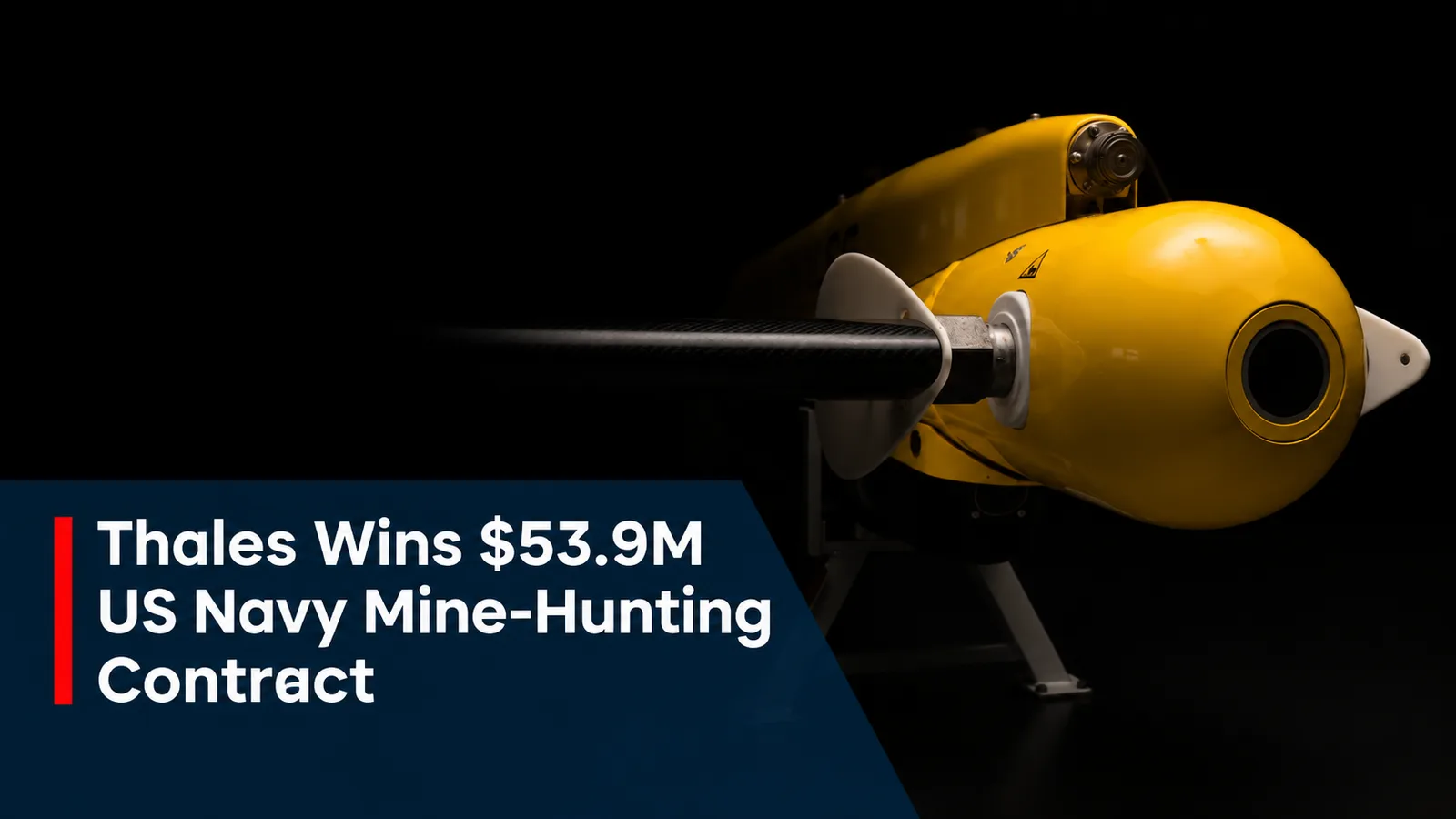
Thales subsidiary Advanced Acoustic Concepts (AAC) has secured a $53.9 million US Navy remote mine-hunting contract to deliver two integrated Remote Mine Hunting (RMH) modules and engineering support, with unexercised options that could increase the total to approximately $196.2 million. Although Thales announced the programme on 2 November 2026, the underlying US federal award record shows that the contract was awarded on 5 August 2026 and publicly posted on 3 September 2026. The development matters because it adds a defined production requirement to the Navy's shift towards stand-off mine detection and classification, but it does not demonstrate that the modules have been delivered or accepted for operational service.
Why the US Navy Is Buying Remote Mine-Hunting Modules
The contract places integrated sensing and mission software at the centre of an approach intended to keep sailors and crewed vessels farther from potentially mined waters. The Navy's mine countermeasures (MCM) mission is a sequence of detection, identification, decision-making and, when authorised, neutralisation. A remote capability can move much of the search and initial classification work away from the most hazardous part of an operating area without removing the requirement for trained operators and formal verification.
In its 2 November announcement, Thales characterised the solution as supporting a 'Find, Fix and Finish' mine-warfare workflow. The contracted element is described as an integrated module suite rather than a completed fleet-wide replacement for dedicated minehunters. The public notice establishes the quantities and engineering support but does not provide platform assignments, planned installation dates or an independently verified change in the Navy's mine-clearance rate.
What the $53.9M Contract Actually Covers
The federal award notice identifies contract N00024-26-C-6304, awarded to Advanced Acoustic Concepts, LLC of Great River, New York. Its initial face value is $53,943,257 for two RMH modules and associated engineering work. If all options are exercised, the ceiling stated in the notice is $196,206,760. The notice identifies the US Navy's maritime acquisition organisation as the contracting activity and classifies the procurement as underwater sound equipment.
Those two dollar figures are different kinds of commitments. The initial amount describes the award covered by the base requirement; the larger figure includes potential follow-on work subject to option exercise. The latter should not be reported as fully funded orders, current revenue or a confirmed quantity of additional modules. No public option schedule, unit pricing or total fleet requirement was specified in the reviewed sources. Independent Reuters coverage likewise distinguished the initial order from the conditional higher value.
SAS Sonar and AI-Assisted Target Recognition
The central sensor is a multiview towed synthetic aperture sonar (SAS). SAS combines acoustic measurements collected along a moving path to produce higher-resolution imagery of seabed features than may be available from some conventional sonar arrangements. A multiview approach can provide additional perspectives on ambiguous contacts, improving the information available to analysts when seabed clutter, shadows or complex shapes make classification difficult. Actual detection distances and probability-of-detection figures for this US Navy configuration have not been disclosed.
AAC's package also includes mission-management applications and artificial-intelligence-assisted automatic target recognition (ATR) algorithms. Thales says the software will help personnel process, classify, map and manage acoustic detections and reduce false target rates. The software should be understood as decision support, not evidence of unreviewed autonomous targeting. False-alarm performance depends on seabed conditions, sensor geometry, environmental noise, training data and the decision thresholds used in operational evaluation.
The announcement references remotely operated vehicle technology within the wider solution. It also discusses future remote neutralisation. This is a prospective capability pathway, not proof that the two contracted RMH modules already include an operationally qualified mine-disposal effector. Separating sensing and classification from neutralisation is necessary to assess what the Navy is actually receiving in this initial award.
Integration With Crewed and Uncrewed Naval Platforms
For a fleet commander, a modular RMH capability potentially matters because mine-hunting information can be gathered by an asset that does not place a crew directly over a suspect seabed area. It could also allow data to be reviewed within a broader maritime command picture. Whether the benefits materialise depends on launch and recovery arrangements, system endurance, acoustic processing capacity, communications links and procedures for passing contacts between sensors and effectors.
Thales describes a pathway serving crewed and uncrewed surface-vessel platforms, but the November announcement does not name a specific US Navy ship class, unmanned surface vehicle or acceptance event for the new modules. No assertion should therefore be made that they are already fielded aboard a named platform. The system may fit a wider international movement towards distributed mine countermeasures, although technical compatibility among different national programmes should not be presumed.
How This Fits Thales' Wider Mine-Warfare Portfolio
The US contract complements rather than duplicates Thales' mine-countermeasures activity in other markets. Defence Agenda previously examined Thales' Royal Navy remote command-centre programme, in which the focus is on coordinated control and analysis for uncrewed assets. That is a different procurement and has its own contract value, schedule and integration obligations; it should not be folded into the US Navy RMH award.
The broader challenge of combining small underwater platforms, acoustic payloads and autonomous software is explored in Defence Agenda's micro-AUV mine-warfare analysis. The question is not only whether the sonar detects an object. It is whether the larger mission system can track, classify, confirm and clear a threat reliably within the time and resources available to a naval task group.
There is also an industrial dimension. Defence Agenda reported a separate Thales towed-array sonar production expansion in Australia. That facility concerns different customers and acoustic product lines, but illustrates the specialised manufacturing, calibration and sustainment capacity behind modern undersea sensors. Neither announcement establishes common production allocations for the American RMH contract.
Operational Benefits and Unresolved Risks
Remote mine-hunting may reduce exposure to explosive hazards and allow operators to build a more detailed picture of seabed threats before dispatching a neutralisation asset. From a procurement perspective, better acoustic imagery and faster classification could improve the efficiency of a clearance mission if they also reduce unnecessary investigations and confirmable false positives. These are plausible operational benefits, not measured outcomes of the contract announcement.
The counterargument is integration complexity. Sonar performance can be affected by bottom type, turbidity-related operational conditions, clutter, sea state and the geometry of the survey track. Automatic classification algorithms require representative evaluation data, while operators need sufficiently transparent confidence information to avoid treating machine labels as certain identifications. If a detection is wrongly rejected or an innocuous object is wrongly designated as a mine, mission costs and safety risks can increase even when processing throughput appears to improve.
The other risk is confusing a production award with a deployable naval capability. Software, sensor performance and communications may each pass component trials without the complete RMH suite meeting fleet requirements. Qualification, ship or vehicle integration, cybersecurity assessment, operator training and logistics support are separate milestones that the public record has not yet tied to a firm delivery timetable.
Programme Schedule, Procurement Options and Next Steps
The 5 August 2026 award date is the clearest procurement milestone. The 3 September 2026 public notice subsequently disclosed the contract and its base-and-options value, while the 2 November 2026 company announcement described the system's technical architecture and intended operational role. These dates should remain separate when tracking programme progress or benchmarking contract newsflow.
The next verifiable events would include a Navy or contractor report of module manufacture and delivery, integration with identified host platforms, test and evaluation results, option exercises and an operational acceptance decision. Future reporting should also distinguish delivered modules from trained crews and deployed mine-clearance capability. Neither the initial module delivery schedule nor the exercise conditions for the options were provided in the reviewed public documents.
For Thales and AAC, successful execution would strengthen their position in undersea sensing and maritime autonomy. For the Navy, the relevant test is whether the integrated system converts sensor quality into repeatable mission throughput without unacceptable false alerts or prolonged exposure of human operators. The stated award establishes the procurement starting point; the evidence for operational performance has yet to be published.