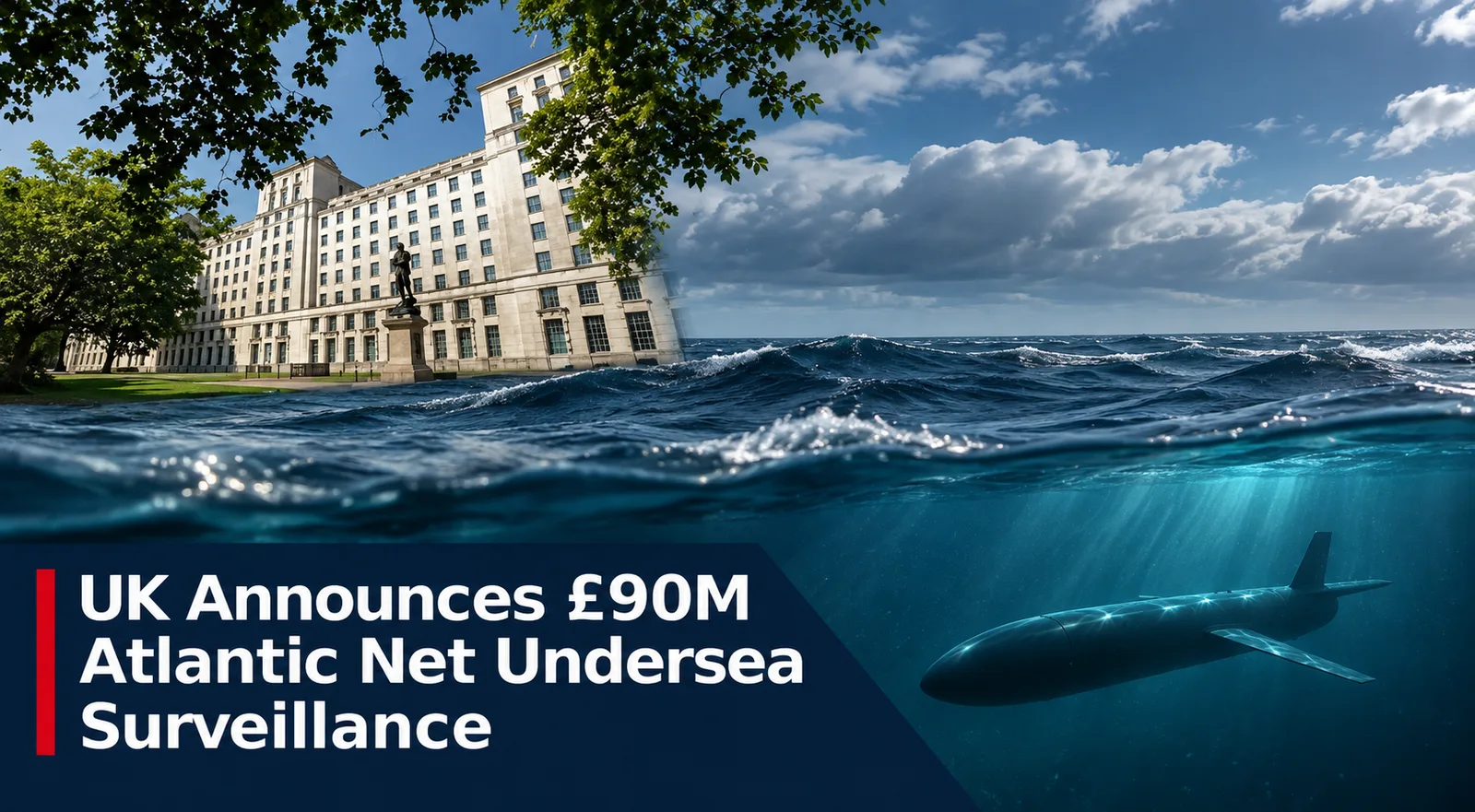
Atlantic Net undersea surveillance will receive a proposed initial £90 million investment under a new UK Ministry of Defence framework with Ocean Infinity Solutions, announced on 10 November 2026 at the International Sea Power Conference in Oslo. The Royal Navy intends to combine autonomous maritime systems, underwater sensors, artificial intelligence and remote operations to detect hostile activity in the North Atlantic and improve protection of communications cables and energy infrastructure. The initiative is the first operational component of the broader Atlantic Bastion programme. It matters because Britain is seeking persistent underwater awareness that can support existing warships and submarines without relying on crewed vessels for every sensing task; the announcement is not confirmation that the full network has already entered service.
What the £90 Million Atlantic Net Framework Covers
The UK Ministry of Defence announcement identifies a new framework with Hampshire-based Ocean Infinity Solutions to create a surveillance service for the North Atlantic. The agreement was described as due to be signed on 10 November, and the government's explanation presents the £90 million as investment to be enabled by the framework. This is a funding and delivery plan, not a published breakdown of firm orders for individual autonomous vehicles, sensors or software licences.
The company's own announcement confirms its selection as the Royal Navy's Commercial Mission Partner. Its task is to integrate maritime technology, data and operating expertise into sustained surveillance. The Royal Navy will direct the resulting capability. Ocean Infinity's statement does not disclose a unit-by-unit production schedule or an independently assessed level of submarine detection performance.
The MOD also estimates that the investment and associated supply chain will support almost 200 skilled jobs. This is the government's stated expected employment effect, not evidence that 200 people have already been recruited. The announcement does not give an explicit duration or split of investment between infrastructure, platforms, digital services and operational support.
Atlantic Net Is the First Phase of Atlantic Bastion
Atlantic Net is an initial integrated surveillance service within Atlantic Bastion, the Royal Navy's wider programme for undersea awareness and anti-submarine warfare. The distinction matters: the £90 million announcement should not be presented as the overall cost of Atlantic Bastion or the budget for every future platform in the Royal Navy's hybrid fleet.
In his 10 November speech in Oslo, Minister for Defence Readiness and Industry Luke Pollard described a network of sensors, sonar and autonomous platforms covering critical North Atlantic approaches, including the Greenland–Iceland–UK (GIUK) Gap. He said the initial investment should allow Atlantic Net to become operational from 2027. In a separate Royal Navy update the same day, the service said the first phase would enter operation within months. These are forward-looking statements rather than confirmed acceptance dates, and neither publication gives an exact in-service day.
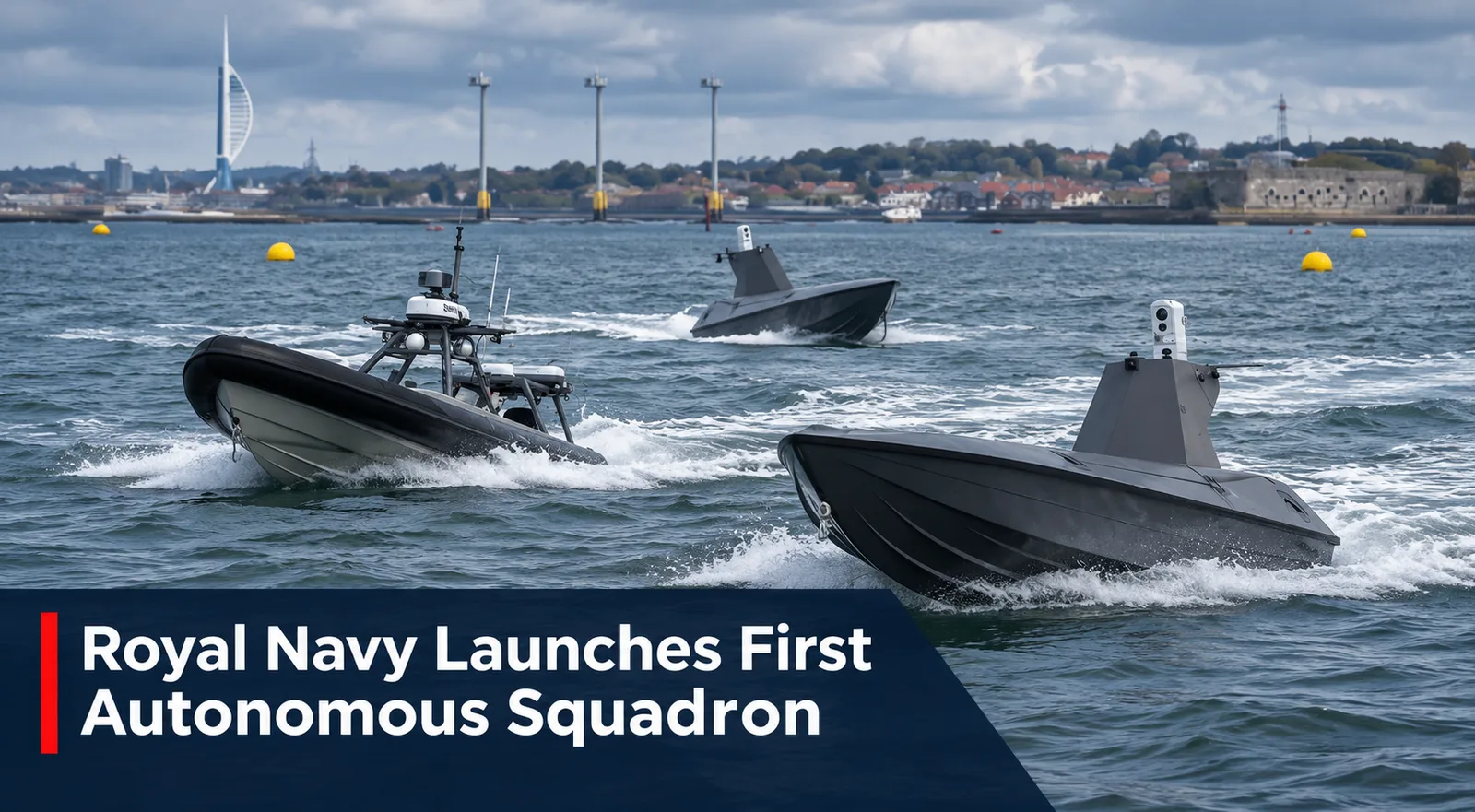
The Royal Navy's concept is to complement submarines and ships with a distributed mix of crewed, remotely operated and autonomous sensing assets. Earlier April 2026 trials examined off-the-shelf technology from smaller companies, including seabed acoustic detection, uncrewed surface vessels, underwater robots, gliders, acoustic floats and remote operations centres. Those activities established experimentation and supplier assessment; they should not be misreported as delivery of the November Ocean Infinity framework.
How Autonomous Sensors Could Improve Undersea Awareness
The programme's operational proposition is persistent collection and analysis, not a claim that one drone can independently search the entire North Atlantic. Underwater sensors can gather acoustic and environmental observations over extended periods. Autonomous or remotely operated platforms can distribute those sensors, while remote operations centres and data services help staff identify patterns and assess contacts.
The MOD says Atlantic Net is intended to provide earlier warnings and a clearer underwater picture for Royal Navy anti-submarine warfare assets, including Astute-class submarines and submarine-hunting warships. Artificial intelligence is expected to support the processing of sensor information. The published material does not give detection ranges, autonomous decision thresholds, false-alarm rates, environmental qualification results or independently demonstrated performance against a named class of submarine.
Underwater communications remain a practical limitation for any persistent network. Data collected beneath the surface must ultimately reach operators through available communications architectures, and commanders must evaluate contact quality before acting on a report. A network may increase coverage, but sensing density, reliability and the ability to correlate observations determine how much useful warning it delivers. Neither Ocean Infinity nor the MOD has published the detailed communications architecture or operational availability requirement for the initial service.
The Royal Navy already has relevant experience in autonomous ocean data collection. In a 15 September 2026 release, it described a 64-day mission involving five Slocum G3 gliders gathering oceanographic data. The operation demonstrates a separate, completed use of uncrewed sensing; it is not evidence that those exact five vehicles will be contracted under Atlantic Net.
Submarine Detection and the Protection of Undersea Cables
Critical undersea infrastructure includes telecommunications cables, energy links and other seabed systems used by the United Kingdom and its allies. Persistent sensing can support awareness of unusual activity near these assets and can help build an operational picture of the underwater environment. It does not guarantee prevention of every act of interference or immediate attribution of damage.
The government explicitly frames Atlantic Net against Russian undersea threats, including risks to maritime routes and infrastructure. That is the government's strategic assessment, not evidence that a Russian submarine was detected or intercepted during the announcement. The MOD release does not identify a recent incident that was prevented by the planned service.
Defence Agenda's earlier analysis, Threats to Undersea Infrastructure in Seabed Warfare, examines why seabed assets demand both monitoring and resilient response arrangements. The new UK funding can be understood as one element of that requirement, although it remains to be shown how quickly the service can generate actionable reports over the intended operating area.
Ocean Infinity's Industrial Role and the Service Model
Ocean Infinity presents itself as a specialist in autonomous maritime operations, robotic vessels, data processing and remote mission delivery. Being named a Commercial Mission Partner therefore makes the company an integrator and operating partner rather than simply a supplier of one sonar or one underwater drone.
In practical procurement terms, the service model could allow the Royal Navy to access combined sensing, data management and operational expertise through an industry-led arrangement. The potential advantage is a shorter path from commercial technology to sustained observation. The corresponding challenge is to define accountability, security, interoperability, continuity of service, control of sensitive information and acceptance standards across a network supplied by different manufacturers.
Minister Pollard's 10 November remarks suggested that British small and medium-sized companies would provide much of the system's equipment and services. However, the announcement does not name a complete set of subcontractors or give their allocations. It would be premature to treat the initial £90 million as fully awarded revenue to any individual sub-supplier.
This procurement is also distinct from related industrial offers. A 10 November Naval News report describes a Thales–Kongsberg initiative aimed at future UK Type 92 uncrewed-surface-vessel anti-submarine warfare requirements. A supplier proposal for that vessel class should not be automatically treated as equipment already selected for Atlantic Net.
NATO, the JEF and North Atlantic Interoperability
The Joint Expeditionary Force Northern Navies Initiative, also announced on 10 November, seeks closer operational cooperation among its maritime members and better compatibility among their command-and-control arrangements. The Royal Navy says Atlantic Net information could benefit NATO and JEF partners. It has not, however, published the final interface standards, national access conditions or classified data-sharing rules governing that future exchange.
Undersea surveillance is an area where interoperability is especially consequential. Aircraft, submarines, ships and uncrewed systems supplied by different nations may collect different kinds of information, but commanders need a usable operational picture rather than isolated reports. Defence Agenda's AUKUS undersea warfare analysis from RIMPAC 26 details the challenges of integrating underwater sensors, relay platforms and remote mission systems; this was a separate exercise, not an Atlantic Net acceptance trial.
The UK also recently identified three AUKUS Pillar II undersea payload developments for 2027. Their technical areas include sensing and a non-kinetic effect, but the October AUKUS programme announcement does not make those payloads part of the November Ocean Infinity framework. Similar technologies can contribute to the same strategic mission without belonging to the same contract.
Programme Risks and What Is Not Yet Confirmed
The primary uncertainty is the conversion of the £90 million framework into a reliably functioning operational service. The government has not disclosed a firm number of contracted surface or underwater vehicles, the mix of sensor types, a detailed geographic coverage map, guaranteed service availability, independently evaluated detection probabilities or a total through-life cost.
An AI-assisted network can help analysts handle large volumes of acoustic observations, but effectiveness depends on representative data, confidence assessment and human decision-making. An increased number of detections is not automatically an improved operational outcome if false alarms or missing information consume too much attention. The programme will also need to address cybersecurity, communications resilience and maintenance of remotely operated equipment in demanding Atlantic conditions.
The alternative to extensive automation is not simply a return to a fully crewed fleet. Conventional frigates, patrol aircraft and submarines remain important for verification, deterrence and follow-on action. Uncrewed systems may extend awareness and persistence while placing new demands on support infrastructure and fleet-wide integration. For comparison, Defence Agenda's coverage of the US Navy's remote mine-hunting modules illustrates how complex sensors and autonomous processing still require separate platform integration, testing and acceptance milestones.
Implications / Next: First Operational Capability in 2027
The immediate milestones to monitor are formal confirmation of the framework's contractual implementation, identification of initial platforms and sensor providers, selection of operating locations, integration with Royal Navy command systems and the first documented operational capability. Government statements indicate introduction within months or from 2027, but neither should be converted into a guaranteed delivery date without a subsequent official update.
For the United Kingdom and its allies, the strategic objective is persistent North Atlantic awareness that supports anti-submarine warfare and the protection of cables and energy infrastructure. For the defence-industrial base, the programme tests whether an industry-led surveillance service can integrate commercial maritime robotics into naval operations at speed and with accountable performance standards. As of 11 November 2026, the verified milestone is the announcement of an initial £90 million Atlantic Net framework and Ocean Infinity's selection—not the completed deployment or acceptance of an operational undersea sensor network.