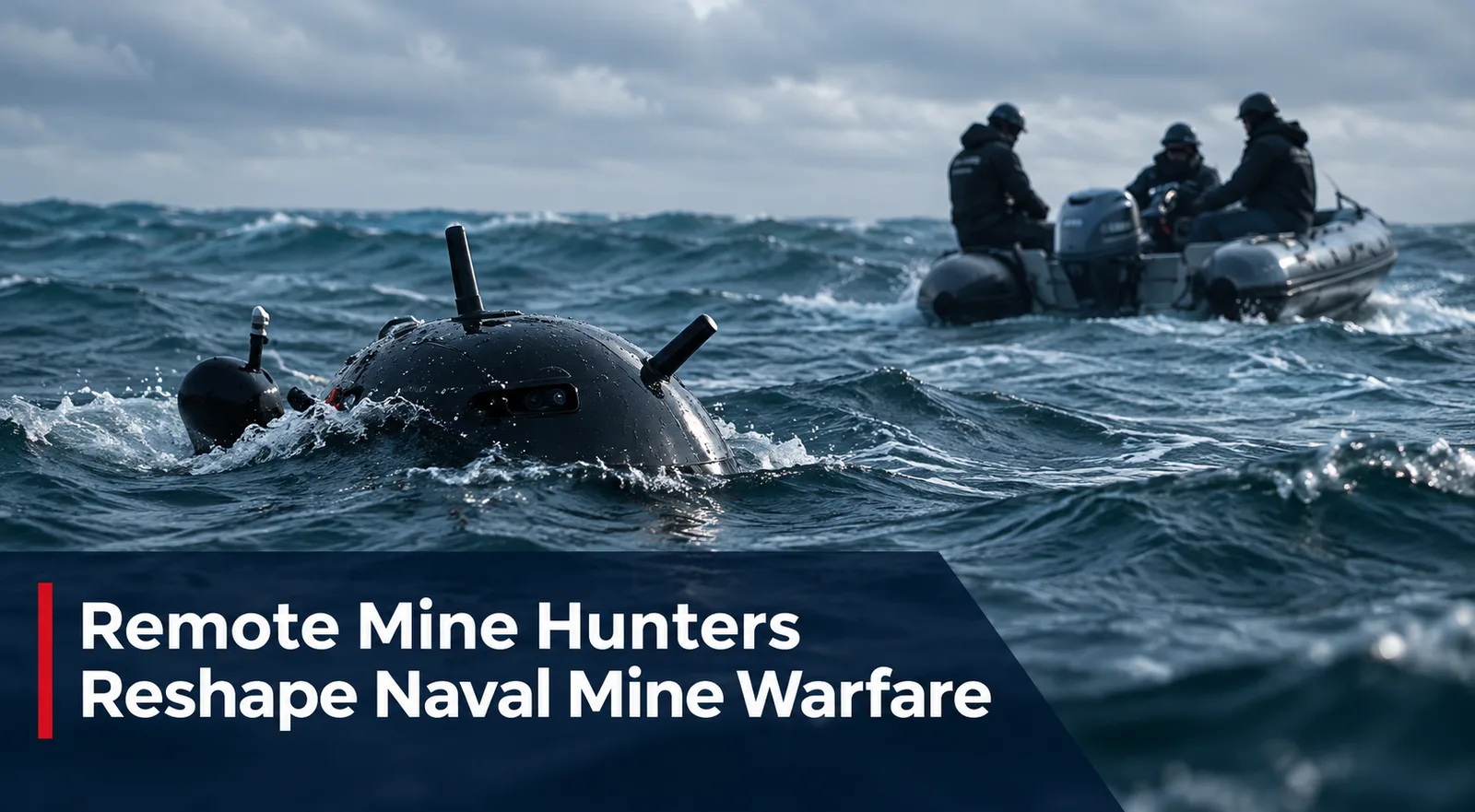
Remote mine hunting is becoming a central element of naval mine countermeasures as the US Navy and allied forces adopt uncrewed vehicles, advanced sonar and software-assisted classification to reduce the exposure of sailors and ships to mined waters. A 10 November 2026 Breaking Defense report examined the shift away from reliance on dedicated crewed minesweepers and towards distributed detection and neutralisation systems. The change matters for access to strategic waterways and fleet protection, although autonomy does not remove the need for human judgement, verified classification or reliable integration across the clearance mission.
The US Navy's Shift From Minesweepers to Remote Mine Hunters
Maritime mines can restrict the movement of warships and commercial shipping even when relatively few devices have been confirmed. An area considered potentially contaminated may require extensive surveying before commanders and shipping authorities can restore access. The problem is particularly consequential at chokepoints such as the Strait of Hormuz, where limited transit space increases the economic and operational impact of disruption.
The changing operational response is not simply to replace one crewed hull with one robot. Instead, navies are moving towards a system in which different sensing, control and neutralisation functions can be distributed across uncrewed surface vehicles (USVs), uncrewed underwater vehicles (UUVs), aircraft and crewed support platforms. A remote vehicle can enter or survey a suspect area while operators and higher-value vessels remain at a safer distance, but personnel may still be required for command, interpretation, recovery and other mission functions.
The US Navy's official Littoral Combat Ship mine countermeasures fact file identifies unmanned surface and underwater vehicles, helicopter-borne systems and remote sensing as elements of the MCM mission package. Its description makes an important distinction: the host ship is designed to remain outside the mine-threat area while its deployed systems undertake specific tasks. It does not mean the minefield itself has become risk-free or that all decisions have been automated.
Find, Fix and Finish: The Mine-Clearance Chain
The 10 November reporting describes the familiar find, fix and finish sequence. In the first stage, sonar and other sensors identify objects or areas requiring investigation. The second stage involves analysing and classifying possible mine-like contacts, separating potentially hazardous items from seabed clutter and recording their locations. The final stage is the authorised disposition of a confirmed threat, which may involve a separate remotely operated system and human oversight.
This workflow helps explain why detecting an unusual shape is not equivalent to finding a mine. Navigation aids, discarded objects, natural features and acoustic artefacts can all produce contacts that require additional scrutiny. A system that generates large quantities of unverified detections can impose a significant workload on analysts, even if its initial survey coverage is wide.
Bryan Clark of the Hudson Institute and Mark Bock of Thales subsidiary Advanced Acoustic Concepts (AAC) described the operational trade-offs to Breaking Defense. Their assessments suggest that the value of autonomy is partly economic and logistical: multiple smaller assets may be transported and deployed more flexibly than a fleet of dedicated crewed minehunters. These are expert assessments, not published results of a controlled comparison demonstrating identical performance in every maritime environment.
The 2026 development is therefore better understood as an evolving mission architecture. No individual system named in the report should be assumed to complete all three stages autonomously, and a claimed reduction in operator exposure does not establish faster clearance without evidence from representative trials.
Synthetic Aperture Sonar and AI-Assisted Classification
Advanced sensing is essential to making remotely collected data useful. AAC and Thales emphasise multiview synthetic aperture sonar (SAS), which builds high-resolution seabed imagery and can provide more than one perspective on an object during a survey. The intention is to help analysts distinguish candidate threats from non-threatening objects without repeating unnecessary survey passes.
The 2 November 2026 Thales announcement describes a Remote Mine Hunting module that integrates multiview towed SAS, mission-management applications and AI-assisted automatic target recognition. The company's associated SAMDIS product family was also discussed in the Breaking Defense interviews. In those descriptions, algorithms assist with detecting, classifying, mapping and reviewing contacts; they do not provide independent proof that the system can make every mine-neutralisation decision without human authorisation.
Classification quality depends on the environment, sensor geometry, data quality and criteria applied by the operator. A false positive can lead to unnecessary investigations, while a false negative may create a serious safety risk. Published programme statements do not provide a sufficiently complete, independently audited performance dataset to compare these errors across seabed types, depths and operating conditions.
AI-assisted change detection is another prospective benefit. By comparing new surveys with earlier seabed records, software may help analysts identify objects that appear to have moved or been added. That approach could prioritise further investigation, but confidence depends on data registration, coverage consistency, environmental variation and independent checks. The technology should be evaluated as decision support within a managed clearance process.
Remote Neutralisation Still Requires Human Control
Detecting and classifying a suspected mine are only part of the problem. A naval force must also decide whether an object presents a threat, whether disposal is authorised and how any action can be conducted without creating unacceptable risks to people or surrounding shipping.
AAC's Angler remote system is presented by the company as a means of dealing with selected underwater hazards while allowing operators to observe the result from a distance. Company representatives also describe methods designed to limit the visible disturbance associated with some disposal events. Those are product claims, not evidence that the system has been independently qualified under all relevant conditions or included in every contracted US Navy RMH module.
The appropriate operational distinction is between a sensor module, a neutralisation system and an integrated command-and-control arrangement. A vehicle carrying a sonar does not automatically possess a mine-disposal capability. Similarly, a weapon or effector that can be controlled remotely does not itself confirm that the entire detect-to-dispose sequence has passed formal fleet acceptance. Public procurement descriptions must be read against the exact configuration being purchased.
What the $53.9 Million Thales Contract Adds
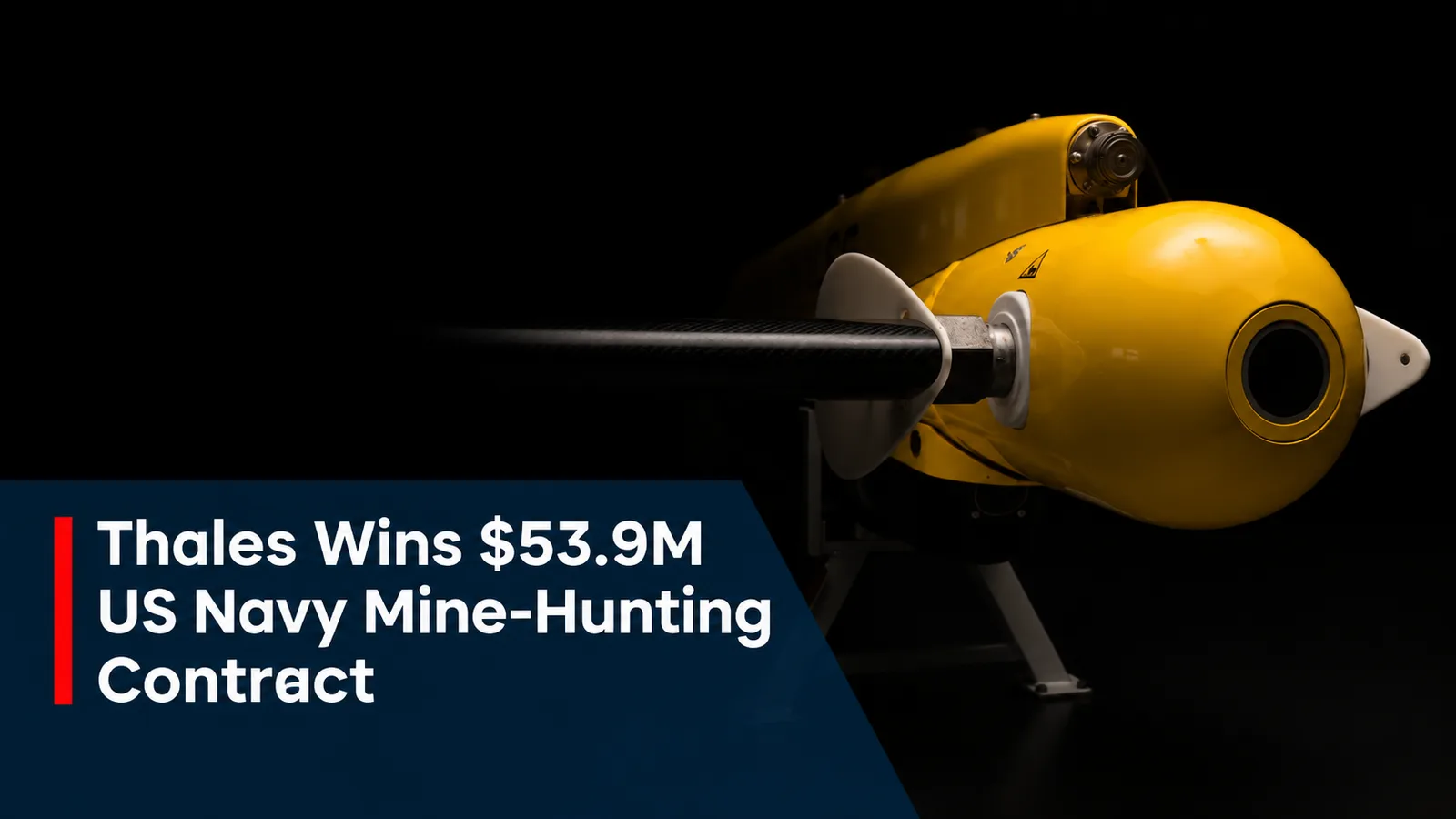
The shift has a concrete industrial dimension. On 2 November 2026, Thales Defense & Security announced that its US subsidiary AAC would supply two integrated Remote Mine Hunting modules and engineering support under an initial US$53.9 million Navy contract. The announcement described potential additional modules that could increase the cumulative value to around US$196.2 million if options are exercised. These amounts are not interchangeable: the higher ceiling is not a confirmed funded order for the full amount.
Defence Agenda's earlier procurement report established a further date distinction: the underlying federal contract award was recorded on 5 August 2026, with a public federal notice on 3 September 2026 and the supplier's announcement on 2 November. The Breaking Defense feature dated 10 November 2026 is a subsequent account of the operational and technology trend, not a second award of the same $53.9 million.
The manufacturer describes integrated sensing and software for remote detection and classification. A separate 3 November Breaking Defense report indicated that the first two modules were expected by October 2029, an attributed schedule rather than proof of delivery. Specific operational assignments and acceptance conditions for the new modules have not been established in the cited announcement.
The US Navy has pursued related capabilities through its broader MCM mission package for years. NAVSEA's 3 February 2025 notice described awards for mine-hunting and minesweeping payload delivery systems, built around a configurable MCM USV. That official record demonstrates that remote mine countermeasures are part of an established acquisition pathway rather than a concept invented in November 2026.
Allied Programmes and Different Procurement Models
The United Kingdom is also moving towards remotely controlled mine countermeasures, although its programme structure and acceptance process are separate. In an 8 October 2026 update, the Royal Navy described Zulu Squadron's training and preparations to receive three autonomous technologies, including a Thales mine-countermeasures system, a TKMS SeaCat underwater vehicle and a portable sweep system. The release described expected equipment receipt and training by year-end, not proof that every component was already on operational deployment.
Defence Agenda previously covered Thales' Royal Navy AI-enabled mine-warfare command-centre programme. The UK command centres and the American RMH modules address related functions but belong to distinct procurements. Their contract values, quantities and programme milestones should not be combined.
The wider maritime autonomy supply chain is also expanding. Defence Agenda reported HII's Pocasset UUV manufacturing expansion, which supports the REMUS family and other unmanned systems, while its report on Thales' Australian towed-array sonar production hub examines acoustic manufacturing capacity. These investments support a broader industrial trend without establishing that the facilities are producing the newly contracted US RMH modules.
Autonomy's Limits: Communications, Weather and Classification
Remote mine hunting offers the possibility of keeping crews farther from the immediate hazard, but it transfers some risk into data handling and systems integration. Survey coverage alone does not ensure that all objects have been correctly classified. Vehicle recovery, maintenance, software configuration and the availability of trained operators may constrain how quickly a task group can conduct repeated missions.
Communications and onboard processing are another challenge. A vehicle may collect acoustic information faster than the data can be reviewed and acted upon. More processing at the edge could shorten decision cycles and reduce dependence on repeated retrieval and manual downloading, but those benefits would need to be shown through reliable trials in contested and degraded conditions.
The economic case also demands care. An uncrewed vehicle generally avoids a permanent embarked crew, but total cost includes sensors, software, support craft, maintenance, spare components, specialist operators and sustainment. Replacing a dedicated minesweeper does not automatically eliminate all crewed support requirements. Nor does a large fleet of inexpensive robots guarantee an equivalent ability to clear a minefield within an operational deadline.
In a separate effort, the US Navy and Defense Innovation Unit announced results from a mine-countermeasures modernisation prize challenge on 1 October 2026, recognising companies in mine detection and neutralisation categories. That initiative illustrates continuing experimentation, but a prize or demonstration award is not necessarily an operational procurement or validated fleet-wide capability.
Implications / Next: Measuring Real Mine-Clearance Performance
The next meaningful benchmarks are not simply the number of autonomous craft purchased. Programme managers need to establish performance against representative mine-like objects, reliable classification and false-alarm rates, deployment and recovery availability, crew workload, full-mission clearance time and traceable human decision-making. Results should be reported separately for detection, classification and neutralisation.
Near-term procurement tracking should distinguish the manufacture and acceptance of the two contracted AAC modules from existing US Navy MCM mission-package deployments. Allied programmes likewise require their own integration and sea-trial evidence. The critical operational question is whether distributed systems can provide dependable access to contested waterways while improving fleet readiness and reducing personnel exposure.
As of 11 November 2026, the confirmed trend is a transition towards remotely conducted mine-countermeasures missions supported by sonar, autonomy and software-assisted analysis. Specific new contracts and equipment deliveries provide evidence that navies are funding the transition, but neither the 10 November feature nor the referenced announcements establishes that human-controlled mine clearance has been replaced by a fully autonomous, independently certified end-to-end process.