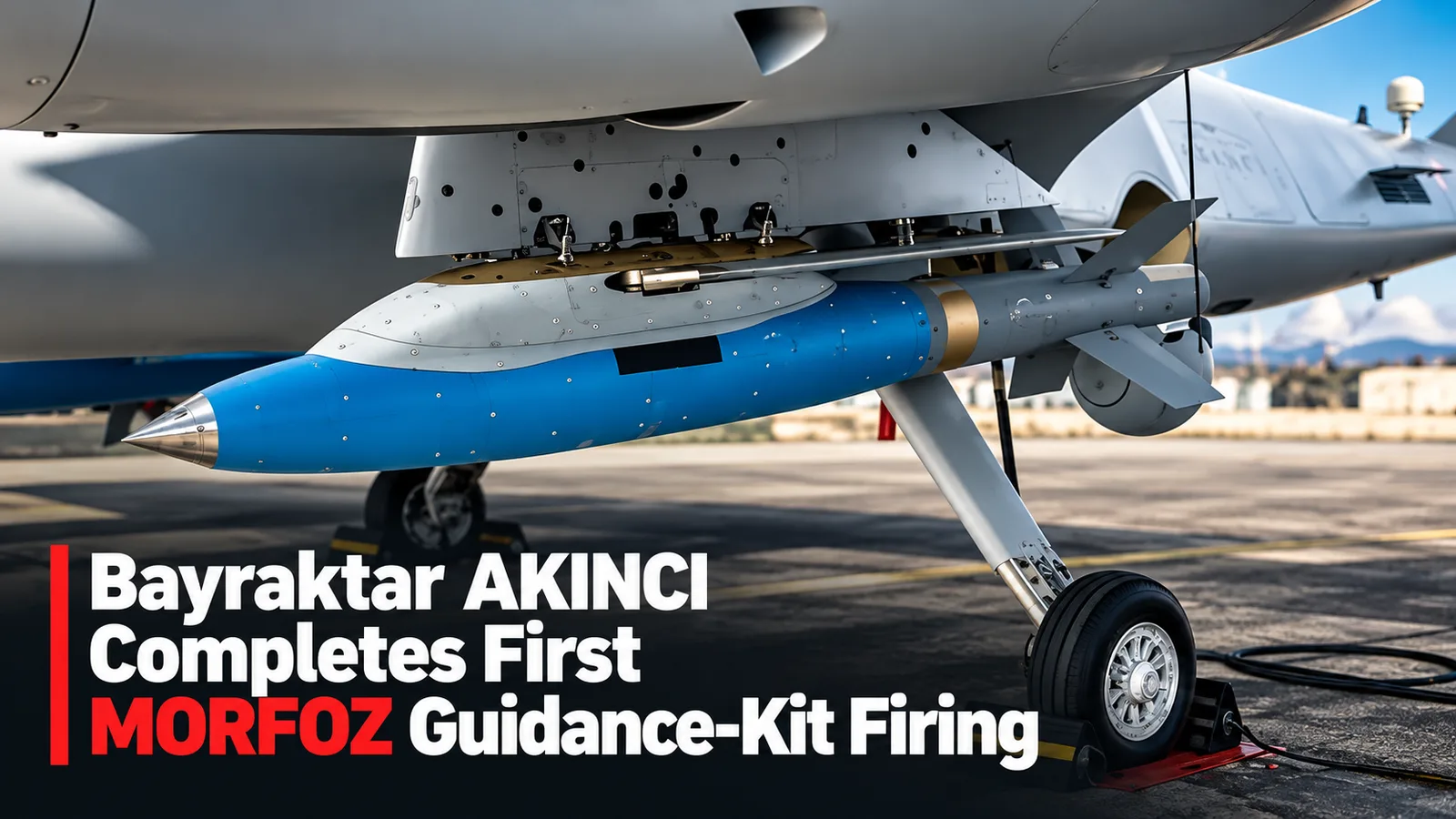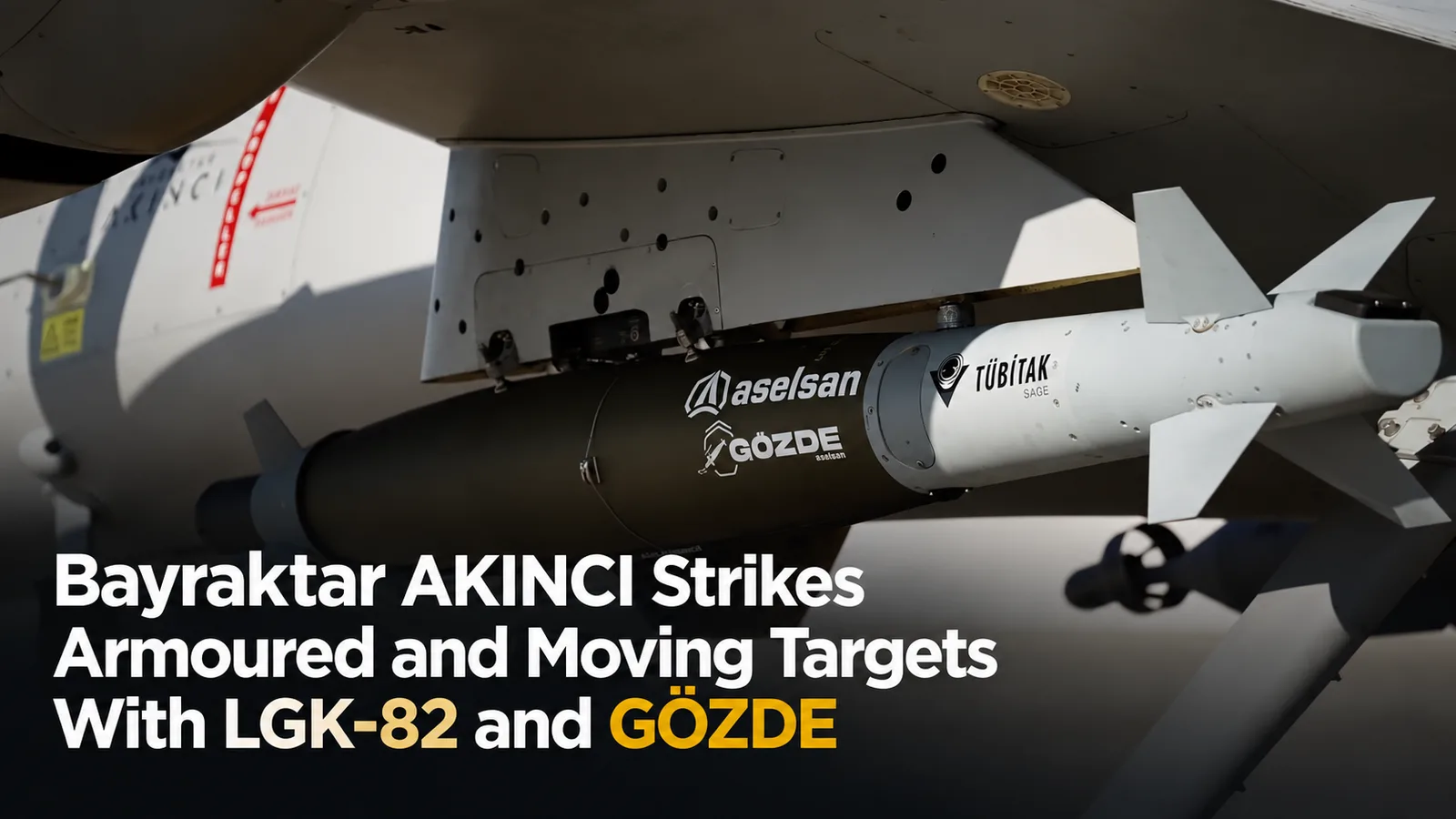
Bayraktar AKINCI has completed a new precision-strike test sequence using two nationally developed guidance kits, with an LGK-82-equipped weapon destroying an armoured military vehicle and a GÖZDE-equipped weapon striking a moving target.
The 3 September 2026 tests were conducted through cooperation between Baykar, ASELSAN and TÜBİTAK SAGE. Anadolu Agency reported that both targets were hit with high precision, while Baykar published footage identifying the weapons as LGK-82 and GÖZDE. Türkiye’s Minister of Industry and Technology Mehmet Fatih Kacır subsequently described the GÖZDE event as a live-warhead firing from AKINCI against a moving target.
Key Facts
- Platform: Bayraktar AKINCI
- Weapons: LGK-82 and GÖZDE guidance-kit-equipped munitions
- Partners: Baykar, ASELSAN and TÜBİTAK SAGE
- LGK-82 target: Armoured military vehicle
- GÖZDE target: Moving target
- GÖZDE September milestone: Live-warhead moving-target firing from AKINCI, according to Minister Mehmet Fatih Kacır
- Exact release range: Not publicly disclosed
- Exact target speed: Not publicly disclosed
The Latest Test Combined Two Different Guidance Concepts
The test sequence is significant because LGK-82 and GÖZDE solve different targeting problems even though both are used with general-purpose bomb bodies.
LGK-82 is a laser-guidance kit. ASELSAN states that it converts Mk-82, OFAB-250T and QFAB-250 LG-class bombs into precision-guided weapons by using a semi-active laser seeker that homes on reflected laser energy.
GÖZDE is a more complex new-generation kit developed by TÜBİTAK SAGE and produced by ASELSAN. It combines inertial navigation, satellite navigation and a laser seeker and is designed for both stationary and moving targets.
The September event therefore demonstrated both a conventional laser-designated armoured-target engagement and a moving-target engagement using a multi-mode guidance architecture.
LGK-82 Destroyed an Armoured Vehicle Target
Anadolu Agency reported that an LGK-82-equipped munition released from AKINCI struck and destroyed a designated armoured military vehicle.
ASELSAN’s current LGK-82 brochure lists Bayraktar AKINCI among the system’s certified platforms. For UCAV use, the company publishes a maximum range of up to 2.5 nautical miles, or 4.6 km, and an altitude envelope of up to 30,000 ft MSL.
ASELSAN also publishes a CEP of less than 10 metres for the system and states that the kit can engage stationary and moving targets, support opportunity targets and allow retargeting during captive flight.
Those figures are product specifications. The September report does not disclose AKINCI’s actual release altitude, distance, speed, laser-designation source or impact geometry.
AKINCI First Fired LGK-82 in 2022
The September firing was not the first integration of LGK-82 with AKINCI.
Baykar announced the first LGK-82 firing from an unmanned aircraft on 2 July 2022. In that test, AKINCI flew at roughly 30,000 ft above cloud while a Bayraktar TB2 below the cloud layer laser-designated the target.
The weapon hit the target successfully, establishing the basic AKINCI/LGK-82 integration pathway four years before the latest test.
The new event therefore adds another live-fire data point and a different target set rather than representing first platform integration.
GÖZDE Struck a Moving Target
In the second part of the latest firing sequence, a GÖZDE-equipped weapon released from AKINCI struck a moving target with high precision.
Minister Mehmet Fatih Kacır described the event as a live-warhead moving-target firing, which is the most important additional detail beyond the original Anadolu Agency report.
GÖZDE converts the 500 lb Mk-82 general-purpose bomb into a precision-guided weapon using inertial navigation, satellite navigation and a modular laser seeker.
TÜBİTAK SAGE publishes four guidance modes: laser/INS/GPS, laser/INS, INS/GPS and INS-only.
GÖZDE’s Moving-Target Capability Predates the September Test
The September event should not be described as the first time GÖZDE has ever engaged a moving target.
TÜBİTAK SAGE announced on 27 February 2025 that GÖZDE struck an 80 km/h moving vehicle during F-16 integration testing. The target was engaged using the weapon’s combined navigation and laser-guidance architecture.
ASELSAN’s 2025 annual report also states that GÖZDE successfully hit a moving target from AKINCI during previous integration work.
The latest event is therefore best framed as a further AKINCI moving-target live-fire milestone, with the additional public detail that a live warhead was used.
GÖZDE Gives AKINCI a Longer Published UCAV Engagement Envelope Than LGK-82
TÜBİTAK SAGE publishes an 8-nautical-mile range for GÖZDE when released from a UCAV and 15 nautical miles from a fighter at high altitude.
That is longer than ASELSAN’s current published LGK-82 UCAV figure of 2.5 nautical miles.
The difference reflects the aerodynamic and guidance architectures of the two kits and should not be interpreted as a direct measure of combat effectiveness.
Actual range depends on release altitude, speed, flight profile, target geometry and environmental conditions.
GÖZDE Is Designed Specifically for Moving Targets
TÜBİTAK SAGE lists engagement of targets moving at more than 50 km/h among GÖZDE’s core capabilities.
The developer also publishes laser-guided CEP values below 3 metres against stationary targets and below 10 metres against moving targets.
These figures explain why GÖZDE occupies a different niche from simpler laser-only kits. Its integrated navigation system supports mid-course guidance while the laser seeker enables precise terminal correction against a target whose position changes after weapon release.
The 3 September report does not state the speed of the moving target or whether the laser designation came from AKINCI itself, another aircraft or a ground team.
The Test Strengthens AKINCI’s Role as a National Weapons Integration Platform
AKINCI has become one of Türkiye’s principal airborne integration platforms for indigenous weapons.
Baykar’s current programme material lists a broad set of tested munitions including MAM-L, MAM-T, TOLUN, TOLUN-IIR, TEBER-81/82, LGK-81/82, HGK-82, GÖKÇE, GÖZDE, KGK-82-SİHA, İHA-230, İHA-122 and ÇAKIR.
This breadth is operationally important because it allows the same aircraft to be configured for different target classes, ranges, guidance modes and desired terminal effects.
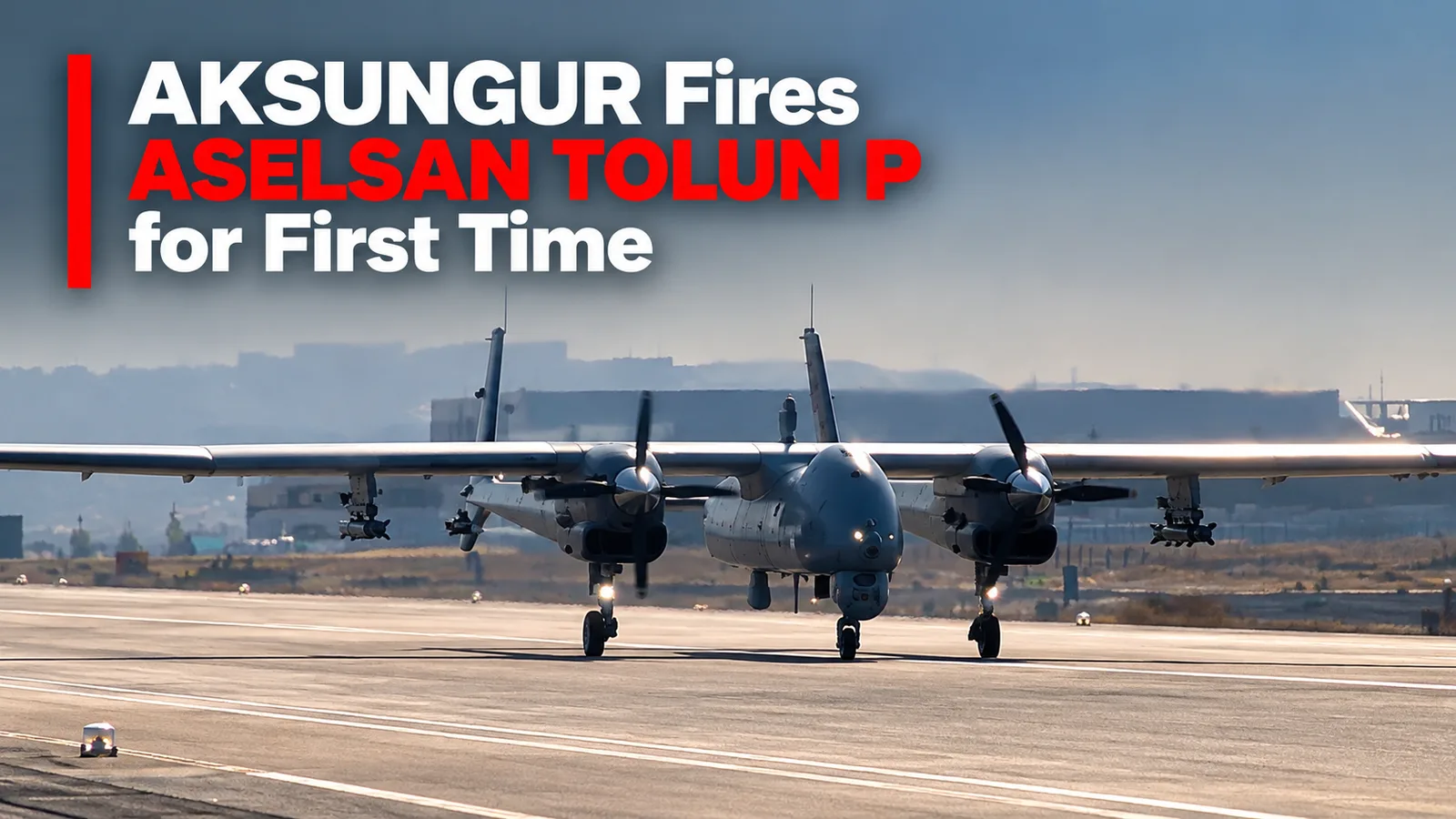
The September LGK-82/GÖZDE sequence came only one day after ASELSAN and Baykar publicised a separate AKINCI firing involving TOLUN I, TOLUN F and TOLUN P variants at Karapınar.
Two Consecutive Test Packages Show Different Strike Philosophies
The TOLUN demonstration focused on different warhead and fuze effects: fragmentation, proximity-fuzed attack and hardened-target penetration.
The LGK-82/GÖZDE test focused more on guidance method and target motion.
Together, the two test packages illustrate how AKINCI’s weapons architecture is expanding along multiple axes at once: target type, target movement, warhead effect, seeker type, navigation resilience and carriage density.
This is a more meaningful measure of strike flexibility than simply counting the number of compatible munitions.
Laser Guidance Still Requires a Designation Chain
Both LGK-82 and GÖZDE can use laser energy during terminal guidance.
That means successful employment depends not only on the weapon but also on the target-designation chain.
The designator can theoretically be carried by the launch aircraft, another airborne platform or a ground element, depending on the integration and mission architecture.
The 2022 LGK-82 test demonstrated buddy lasing from TB2 to AKINCI. The September 2026 public reporting does not specify how the targets were designated.
That missing detail matters because designation range, line of sight and coordination requirements can shape how the weapon is used operationally.
National Guidance Kits Reduce Dependence on Imported Conversion Kits
LGK-82 and GÖZDE both convert widely available general-purpose bombs into guided weapons rather than requiring an entirely new airframe for every precision-strike role.
That approach can make use of existing bomb stocks while moving the critical guidance, navigation, seeker and control technology into domestic production.
ASELSAN states that LGK-82 does not require an export licence from a foreign supplier, while TÜBİTAK SAGE identifies GÖZDE as a nationally developed system that ASELSAN will produce.
The industrial significance therefore extends beyond a single firing test: the programmes increase domestic control over precision-guided weapon availability and platform integration.
Export Relevance Is Already Visible
ASELSAN’s 2025 annual report says LGK-82 deliveries were continuing both domestically and internationally.
The report also notes LGK-82 integration onto a foreign customer’s Embraer Super Tucano and QFAB bomb integration for a Su-25 user.
That shows the kit is not limited to Turkish platforms.
The 3 September AKINCI firing itself did not announce a new export customer or contract, so the event should not be presented as an export award.
Moving-Target Engagement Raises the Value of Low-Cost Bomb Bodies
Converting Mk-82-class bombs into weapons able to engage moving vehicles changes the utility of a relatively inexpensive general-purpose bomb body.
Instead of being limited to fixed coordinates, the weapon can be redirected during terminal flight toward a target that continues to move.
This can be particularly valuable against vehicles, mobile command posts and other relocatable ground assets.
However, the public test information does not disclose the target’s manoeuvre pattern, speed, countermeasures or whether the weapon was tested under navigation jamming.
Limitations and Counterpoint
The latest public material confirms successful target engagements but does not disclose the complete test envelope.
For LGK-82, no release distance, altitude, speed, target motion profile or laser-designation source was published.
For GÖZDE, the moving target’s exact speed, route and designation method were not disclosed.
The product ranges and CEP figures cited by Defence Agenda come from ASELSAN and TÜBİTAK SAGE technical pages and are manufacturer/developer specifications rather than independent measurements from the September shots.
The event also does not represent first-ever moving-target success for GÖZDE. Earlier F-16 and AKINCI testing had already demonstrated that capability.
No new procurement quantity, contract value, serial-production milestone or export order was announced with the latest tests.
Implications / Next
The first issue to watch is whether Baykar, ASELSAN or TÜBİTAK SAGE release the detailed test geometry, especially release distance, target speed and designation architecture.
The second is contested-environment testing. Demonstrations that combine moving-target engagement with GNSS degradation, jamming or deceptive navigation conditions would provide stronger evidence of combat resilience.
The third is carriage density. AKINCI’s ability to combine different Mk-82-class guided weapons in the same sortie could allow target-specific loadouts rather than one munition type per mission.
The fourth is export integration. Additional aircraft certifications would widen the commercial market for national guidance kits independently of AKINCI exports.
The fifth is operational fielding. Public confirmation of inventories, unit-level use or sustained training would distinguish integration success from routine service adoption.
Conclusion
Bayraktar AKINCI’s latest weapons test demonstrates two different national precision-strike paths in one sequence.
LGK-82 used laser guidance to destroy an armoured target, while GÖZDE struck a moving target using a more advanced multi-mode guidance architecture. The subsequent description of the GÖZDE event as a live-warhead moving-target firing adds the most important new detail.
The milestone does not create the moving-target capability from zero; earlier tests had already established it. Instead, it shows continued maturation of AKINCI as a carrier for increasingly diverse Turkish precision weapons and reinforces the industrial value of converting standard bomb bodies with domestically controlled guidance technology.