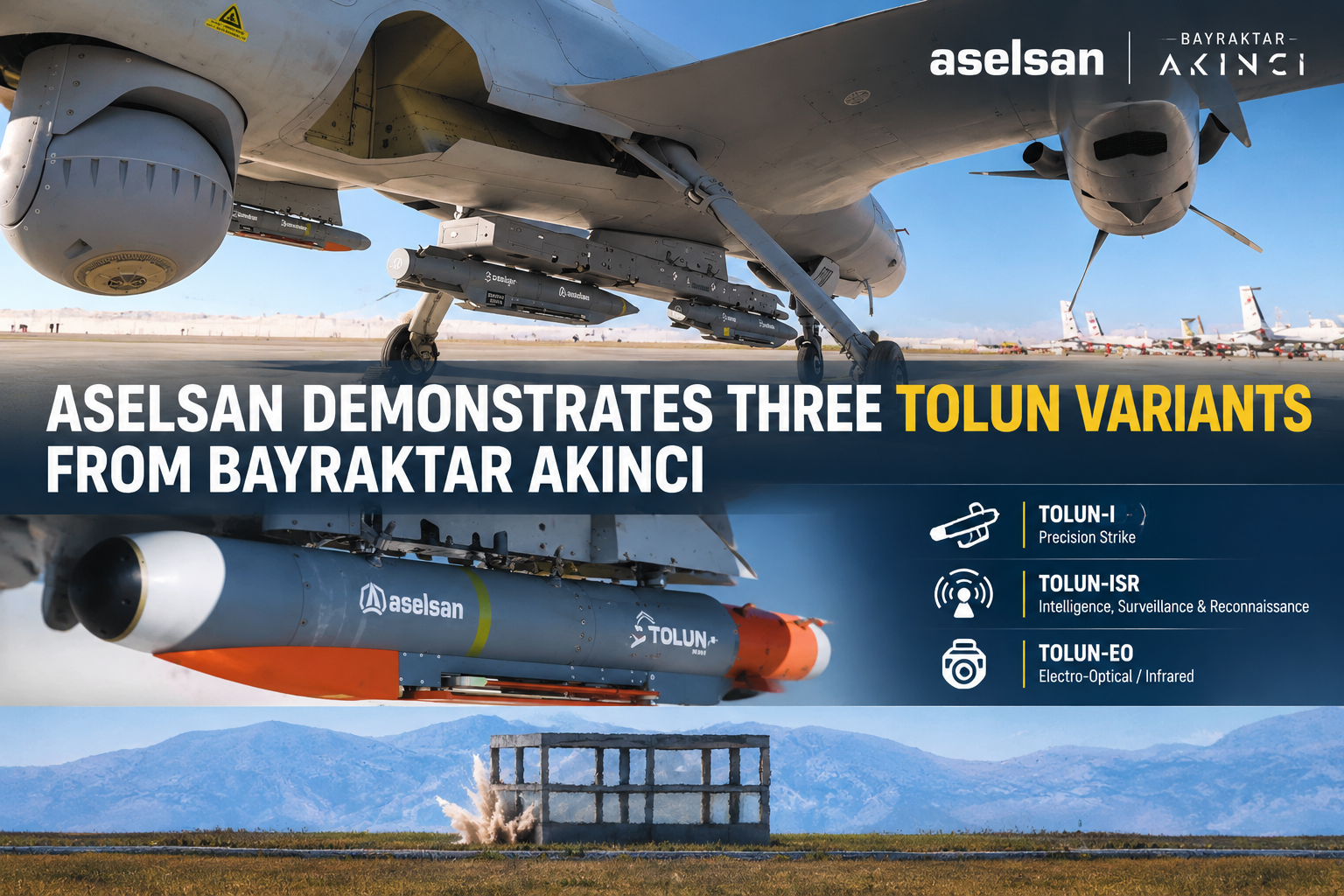
ASELSAN has demonstrated three members of its TOLUN Deep Strike Munition Family from Bayraktar AKINCI during an international live-fire event at the Konya Karapınar Firing Test Range, showing distinct fragmentation, proximity-fuzed and hardened-target effects from a common compact guided-weapon architecture.
The 1 September 2026 Guidance Systems International Demonstration was attended by military officials from more than 15 countries. TOLUN I struck a container target with an impact-fuzed fragmentation warhead, TOLUN F attacked an armoured personnel carrier scenario using a proximity sensor and programmable electronic fuze, and TOLUN P penetrated a two-storey concrete target before detonating at the programmed layer.
Key Facts
- Event: Guidance Systems International Demonstration
- Date: 1 September 2026
- Location: Konya Karapınar Firing Test Range
- Attendance: Military officials from more than 15 countries
- Launch platform: Bayraktar AKINCI
- Weapons: TOLUN I, TOLUN F and TOLUN P
- Multi-carriage: SADAK-4T
The Demonstration Showed Target-Effect Diversity
The most important feature of the Karapınar event was the use of three TOLUN variants against three different target sets. ASELSAN’s supplied programme note states that all three weapons were released from Bayraktar AKINCI and successfully engaged their designated targets.
TOLUN I was used against a container target, TOLUN F was fired at an armoured personnel carrier scenario with personnel represented around it, and TOLUN P was released against a two-storey concrete building target.
This makes the event more operationally meaningful than repeated firings of the same precision weapon. The family concept is being used to address soft, armoured and hardened targets with different terminal effects.
TOLUN I Demonstrated Direct-Impact Fragmentation
TOLUN I was configured with an impact fuze and fragmentation-effect warhead. According to the ASELSAN material supplied for the event, the weapon achieved a direct hit on a container target and is intended for use against stationary and moving targets.
The supplied note does not provide a full standalone technical specification for the exact TOLUN I configuration demonstrated at Karapınar. Defence Agenda therefore does not transfer range, weight or accuracy figures from TOLUN F or TOLUN-IIR to TOLUN I.
TOLUN F Adds a Programmable Proximity Effect
TOLUN F was fired against an armoured personnel carrier target scenario. ASELSAN states that the munition includes a cockpit-programmable electronic fuze and an adjustable proximity sensor that can initiate the fragmentation warhead before impact.
The company also lists waypoint tracking, selectable impact angle, retargeting during captive flight, a CRPA anti-jam antenna and embedded software intended to improve resistance to GPS spoofing.
Those are manufacturer-stated capabilities. The September firing confirms a successful target engagement but does not publicly quantify anti-jam or anti-spoof performance during the test.
ASELSAN Publishes Separate Fighter and UAV Ranges for TOLUN F
ASELSAN’s current TOLUN F brochure describes the weapon as a 250 lb-class INS/GNSS-guided glide munition. It publishes a range of up to 47 nautical miles, or 87 km, from fighter aircraft and up to 28 nautical miles, or 52 km, from UAVs.
The same brochure lists a weapon weight of 119 kg, a 70 kg fragmentation warhead and a diameter of 185 mm. These are product specifications and should not be interpreted as the actual release range or altitude used during the Karapınar firing.
TOLUN P Demonstrated Controlled Penetration
TOLUN P was used against a two-storey concrete structure. The ASELSAN event note says the weapon penetrated two concrete layers and then detonated at the programmed layer, destroying the intended elements inside the target.
The weapon combines a specialised penetrator nose, penetrator warhead and programmable time-delay fuze. ASELSAN also identifies the ASAF hard-target fuze as part of the TOLUN P architecture.
Defence Agenda previously reported ASELSAN’s stated capability for TOLUN P to penetrate one metre of reinforced concrete. The September demonstration provides a new target-specific result, but the public material does not identify concrete strength, reinforcement density, layer thickness, impact velocity or impact angle.
The Fuze Architecture Is Becoming a Core Differentiator
The three firings show that ASELSAN is differentiating TOLUN variants not only by guidance but also by fuze and warhead behaviour. TOLUN I uses direct-impact initiation with a fragmentation effect. TOLUN F adds proximity sensing and programmable timing. TOLUN P combines a penetrator structure with programmable delayed initiation after entering the target.
This gives mission planners more control over where and how the weapon releases its energy while retaining a related family architecture.
SADAK-4T Is Central to the TOLUN Concept
ASELSAN’s SADAK-4T Smart Pneumatic Quad Rack is central to the family’s carriage concept. The rack allows multiple TOLUN-class weapons to be carried on one aircraft station, increasing the number of precision weapons available per sortie.
ASELSAN describes TOLUN as capable of engaging single or multiple targets during one sortie. The September material does not disclose the exact number of TOLUN weapons carried by AKINCI during the event or whether the weapons were released in a ripple sequence.
AKINCI Is Becoming a Major TOLUN Integration Platform
Bayraktar AKINCI has become one of the principal flight-test and integration platforms for the TOLUN family. The aircraft has previously conducted TOLUN penetration tests, TOLUN-IIR trials and other guided-weapon demonstrations.
Defence Agenda reported in August 2026 that TOLUN P had successfully struck a hardened target from AKINCI. The 1 September event broadens that relationship by showing three terminal-effect configurations from the same unmanned platform before an international military audience.
The Wider TOLUN Family Extends Beyond the Three Weapons Fired
ASELSAN’s 2025 annual report describes a wider family including TOLUN-IIR and TOLUN-S. TOLUN-IIR combines GPS/INS guidance with an imaging-infrared seeker and a bidirectional datalink, enabling terminal target update and man-in-the-loop control.
ASELSAN publishes a range of 43 nautical miles, or 80 km, for TOLUN-IIR and states that it can engage stationary and moving targets. The annual report also records successful development of the surface-launched TOLUN-S.
These variants were not part of the three-weapon Karapınar firing sequence described in the supplied ASELSAN note.
Anti-Jam and Anti-Spoof Features Address a Growing Strike Problem
Satellite-navigation disruption is a central design problem for modern guided weapons. ASELSAN states that TOLUN F uses a CRPA anti-jam antenna and includes software intended to resist GPS spoofing.
TOLUN-IIR adds an electro-optical terminal seeker, providing a separate terminal sensing channel and allowing target update after launch. ASELSAN’s annual report also notes a previous AKINCI firing involving TOLUN integrated with the KARETTA anti-jam GNSS system.
Public sources do not disclose jamming-to-signal ratios, spoofing scenarios or resilience thresholds, so these capabilities remain manufacturer-attributed rather than independently validated combat performance.
The Demo Was Also Export-Facing
Military representatives from more than 15 countries attended the Karapınar demonstration, giving the event a clear international marketing dimension in addition to its technical purpose.
ASELSAN’s 2025 annual report states that SADAK-4T and ground-launched TOLUN systems had already achieved first exports and deliveries to multiple countries. No new export contract, customer or order quantity was announced in connection with the 1 September demonstration.
Limitations and Counterpoint
The demonstration confirms successful engagements but does not disclose the complete qualification matrix for each variant. No public source reviewed for this package gives the exact release altitude, release speed, standoff distance, impact speed or detailed CEP for the three September shots.
The concrete target used for TOLUN P is described as a two-storey structure, but the thickness and reinforcement specification of the penetrated layers are not published. The TOLUN F firing demonstrates proximity-fuze functionality, but no quantitative fragment pattern or lethal-radius data are public.
Attendance by officials from more than 15 countries should not be interpreted as evidence that those countries are customers or that procurement decisions have been made.
Implications / Next
The next indicators are additional instrumented data from the Karapınar event, follow-on export announcements, further platform integrations, contested-navigation testing and a multi-weapon or multi-target AKINCI firing that directly demonstrates SADAK-4T carriage density.
Conclusion
ASELSAN’s Karapınar demonstration moves the TOLUN story beyond a single precision-guided munition. Three variants were used from Bayraktar AKINCI to create three different target effects: direct-impact fragmentation with TOLUN I, proximity-fuzed fragmentation with TOLUN F and delayed detonation after concrete penetration with TOLUN P.
The common SADAK-4T carriage architecture and growing family of seeker, fuze and launch configurations point toward a modular strike ecosystem rather than a one-purpose weapon.