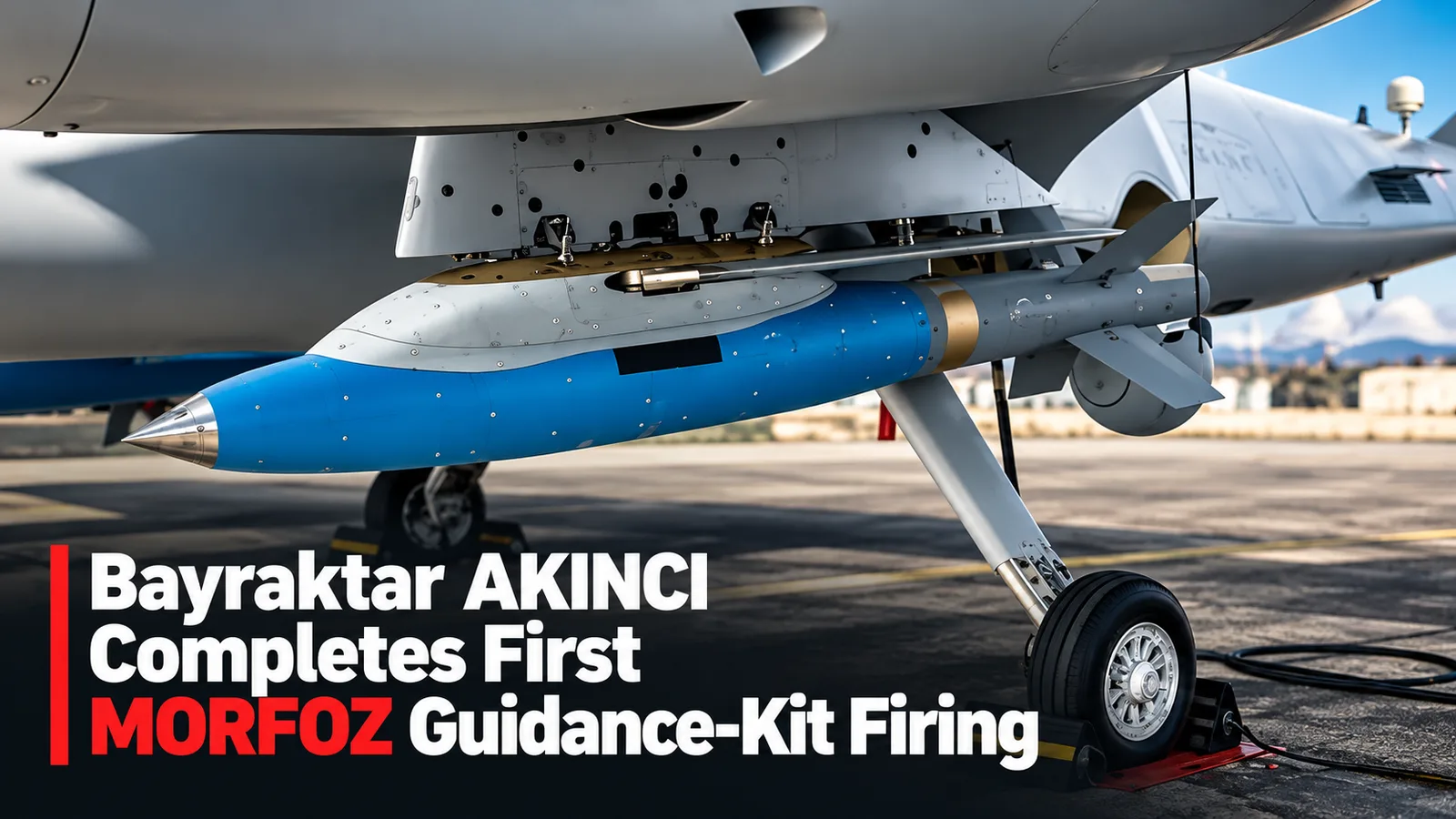
Baykar’s Bayraktar AKINCI uncrewed combat aircraft completed its first firing with the ASELSAN-developed MORFOZ Guidance Kit (MGK) on 8 October 2026, with Baykar reporting a direct hit over the Gulf of Saros. The test adds a further Turkish precision-weapon integration to an operational aircraft family, but it is a first firing rather than an announcement of full operational qualification or a new weapons order.
The First MGK Firing Was Conducted from Çorlu
Baykar said the AKINCI aircraft took off from its Çorlu Flight Training and Test Centre in Tekirdağ carrying the MORFOZ kit and an ALPAGUT munition. During the sortie over the Gulf of Saros, the aircraft fired the MGK-configured weapon and struck its designated target. After the event, it returned to Çorlu. Baykar’s public report is dated 9 October, while the firing itself took place on 8 October.
The distinction between carriage and release is important in weapons integration. The source states that ALPAGUT was aboard the aircraft but attributes the recorded hit to MGK. It would be incorrect to count this event as a newly confirmed ALPAGUT live firing or assume that every store carried on the aircraft was released during the same mission.
Guidance-Kit Integration Broadens the Payload Portfolio
ASELSAN developed MORFOZ using Turkish components, according to Baykar and Anadolu Agency. Such guidance kits can be valuable because they offer an alternative precision-attack configuration without necessarily requiring an entirely new aircraft or weapon family. The key technical work is still substantial: aerodynamics, release separation, aircraft software, targeting data, fuze safety and flight-envelope compatibility must be validated for each certified combination.
AKINCI already supports a broad set of domestic munitions and has been used as an integration platform for several weapon classes. Adding MGK increases possible mission combinations, but the public release does not disclose the kit’s tested envelope, accuracy statistics across repeated firings, production quantity or a named customer order. A direct hit at one test point is an important step, not a full public qualification report.
The Industrial Significance Is Cross-Company Integration
This event brings together Baykar’s aircraft integration effort and ASELSAN’s precision guidance development within Türkiye’s wider indigenous weapons ecosystem. Cross-company integration can reduce external approval dependencies and create additional export options, subject to national licensing and customer requirements. It also provides an opportunity to standardise mission-system interfaces and shorten future engineering cycles if technical results are shared appropriately.
For a procuring air force, however, industrial sovereignty must still be translated into predictable in-service performance. A qualification campaign usually needs more than one accurate strike: varying release altitudes, speeds, target conditions and environmental factors all influence reliability. The programme should be judged against the demonstrated test and subsequent clearance records rather than marketing lists of all weapons associated with the aircraft.
How a Successful Firing Becomes a Qualified Weapon
Integration testing is a sequence rather than a single event. Engineers must show that the aircraft can carry the store safely, communicate with its electronics, release it inside a defined flight envelope and achieve the intended effect under specified conditions. A reported direct hit satisfies an important observation for the trial but does not prove every planned release altitude, speed, weather condition or target type. A separate operational acceptance process may follow even after several successful tests.
The industrial implications are still significant. Every new compatible munition can broaden an aircraft operator’s mission-planning choices and create demand for associated software, training and maintenance work. However, procurement officers will look for qualification documentation, reliability figures, configuration control and spare-part arrangements before drawing conclusions about fleet-wide availability. Those particulars have not been announced in the cited first-firing account, so the milestone should remain precisely described as an integration test.
Implications / Next
The next evidence will be additional MGK shots, operating-envelope clearance, customer acceptance and any identified production or export programme. Baykar’s first-firing announcement supports reporting a successful integration test, not a completed procurement or universal combat clearance. The timing is also relevant: it occurred on 8 October and should not be rebranded as a breaking 13 October firing merely because it appears in a new radar collection.