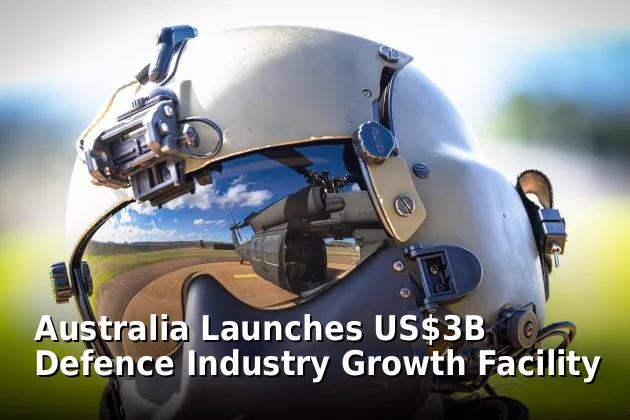
Australia has launched a US$3 billion Defence Industry Growth Facility that expands government-backed defence finance beyond exports to include sovereign capability, new manufacturing capacity and projects aligned with national defence priorities.
The 28 August 2026 announcement replaces the underused Defence Export Facility with a broader financing mechanism administered by Export Finance Australia. The Government says the facility will provide loans, bonds, guarantees and equity to support export opportunities, expand or upgrade facilities and develop new capabilities aligned with Defence priorities.
The US$3 Billion Is a Financing Facility, Not a Grant Pool
The headline figure requires careful interpretation. Australia is not allocating US$3 billion in grants to defence companies on 28 August. The Defence Industry Growth Facility is a financing capacity administered by Export Finance Australia using instruments such as loans, bonds, guarantees and equity.
It also does not represent an entirely new US$3 billion pool layered on top of the previous Defence Export Facility. The Government says the existing facility is being modernised and its scope expanded.
Why the Previous Defence Export Facility Was Reworked
The original Defence Export Facility was created in 2018 to help Australian companies overcome gaps in private finance when pursuing defence exports.
Defence Industry Minister Pat Conroy said on 27 August 2026 that the facility had been used only three times since it was created and had not been used at all since 2020. He said its limited scope and approval process did not meet industry needs, particularly those of SMEs.
The Mandate Now Extends to Sovereign Capability
The central policy change is that the facility can support projects aligned with sovereign defence capability and self-reliance even when the immediate purpose is not an export sale.
Potential areas include factory expansion, production equipment, new capabilities and other capital-intensive investments aligned with Defence priorities. The Government has not yet published a complete project-by-project eligibility framework, so qualification should not be assumed automatically.
Export Finance Australia Will Run the Facility
The Defence Industry Growth Facility will be administered by Export Finance Australia on the National Interest Account.
EFA is Australia’s export credit agency and already provides loans, guarantees, bonds and project-finance solutions. The National Interest Account allows the Government to direct finance toward strategic national priorities.
Equity Adds Flexibility
The Government explicitly includes equity among the available instruments. This could be relevant where defence companies require patient capital rather than additional debt, particularly during expensive production scale-up.
The announcement does not specify equity limits or whether EFA will routinely take direct corporate stakes. Equity should therefore be treated as an available tool rather than an indication of immediate widespread government ownership.
The Facility Is Designed to Crowd In Private Capital
Ministers Pat Conroy and Don Farrell emphasised that the objective is to attract private finance into defence projects. Government-backed guarantees, loans or co-investment can reduce the perceived risk of factory expansion and other capital-intensive defence projects.
No target private-capital leverage ratio has yet been disclosed.
SMEs Are a Primary Policy Target
The Government says the new structure should be more flexible and responsive to SMEs. Smaller defence suppliers often need working capital or capital expenditure before revenue from a defence programme arrives.
The real test will be whether approval thresholds and processing times allow smaller companies to use the facility in practice.
The Reform Implements the 2026 Defence Industry Development Strategy
The facility was foreshadowed in the 2026 Defence Industry Development Strategy, which identified the previous Defence Export Facility as underutilised and committed the Government to reforming it.
The strategy also adds A$80 million to Defence Industry Development Grants and expands workforce programmes, showing that finance is only one component of the wider industrial policy.
Australia Is Linking Finance to a A$425B Capability Programme
The 2026 Integrated Investment Program allocates around A$425 billion over the decade to capabilities including undersea warfare, maritime strike, integrated air and missile defence, autonomous systems, counter-UAS and resilient satellite communications.
The Growth Facility provides a mechanism to finance qualifying industrial capacity that can support those capability priorities.
Exports Remain Part of the Mission
The reform does not abandon defence exports. Export sales can increase production scale, preserve skilled workforces and support Australian supply chains between domestic orders.
The new model attempts to combine export competitiveness with sovereign domestic capability rather than treating them as separate objectives.
CEA Technologies Provides a Useful Precedent
In 2019, CEA Technologies signed a A$90 million Defence Export Facility loan to finance a new radar engineering and manufacturing facility in Canberra.
The investment supported export growth while also increasing capacity relevant to Australian Defence Force requirements. The Growth Facility makes this kind of combined export-and-sovereign industrial logic more explicit.
AUKUS and Autonomous Systems Increase Capital Demand
Australia’s expanding AUKUS and autonomous-systems programmes can create significant capital requirements for companies entering new supply chains or moving from prototypes into serial production.
The Growth Facility could potentially support eligible factory, testing, security and working-capital investments associated with those programmes, although no dedicated AUKUS or autonomous-systems transaction has yet been announced.
Finance Does Not Replace Procurement Reform
Companies also require credible demand. The Defence Industry Development Strategy therefore combines financing changes with acquisition reforms such as Continuous Capability Development and Delivery and Minimum Viable Contracting.
Finance without procurement demand risks stranded capacity; procurement without industrial finance can leave suppliers unable to scale.
Limitations and Counterpoint
The first transaction under the Defence Industry Growth Facility has not yet been publicly identified.
Detailed operating rules covering transaction sizes, equity limits and approval timelines are also not yet public.
The official facility is denominated at US$3 billion. Australian Defence Magazine described this as approximately A$4 billion, but exchange-rate conversions should not be treated as a fixed programme value.
The facility also cannot solve workforce, supply-chain, energetics, semiconductor or specialised-test-capacity constraints by itself.
Implications / Next
The first approved transaction will show how far the new programme has moved from the old export-only model.
SME participation, domestic sovereign-capability investments and the amount of private capital mobilised alongside EFA finance will be the most useful measures of whether the reform works as intended.
Conclusion
Australia’s Defence Industry Growth Facility is a redesign of government-backed defence finance rather than a new US$3 billion grant programme.
The reform keeps the export role of the original facility but expands eligibility toward domestic sovereign capability, factory growth and new technologies. Its success will depend on whether EFA can turn an underused financing pool into practical capital for companies building the industrial base required by Australia’s A$425 billion defence-investment programme.