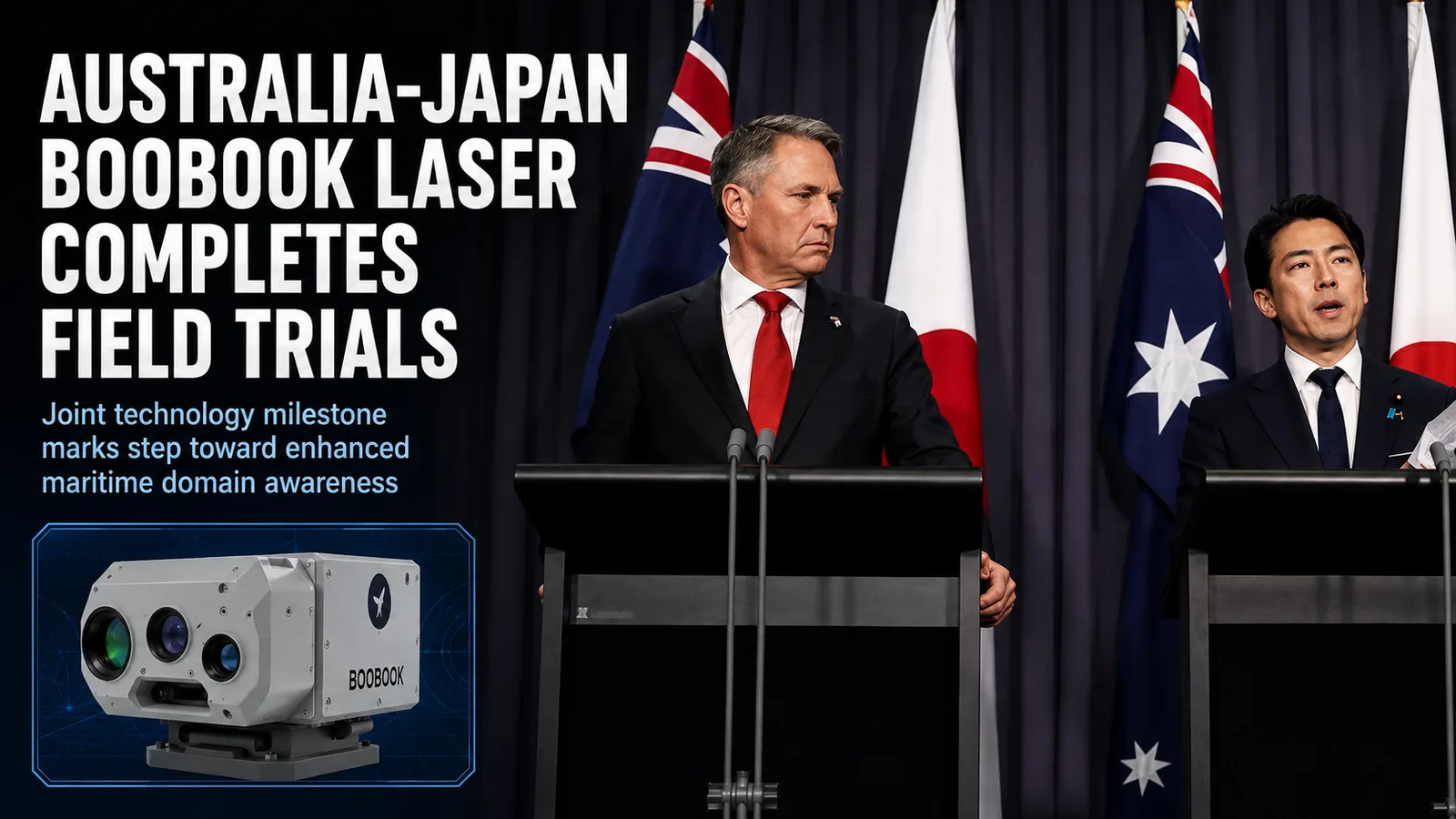
Australia-Japan Boobook laser development has reached a major milestone after successful field trials of the jointly developed high-energy laser prototype in South Australia, advancing what Canberra describes as the first co-development project between the Australian and Japanese defence industries.
Australia’s Department of Defence announced the result on 18 August 2026, saying the Boobook system had been tested at Cultana Training Area and Defence Science and Technology Group facilities at Edinburgh.
The programme is strategically important for reasons extending beyond the laser itself. Boobook combines more than two decades of Australian laser research with Japanese industrial expertise from Mitsubishi Electric, while Mitsubishi Electric Australia is simultaneously preparing new domestic defence-manufacturing capacity. The result is becoming a test case for how Australia and Japan can move from defence-technology cooperation toward genuine bilateral co-development and production.
Key Facts
- Programme: Boobook, a joint Australia-Japan high-energy laser technology project.
- Milestone: Successful field trials announced on 18 August 2026.
- Test locations: Cultana Training Area and DSTG Edinburgh in South Australia.
- Partners: Australia’s Defence Science and Technology Group, Mitsubishi Electric Australia and Mitsubishi Electric Corporation.
- Industrial significance: Australia describes Boobook as the first co-development project between Australian and Japanese defence industries.
- Technology base: The prototype draws on more than 20 years of DSTG laser research and development.
- Manufacturing investment: Mitsubishi Electric Australia is investing A$70 million in new Rydalmere facilities and a Defence Division preparing for large-scale Australian manufacturing.
Australia-Japan Boobook Laser Completes Field Testing
The latest milestone moves Boobook beyond laboratory development and into field evaluation.
Australian Defence said the trials generated data on the prototype’s design and technical requirements that will inform subsequent development and commercialisation.
Testing was conducted at two South Australian locations: Cultana Training Area and DSTG Edinburgh.
This combination is significant because it allows engineers to move from controlled technical evaluation toward conditions more representative of eventual defence use.
Defence has not released the system’s beam power, engagement range, wavelength, tracking performance or detailed trial scenarios.
Those parameters should therefore not be inferred from the description “high-energy laser” or from specifications associated with unrelated Australian and Japanese directed-energy programmes.
Boobook Is Not Yet Publicly Defined as an Operational Laser Weapon
The distinction is important when assessing the programme.
Australia’s 18 August announcement describes Boobook as a high-energy laser prototype and states that the technology has the potential to enhance surveillance capability.
The original 2023 agreement was similarly framed around improving surveillance capability and the survivability of Australian Defence Force platforms.
Neither announcement publicly states that the latest field trials involved destroying a drone, missile or other target.
That means Boobook should not currently be presented as a fielded counter-UAS laser weapon simply because other high-energy laser programmes use similar underlying physics.
Its eventual military applications could broaden as the programme matures, but the publicly confirmed 2026 milestone is successful field testing of the prototype and validation of its design requirements.
The Project Began as a Surveillance and Survivability Partnership
The industrial partnership dates to October 2023.
Australia’s Department of Defence announced on 20 October 2023 that DSTG and Mitsubishi Electric Australia would develop and transition cutting-edge laser technology intended to strengthen ADF surveillance and platform survivability.
Mitsubishi Electric Corporation brought Japanese electro-optic and industrialisation expertise to the project, while the Australian side contributed technology developed through more than a decade of research.
The 2026 release now describes that Australian R&D heritage as extending for more than 20 years.
This progression is a useful indicator of the programme’s purpose: translating a long-running national research activity into a prototype that can be industrialised with an international partner.
Boobook Is the First Australia-Japan Defence Industry Co-Development
The project is particularly significant from Japan’s perspective.
The Japanese and Australian governments have repeatedly described Boobook as the first co-development project between their respective defence industries.
The September 2025 Japan-Australia 2+2 statement specifically highlighted progress on Boobook and identified the programme as a milestone in bilateral industrial collaboration.
This matters because Japan’s international defence-industrial model has historically been constrained compared with major Western exporters.
Boobook demonstrates a different model: Australian-developed science, Japanese defence technology and an Australian industrial subsidiary working together on one new capability rather than simply transferring an existing finished product.
Mitsubishi Electric Australia Will Add A$70M in Manufacturing Capacity
The field trial is being accompanied by a substantial industrial investment.
Australian Defence says Mitsubishi Electric Australia is establishing new facilities at Rydalmere in New South Wales as preparations begin for large-scale manufacturing in Australia.
The company is investing A$70 million in the development.
The facility will become the home of a new Mitsubishi Electric Australia Defence Division.
Defence says the investment is expected to support future manufacturing opportunities, technology transfer and Australian workforce growth while giving the ADF greater access to Mitsubishi Electric defence technology.
This is arguably one of the most strategically important elements of Boobook.
A successful bilateral technology demonstration creates limited sovereign value if manufacturing, support and future engineering remain entirely offshore.
Building the industrial capability inside Australia gives the programme a potential pathway from research cooperation toward enduring production and sustainment.
Mitsubishi Electric Is Becoming More Important to Australian Defence
Boobook is no longer Mitsubishi Electric’s only major Australian defence activity.
On 18 April 2026, Mitsubishi Electric announced a contract to provide anti-air warfare systems for Australia’s future general-purpose frigates based on Japan’s upgraded Mogami-class design.
The company already provides key sensor and information-processing technologies for Japanese naval platforms.
The combination of naval sensor work and Boobook gives Mitsubishi Electric an increasingly substantial role inside the Australia-Japan defence-industrial relationship.
The planned Rydalmere Defence Division could consequently support a wider portfolio than the laser project alone if additional bilateral programmes materialise.
Australia-Japan Defence Cooperation Has Expanded Rapidly
Boobook is developing inside a significantly deeper strategic relationship.
Australia and Japan brought their Reciprocal Access Agreement into force in 2023, allowing more complex deployments and exercises between the Australian Defence Force and Japan Self-Defense Forces.
The two governments established a Framework for Strategic Defence Coordination in December 2025 and expanded cooperation again in 2026.
Boobook is therefore one of the first programmes demonstrating what those policy commitments can look like at industrial level.
The Mogami Programme Raises the Industrial Relationship to Another Scale
The upgraded Mogami-class frigate programme provides the much larger industrial counterpart to Boobook.
Australia selected Japan’s upgraded Mogami design for its future general-purpose frigate requirement and finalised contracts for the first three vessels in April 2026.
The first Royal Australian Navy ship is targeted for delivery in 2029, with the programme ultimately intended to establish associated sustainment and shipbuilding capability in Australia.
The combination is strategically instructive.
Mogami provides a major platform-level acquisition and industrial partnership. Boobook provides a technology-level co-development model.
Together they indicate that Australia-Japan defence-industrial cooperation is broadening from equipment acquisition into engineering, production, sustainment and advanced technology.
Directed Energy Is Already a Major Australian Defence Priority
Boobook also sits within a much broader Australian investment in laser technology.
In April 2023, Defence awarded QinetiQ Australia a A$12.9 million contract to co-develop and manufacture a separate high-energy defensive laser prototype with DSTG.
That programme established high-energy laser manufacturing capability in South Australia.
Australia has also tested AIM Defence’s Fractl portable high-energy counter-drone laser.
Defence publicly demonstrated Fractl against a drone in 2024, making it an explicitly documented directed-energy weapon test.
This is exactly why the distinction with Boobook matters: Australia operates several laser-development tracks with different publicly disclosed roles, and specifications or engagement results from one programme should not automatically be assigned to another.
Australia Is Preparing to Spend Billions on Counter-Drone Defence
The broader market for directed-energy technology is also growing.
On 21 April 2026, the Australian Government announced plans to invest up to A$7 billion in counter-drone defence.
The programme includes further development of Fractl and other technologies intended to counter individual drones and swarms.
The increasing use of inexpensive unmanned aircraft creates a strong economic case for lasers because they potentially replace expensive expendable interceptors with electrically generated effects.
However, Boobook should not be automatically assigned to that counter-UAS procurement portfolio unless Defence formally defines its operational role accordingly.
For the wider technology context, Defence Agenda has analysed the transition from experimental directed-energy systems toward scalable air defence in Army Advances Directed-Energy Air-Defense Program.
Japan Is Also Accelerating High-Energy Laser Development
Japan brings its own growing directed-energy technology base to the partnership.
The Japan Ministry of Defense has been developing high-energy laser capabilities for counter-UAS and other defensive missions while testing naval laser technology aboard the experimental vessel JS Asuka.
Japan’s current defence planning specifically identifies high-energy lasers and high-power microwaves as potential non-kinetic methods for countering small unmanned aircraft.
That domestic experience gives Japanese industry capabilities that can complement Australian scientific work.
Defence Agenda’s Japan Defense Budget 2026 assessment details the wider Japanese effort to expand unmanned systems, integrated defence and stand-off capability as Tokyo accelerates military modernisation.
Laser Collaboration Tests a New Industrial Model
The technology itself is only one measure of Boobook’s success.
The project is also testing whether Australian and Japanese institutions can combine intellectual property, engineering teams, testing infrastructure and industrial capacity efficiently enough to produce a deployable defence capability.
Joint development is considerably more complicated than purchasing a finished foreign product.
Partners must agree how requirements are defined, which organisation controls different technology layers, how export restrictions operate, where production takes place and how intellectual property is handled through future modifications.
If Boobook transitions successfully into production, it can provide a template for additional bilateral technology programmes.
Australian Ranges Are Becoming a Strategic Asset for Japan
The trials also demonstrate another Australian advantage: physical test space.
Australia offers large and comparatively uncongested defence ranges that can support testing difficult to conduct at equivalent scale in Japan.
The Boobook tests at Cultana reinforce a wider bilateral interest in using Australian ranges for advanced technology evaluation.
This creates a complementary relationship in which Japanese industrial technology can be combined with Australian geography, research infrastructure and testing capacity.
The model could become particularly relevant for future missiles, autonomous systems, sensors and integrated air-defence technologies.
Field Testing Is Only One Step Toward Operational Capability
The successful trial should nevertheless be interpreted as a development milestone rather than proof of operational readiness.
Defence explicitly says the results will inform the next phases of development and commercialisation.
A military laser ultimately has to operate across environmental conditions including atmospheric turbulence, dust, heat, vibration and changing visibility.
Its platform integration also determines available electrical power, cooling, stabilisation and sensor performance.
None of those system-level operational characteristics has been fully published for Boobook.
The programme therefore remains in a transition phase between successful prototype testing and a potential deployable product.
Power Output Is Not the Only Relevant Laser Metric
Public discussion of military lasers often focuses heavily on kilowatt output.
That figure alone does not determine operational effectiveness.
Beam quality, pointing accuracy, atmospheric propagation, target tracking, optical stability, thermal management and the ability to maintain energy on a precise point are also critical.
This is particularly relevant for a project whose stated application includes surveillance and platform survivability rather than only destructive engagement.
Until Australia or Mitsubishi Electric publishes a formal performance specification, assigning Boobook to a specific kilowatt class would therefore be speculative.
Commercialisation Is Now a Key Programme Test
The 18 August announcement repeatedly connects the successful trials with the next phase of commercialisation.
This is significant because many directed-energy programmes demonstrate technically impressive prototypes but struggle to transition into affordable, maintainable production systems.
A commercialised defence product must be manufactured repeatedly, integrated into operational platforms, supported in service and upgraded over time.
Mitsubishi Electric Australia’s A$70 million manufacturing investment potentially addresses part of that transition risk by creating a permanent local industrial structure around advanced Japanese defence technology.
The key question is now what portion of Boobook engineering, production and sustainment ultimately takes place at Rydalmere.
Boobook Could Become a Model for Indo-Pacific Co-Development
The programme also has implications beyond the two countries.
Indo-Pacific defence industrial cooperation has historically been less integrated than equivalent transatlantic structures.
Australia, Japan, the United States and other partners are now trying to deepen cooperation in manufacturing, sustainment, supply chains, autonomous systems, guided weapons and advanced technologies.
Successful bilateral projects can reduce duplication while allowing countries to combine different national strengths.
For Australia and Japan, Boobook provides a relatively contained programme in which to develop the institutional mechanisms required for larger and more complex future co-development efforts.
Directed Energy Is Part of a Wider Air-Defence Cost Shift
The strategic environment also favours continued laser investment.
Large-scale use of inexpensive UAVs and loitering munitions has exposed the economic weakness of relying on expensive interceptor missiles for every short-range threat.
High-energy lasers offer a potentially different magazine model because the number of engagements is constrained principally by electrical power, cooling and component durability rather than a fixed number of interceptor rounds.
That does not make lasers universal replacements for missiles. Weather, propagation, target characteristics and engagement range continue to limit their use.
Instead, they are increasingly being developed as one layer inside integrated air and counter-UAS architectures.
Defence Agenda’s Army’s 2026 Counter-Drone Laser Competition examines how another major military is attempting to move directed energy from prototype fleets toward scalable production.
Implications / Next
The first milestone to watch is clarification of Boobook’s final operational role.
Defence currently emphasises surveillance and platform survivability. Future programme disclosures will show whether the technology remains primarily a sensing and protective system or evolves toward broader directed-energy functions.
The second is the Rydalmere industrial expansion. Mitsubishi Electric Australia’s A$70 million investment should provide a clearer indication of how much advanced defence manufacturing and engineering the company intends to localise.
The third is follow-on testing. Cultana and Edinburgh produced successful field-trial results, but additional environmental, platform-integration and military-user testing will be required before operational adoption can be assessed.
The fourth is commercialisation. A production agreement, Australian Defence acquisition decision or formal platform-integration programme would represent a larger maturity milestone than the current prototype trial.
Finally, Boobook should be watched as an industrial model. Additional Australia-Japan projects using the same co-development structure would demonstrate that the partnership has moved beyond one successful technology collaboration into a repeatable bilateral acquisition mechanism.
Conclusion
The successful Boobook field trials mark an important technology milestone, but their industrial significance may prove even greater.
DSTG has brought more than two decades of Australian laser research into a joint programme with Mitsubishi Electric Australia and Mitsubishi Electric Corporation. The resulting prototype has now moved through field testing at Cultana and Edinburgh.
At the same time, Mitsubishi Electric Australia is committing A$70 million to new defence facilities and preparing for large-scale manufacturing in Australia.
That combination — research, bilateral co-development, field testing and local industrialisation — is what makes Boobook strategically notable.
The next step is to determine whether the prototype becomes a defined Australian Defence Force capability and whether the partnership can deliver a production system with meaningful Australian engineering and manufacturing content.
Until then, Boobook is best understood as a successful high-energy laser technology demonstration and an increasingly important test of Australia-Japan defence-industrial integration, rather than a confirmed operational laser weapon.
For further Defence Agenda coverage, read Army’s 2026 Counter-Drone Laser Competition, Army Advances Directed-Energy Air-Defense Program, Japan Defense Budget 2026: SHIELD and ALKA Laser System Integrated on KAPLAN Vehicle.
Further Reading
- Australian Defence Ministers: Successful Boobook High-Energy Laser Field Trials
- Australian Defence: Australia and Mitsubishi Electric Begin Joint Laser Development
- Japan Ministry of Defense: Japan-Australia 2+2 Defence and Industry Cooperation
- Australian Defence Ministers: Enhanced Defence and Security Cooperation with Japan
- Defence Agenda: Army’s 2026 Counter-Drone Laser Competition
- Defence Agenda: Army Advances Directed-Energy Air-Defense Program
- Defence Agenda: Japan Defense Budget 2026 — SHIELD
- Defence Agenda: ALKA Laser System Integrated on KAPLAN Vehicle