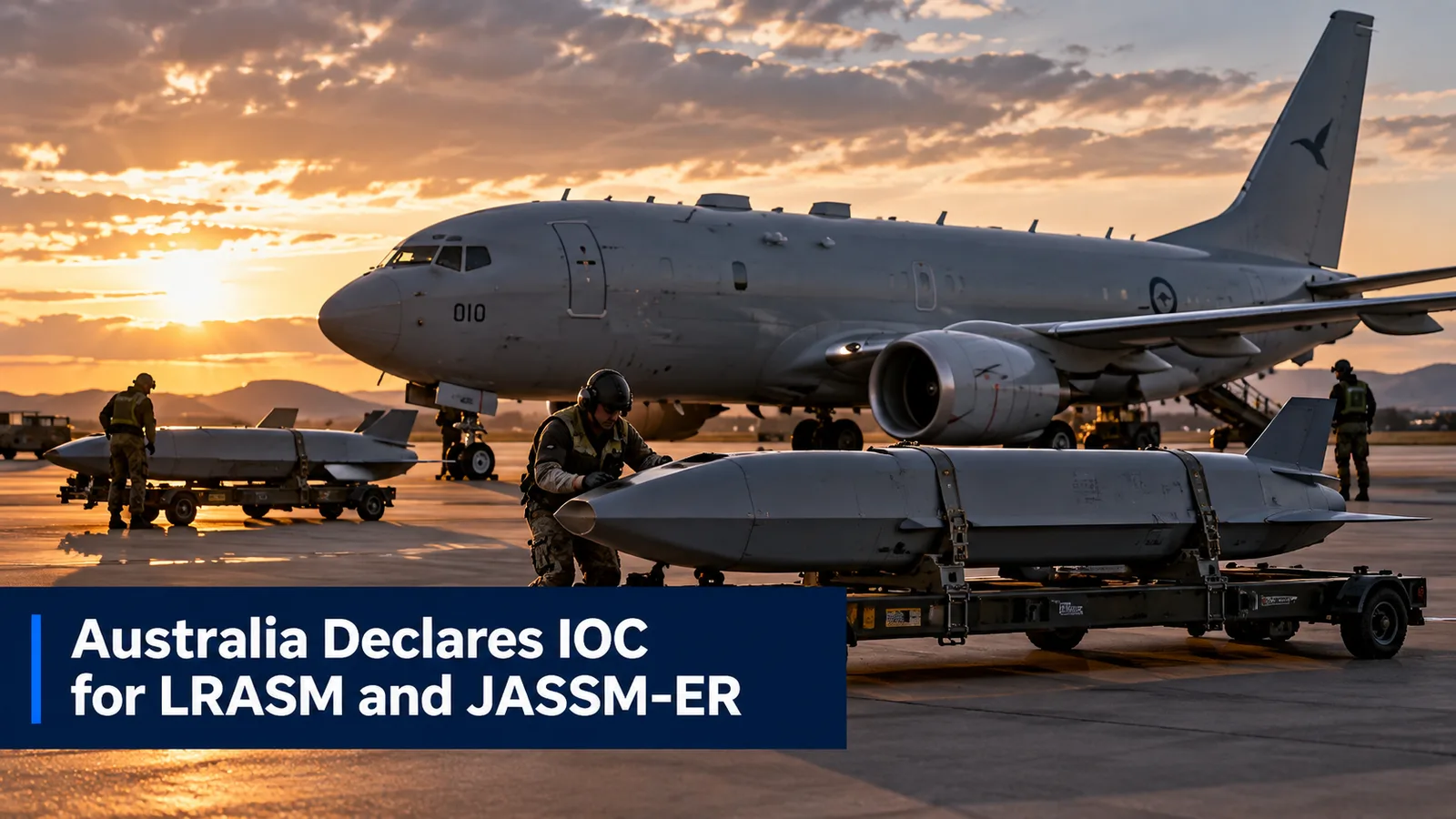
The Royal Australian Air Force has declared initial operational capability for the AGM-158C Long Range Anti-Ship Missile and AGM-158B JASSM-ER, giving its F/A-18F Super Hornet force a new long-range maritime and land-strike capability. The IOC follows operational testing in the United States and Australia and a RIMPAC 2026 LRASM firing from an RAAF P-8A Poseidon, but it does not by itself establish full operational capability across every platform or disclose the size of Australia’s missile inventory.
IOC follows a multi-year operational test sequence
Australia’s Department of Defence announced the milestone on 11 September 2026. It said two LRASM rounds were successfully test-fired at the Point Mugu Sea Range in the United States in February 2025, followed by two JASSM-ER firings at the Woomera Test Range in South Australia in November 2025. Those events validated weapon preparation, loading, targeting and engagement activity on the F/A-18F Super Hornet.
The test programme was expanded during RIMPAC 2026, when an RAAF P-8A Poseidon successfully fired an LRASM and hit its target. That event is important because it demonstrates a maritime-patrol-aircraft pathway for the anti-ship weapon, but the Defence release frames the IOC statement around Air Force readiness to conduct long-range maritime and land strike from F/A-18F aircraft. It would therefore be premature to describe every P-8A weapon-integration step as independently operationally declared.
LRASM and JASSM-ER create complementary strike options
Australia describes LRASM as a semi-autonomous precision-guided anti-ship missile able to attack high-value, well-defended maritime targets at ranges above 370 km. JASSM-ER is the land-strike counterpart, with the Australian release citing a range of up to 900 km from the launch aircraft. Together, the weapons allow the same tactical-aircraft force to threaten ships and fixed land targets without having to approach as closely to sophisticated air defences.
The significance is not simply range. Stand-off weapons complicate an adversary’s force-protection problem by increasing the area that can be held at risk and by allowing launch aircraft to operate from a greater distance. For Australia, that supports a shift toward a more distributed, long-range force designed to impose costs and deny freedom of action across the Indo-Pacific.
Initial operational capability is not the endpoint
IOC means the RAAF has reached a defined threshold for operational employment; it does not mean the programme has completed every planned integration, stockpile build or training objective. The Australian release does not state a full operational capability date, total missile inventory, annual delivery profile or a complete list of certified aircraft configurations. Those details should not be inferred from earlier U.S. sales notifications or acquisition planning documents.
The distinction is especially important for P-8A. The RIMPAC shot shows technical and operational progress, while the F/A-18F is the platform explicitly cited for current long-range strike readiness in the IOC announcement. Future releases may clarify how Australia intends to distribute LRASM across its maritime-patrol and tactical-air fleets.
Implications / Next
The next milestones will include continued training, stockpile growth, additional platform integration and any eventual declaration of full operational capability. Australia may also disclose more about mission planning, sustainment and interoperability with U.S. forces as exercises expand. The current IOC nevertheless marks a clear transition from test activity to an operationally usable long-range strike capability, strengthening Australia’s ability to hold maritime and land targets at risk from outside many traditional defensive envelopes.