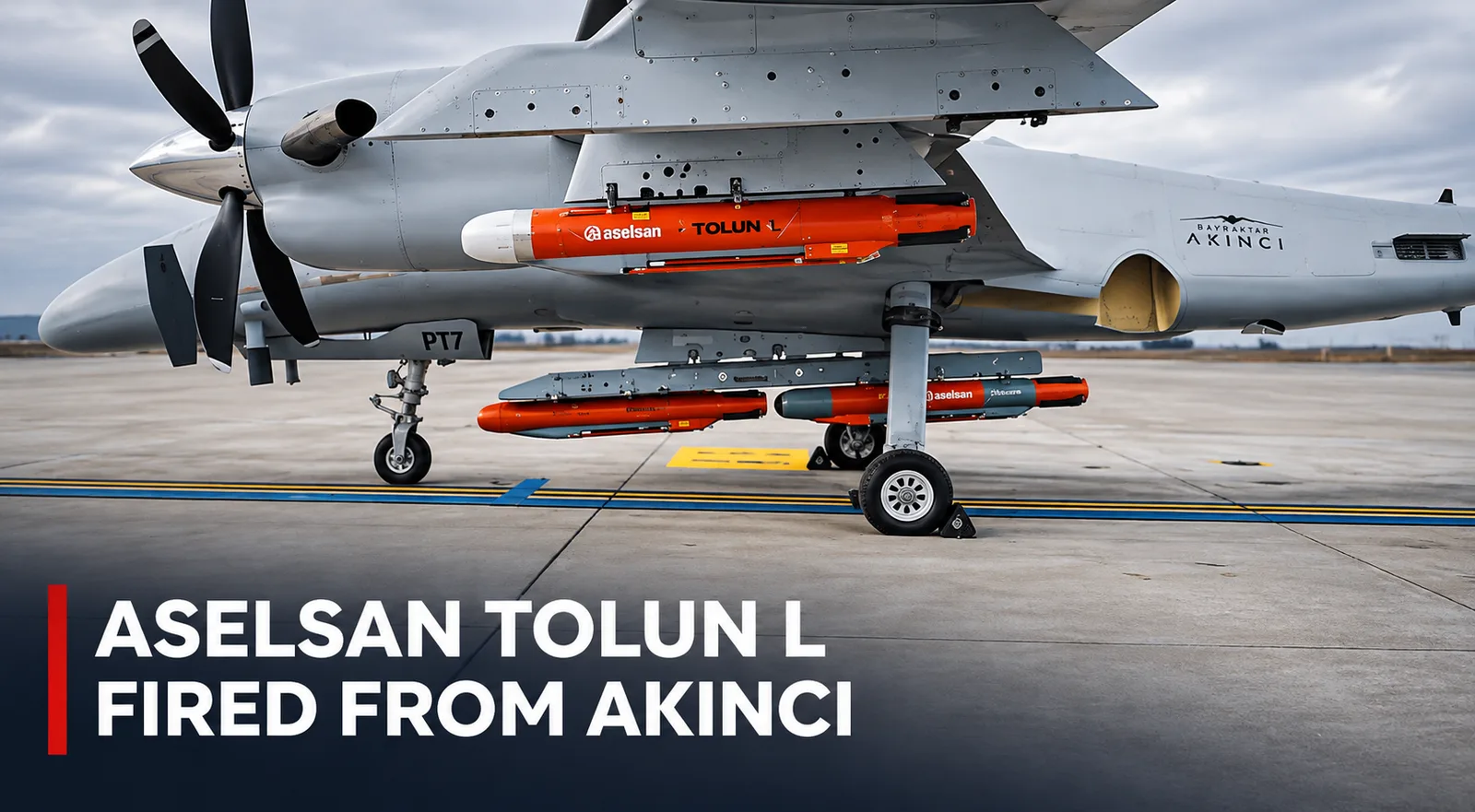
ASELSAN says its 250 lb-class TOLUN L precision-guided munition has struck a target at Saros Target Island after being released from a Bayraktar AKINCI unmanned combat aerial vehicle through the SADAK-4T multi-carriage rack. The company describes the firing as the first integration of this laser-seeker-equipped TOLUN L configuration with a UCAV. The result matters because it extends AKINCI’s existing TOLUN weapons portfolio towards a terminal laser-guided engagement option. The supplied ASELSAN statement does not identify the date of the firing or disclose an independently measured miss distance.
TOLUN L AKINCI Firing: Guidance and Test Evidence
The specific new event is described in an undated ASELSAN press statement supplied for this report. According to that document, TOLUN L was launched from AKINCI for the first time and hit a designated target at Saros Target Island. The release identifies SADAK-4T as the carriage interface and KİLİT 310 as the laser seeker. It gives neither an absolute test date nor an independent test report, flight envelope or measured terminal accuracy. Accordingly, the firing is reported here as ASELSAN’s result, not as independently certified performance.
The weapon is presented as a 250 lb-class, all-up-round munition carrying a fragmentation-effect warhead. ASELSAN describes inertial and satellite navigation for the mid-course portion and laser-based terminal homing on energy reflected from the target. This distinction matters operationally: a weapon capable of terminal homing offers a different target-engagement path from a munition guided solely to pre-entered coordinates. The supplied document does not say whether the reported target was stationary or moving, or describe the source of laser designation.
For unmanned aircraft use, ASELSAN publishes a range exceeding 50 km, supported by the weapon’s deployable wing arrangement. An earlier ASELSAN newsletter on the TOLUN family also describes the L variant as combining INS/GNSS and laser guidance for fixed and moving targets beyond 50 km. That figure is a stated product capability; the range flown during the Saros engagement is not disclosed. It would be inaccurate to present the published specification as a verified distance achieved in this firing.
TOLUN L was publicly presented alongside other family members at SAHA 2026 on 7 May 2026. The ASELSAN introduction of its expanded TOLUN family identified TOLUN L as the laser-guided option within a wider munition portfolio. The company also publishes a KİLİT 310 seeker product page, confirming the seeker product exists as part of its guidance portfolio. These materials substantiate the manufacturer’s earlier programme and product descriptions, but not the specific result of the new Saros firing.
The release additionally lists waypoint-following, selectable impact angle, day/night operation and cockpit-programmable functions. It claims software resistance to GPS spoofing and an anti-jam controlled-reception-pattern antenna, although it publishes no resilience measurements for the reported engagement. Its general all-weather employment language should not be confused with proof that laser designation can operate through all obscurants. Laser terminal performance and aircraft navigation resilience are separate matters, and neither has been independently quantified by this announcement.
The novelty is specific to the L configuration, not to all TOLUN weapons on AKINCI. Defence Agenda’s coverage of the TOLUN I, F and P firings describes demonstrations at Karapınar on 1 September 2026, consistent with ASELSAN’s October 2026 account of the demonstrations. An earlier TOLUN P hardened-target firing from AKINCI likewise predates the new laser-guided claim. The integration milestone should therefore be framed as a further seeker-and-platform combination, not AKINCI’s first use of the TOLUN family.
Programme Implications and Next Milestones for TOLUN L
For a programme office or platform operator, the potential significance lies in broadening a standardised carriage architecture with a different guidance option. SADAK-4T allows TOLUN-family weapons to use a multiple-carriage arrangement, while a laser seeker potentially supports engagements requiring target information later in flight. That is an operational concept, not a demonstrated four-round simultaneous TOLUN L salvo. The number of weapons carried, simultaneous release sequence and separate-target results were not provided for the Saros shot.
ASELSAN’s claim that one aircraft can engage one or several targets in a sortie supports the rationale for multiple carriage, but it does not by itself establish sortie-rate savings, lower total operating costs or effective load-out limits. Those effects depend on aircraft configuration, targeting support, mission demands, clearance work and testing. The statement contains no cost model, unit price, contract award, named customer or procurement quantity for this new TOLUN L milestone.
AKINCI’s broader weapons-integration campaign provides context. In a 9 October 2026 Baykar update, the manufacturer described a separate MGK-guided firing in the Saros area and listed the TOLUN family among weapons integrated with AKINCI. An Anadolu Agency report dated 12 November 2026 covered a different AKINCI test involving two TOLUN P rounds under electronic jamming. Neither source documents the specific TOLUN L live-fire release described in the supplied press text.
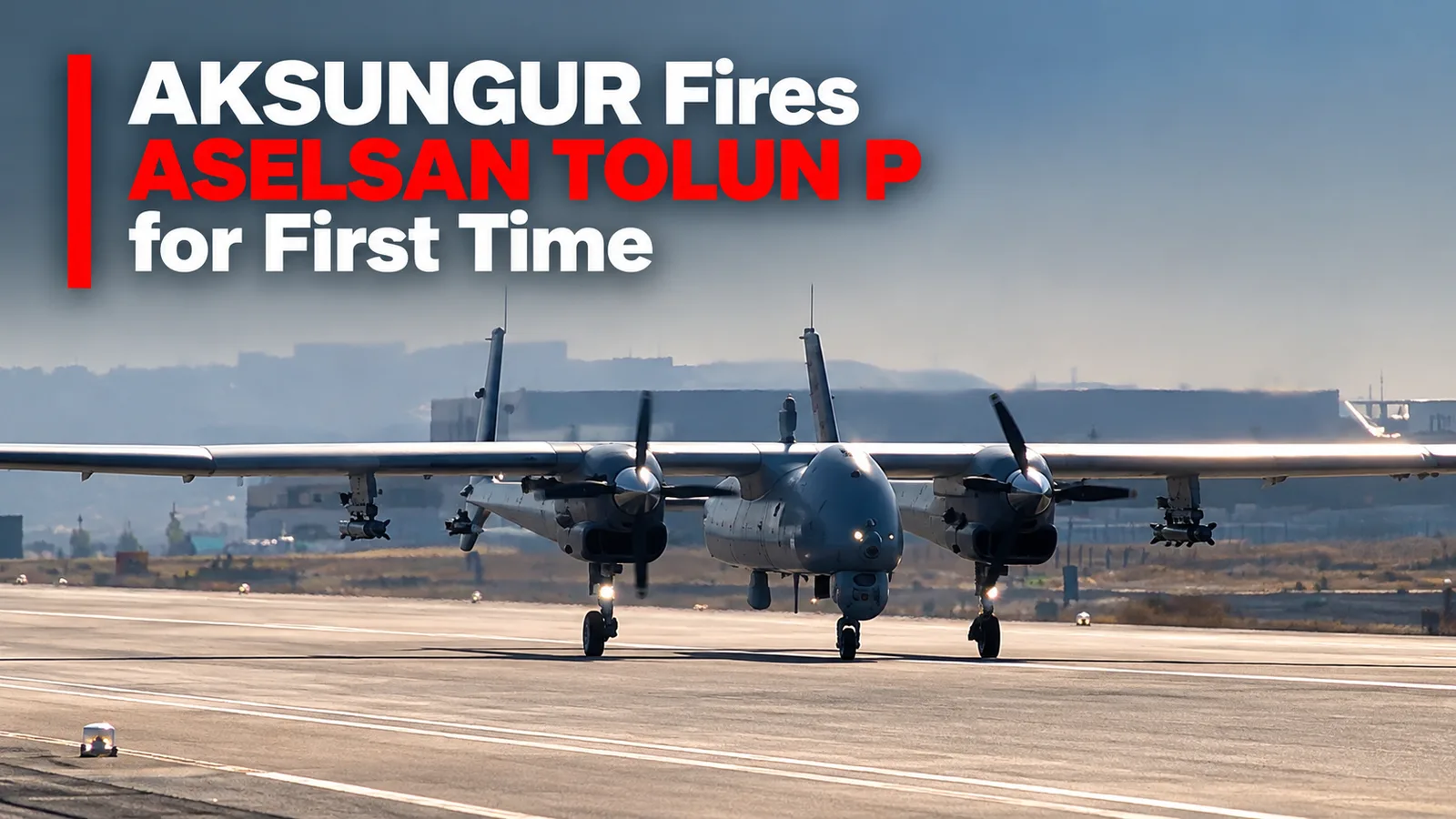
The different seeker and warhead configurations also limit direct comparisons. TOLUN L’s laser terminal guidance and fragmentation-effect design serve a different mission requirement from a TOLUN P penetrator configured for hardened targets. The previous TOLUN P firing from TUSAŞ AKSUNGUR offers another example of how the manufacturer is pursuing cross-platform employment. However, demonstrating another family member on a different UAV does not confirm common qualification status for TOLUN L.
Another important distinction concerns electronic warfare. ASELSAN describes anti-jam GNSS hardware and spoofing-resistant software in its TOLUN L release, but no public test matrix establishes how well those functions performed during this particular sortie. Likewise, a successful strike on an unspecified target does not amount to a published evaluation of moving-target performance, obscured laser designation or repeatability across differing release conditions.
Implications / Next: Subsequent disclosures should establish the absolute firing date, the target profile, whether further tests demonstrate moving-target engagements, the verified release envelope and the qualification status for specific AKINCI configurations. Any announced production or delivery agreement would constitute a separate programme milestone. Until then, this development is a manufacturer-reported successful integration firing that adds a credible new test point to the TOLUN portfolio, without establishing full operational entry into service.
Further Reading
- Defence Agenda — ASELSAN Demonstrates Three TOLUN Variants From AKINCI
- Defence Agenda — ASELSAN TOLUN P Strikes Hardened Target From AKINCI
- Defence Agenda — AKSUNGUR Fires ASELSAN TOLUN P for First Time
- ASELSAN — TOLUN L introduced at SAHA 2026, 7 May 2026
- ASELSAN — TOLUN-L guidance and range specification, Newsletter No. 21
- ASELSAN — AKINCI TOLUN I/F/P firing context, Newsletter No. 25
- Baykar — AKINCI MGK firing and weapons-integration record, 9 October 2026
- Anadolu Agency — AKINCI TOLUN P jamming-condition firing, 12 November 2026