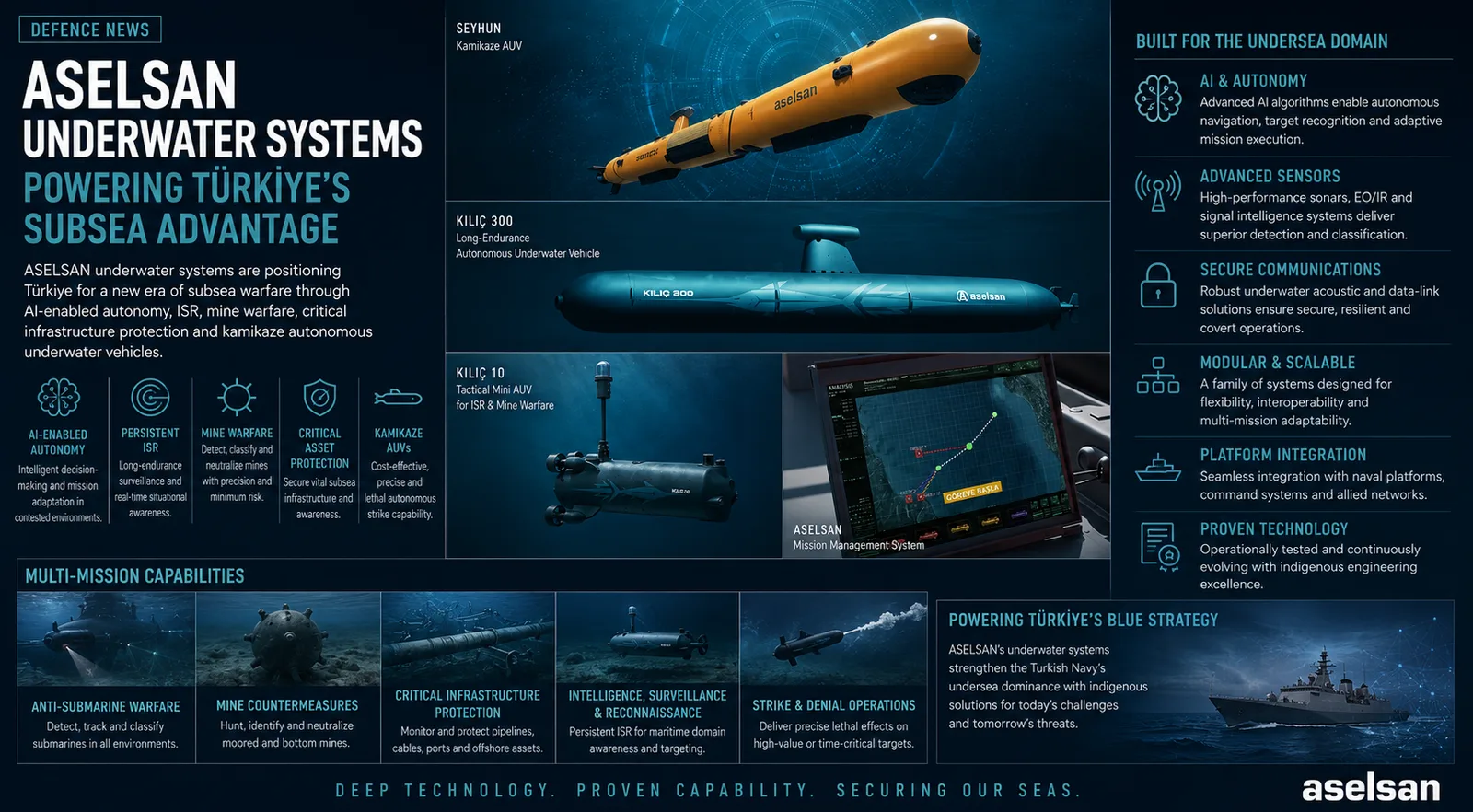
ASELSAN underwater systems are pushing Türkiye toward a new model of subsea warfare, combining artificial intelligence, autonomous capabilities and network-centric operations to create a more persistent and asymmetric undersea defence posture.
According to ASELSAN’s latest concept presentation, the company sees underwater warfare entering a doctrinal transformation shaped by hybrid threats, critical subsea infrastructure protection, autonomous systems and manned-unmanned teaming. The core message is clear: future undersea superiority will depend less on classic crewed platforms alone and more on intelligent, expendable, scalable and continuously networked autonomous systems.
This vision matters because the maritime battlespace is expanding below the surface. Energy transfer lines, underwater communication networks, chokepoints, naval routes and critical port infrastructure are increasingly exposed to sabotage, surveillance and low-cost asymmetric attack. As a result, undersea security is becoming both a military and national-resilience mission.
ASELSAN Underwater Systems Reflect a Doctrinal Shift
The central argument behind ASELSAN underwater systems is doctrinal. Underwater warfare is no longer limited to traditional submarines, divers and mine countermeasures. It is becoming a hybrid environment where crewed submarines, autonomous underwater vehicles, smart seabed munitions, decoys, ISR platforms and kamikaze systems operate together.
ASELSAN frames this as a transition toward a new paradigm in which classical crewed platforms are hybridised with AI-enabled autonomous undersea systems and manned-unmanned teaming. In practical terms, this means future naval operations will depend on invisible forward-deployed systems that can sense, classify, deceive, monitor and strike without exposing high-value crewed platforms to unnecessary risk.
This is one of the strongest strategic implications of the concept. Subsea warfare is becoming a contest of persistence, stealth and data rather than only platform size.
Why Subsea Superiority Has Become Critical
ASELSAN’s concept stresses that the undersea domain is the centre of invisibility and asymmetric advantage. That argument is increasingly relevant in modern naval strategy. Subsea threats are difficult to detect, hard to attribute and capable of targeting both military and civilian systems.
The protection of critical underwater infrastructure is now a strategic necessity. Energy pipelines, seabed communication cables and offshore infrastructure support both economic continuity and military readiness. Any sabotage against them could create paralysing effects across defence, communications, energy and public life.
In addition, the security of sea lanes and chokepoints depends on early detection of undersea threats. Autonomous systems that can monitor these areas continuously may become essential for preventive maritime security.
Modern Underwater Threats Are Becoming Smarter and Cheaper
One of the most important parts of ASELSAN’s threat assessment is its emphasis on low-cost and autonomous threats. The modern underwater battlespace is no longer defined only by large submarines or traditional mines. It increasingly includes intelligent munitions waiting on the seabed, autonomous underwater vehicles and systems that can create asymmetric disruption at lower cost.
This evolution creates a new operational requirement. Naval forces need systems that can stay underwater for long periods, operate 24/7, dive deep, reduce risk to personnel and respond quickly to unclear or distributed threats.
In that sense, the undersea domain is following a wider defence trend: lower-cost autonomous systems are beginning to reshape how military power is distributed and applied.
ASELSAN Underwater Systems Depend on Full Autonomy
ASELSAN’s technology vision is built around the physical difficulty of the undersea environment. GPS does not work underwater, radio waves degrade rapidly and communications are limited by a dark, high-pressure and electromagnetically constrained environment.
This means undersea systems cannot rely on continuous human control in the same way as many surface or air platforms. Instead, they need full autonomy, onboard processing and embedded artificial intelligence that can interpret sensor data, distinguish friend from foe and continue a mission even when communications are disrupted.
That is why ASELSAN focuses not only on hardware, but on AI-enabled autonomy. In underwater warfare, software, perception and autonomous mission continuity may matter as much as propulsion or hull design.
New Communications and Navigation Methods Are Emerging
The technology perspective also highlights a shift beyond classic underwater acoustic methods. ASELSAN points to short-range laser communications as an emerging capability and to integration with seabed seismic and optical sensing networks for navigation and detection.
This matters because future subsea warfare will be shaped by connected systems rather than isolated vehicles. Autonomous underwater platforms that can interface with underwater sensing grids, seabed infrastructure and wider maritime command networks will have a major operational advantage.
In other words, the future is not only the autonomous vehicle. It is the underwater network.
Operational Concepts Move Beyond Traditional Naval Missions
ASELSAN defines autonomous underwater systems as asymmetric force multipliers for naval forces. The operational use cases it highlights show how broad the mission set is becoming.
These missions include intelligence, reconnaissance and surveillance in denied waters, mine warfare without exposing crewed ships or divers, anti-submarine warfare along critical transit routes, asymmetric attack missions using kamikaze systems and tactical deception through acoustic decoys.
Taken together, these roles show that underwater autonomy is not a niche capability. It is becoming a multi-mission layer that can support ISR, protection, attrition, deception and direct strike.
DERİNGÖZ Is ASELSAN’s Modular ISR and Protection Platform
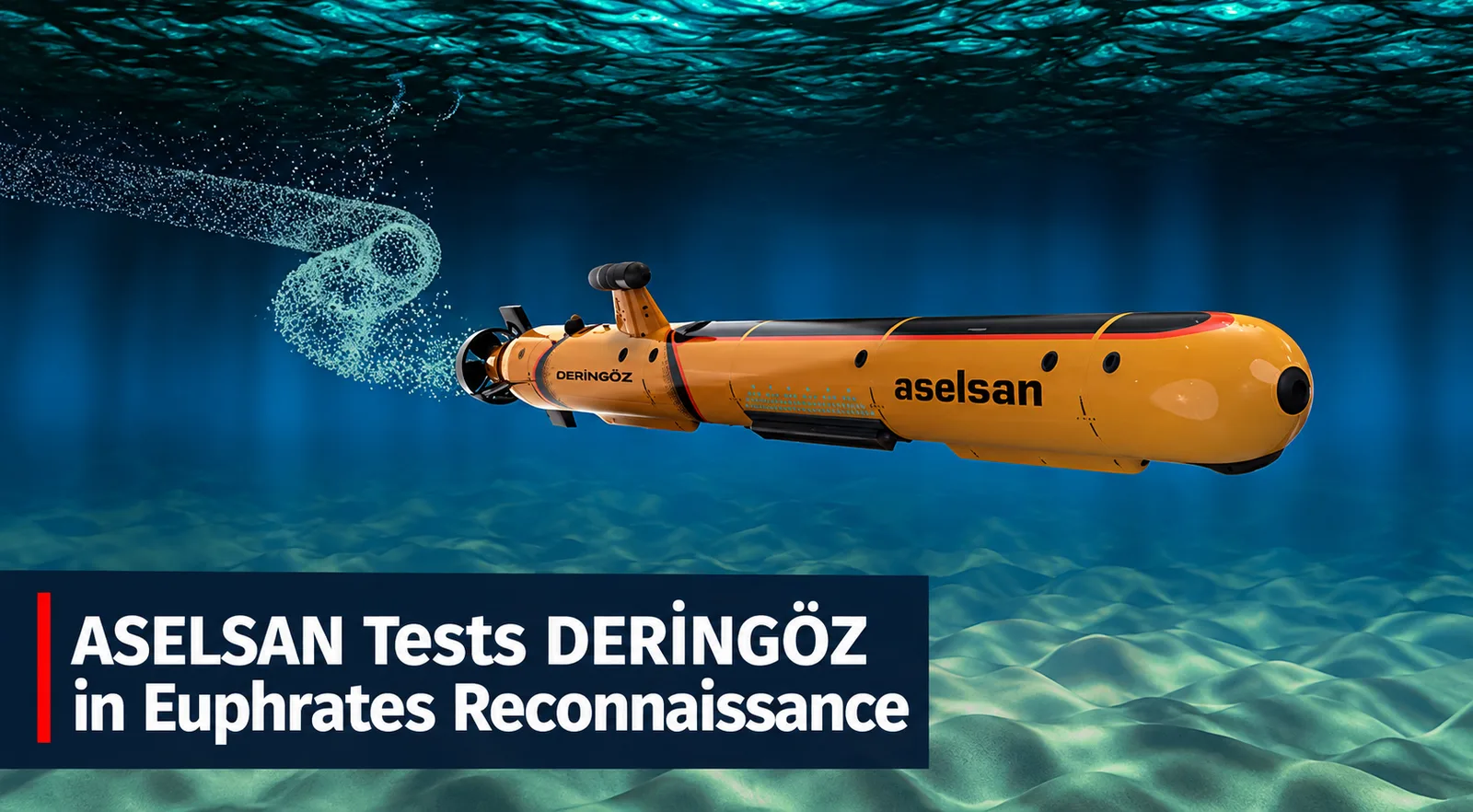
ASELSAN’s DERİNGÖZ product family is positioned as the company’s modular autonomous underwater vehicle architecture for surveillance, monitoring and critical subsea protection missions.
According to the concept description, DERİNGÖZ can be configured with different payloads and supports wireless and acoustic communication. Its mission set includes underwater reconnaissance and surveillance, mine detection and classification, monitoring of undersea energy-transfer lines and communication networks, and the protection of critical infrastructure.
This makes DERİNGÖZ highly relevant for peacetime and grey-zone use as well as wartime operations. It sits at the intersection of naval warfare, infrastructure security and maritime domain awareness.
KILIÇ Introduces a New Asymmetric Strike Layer
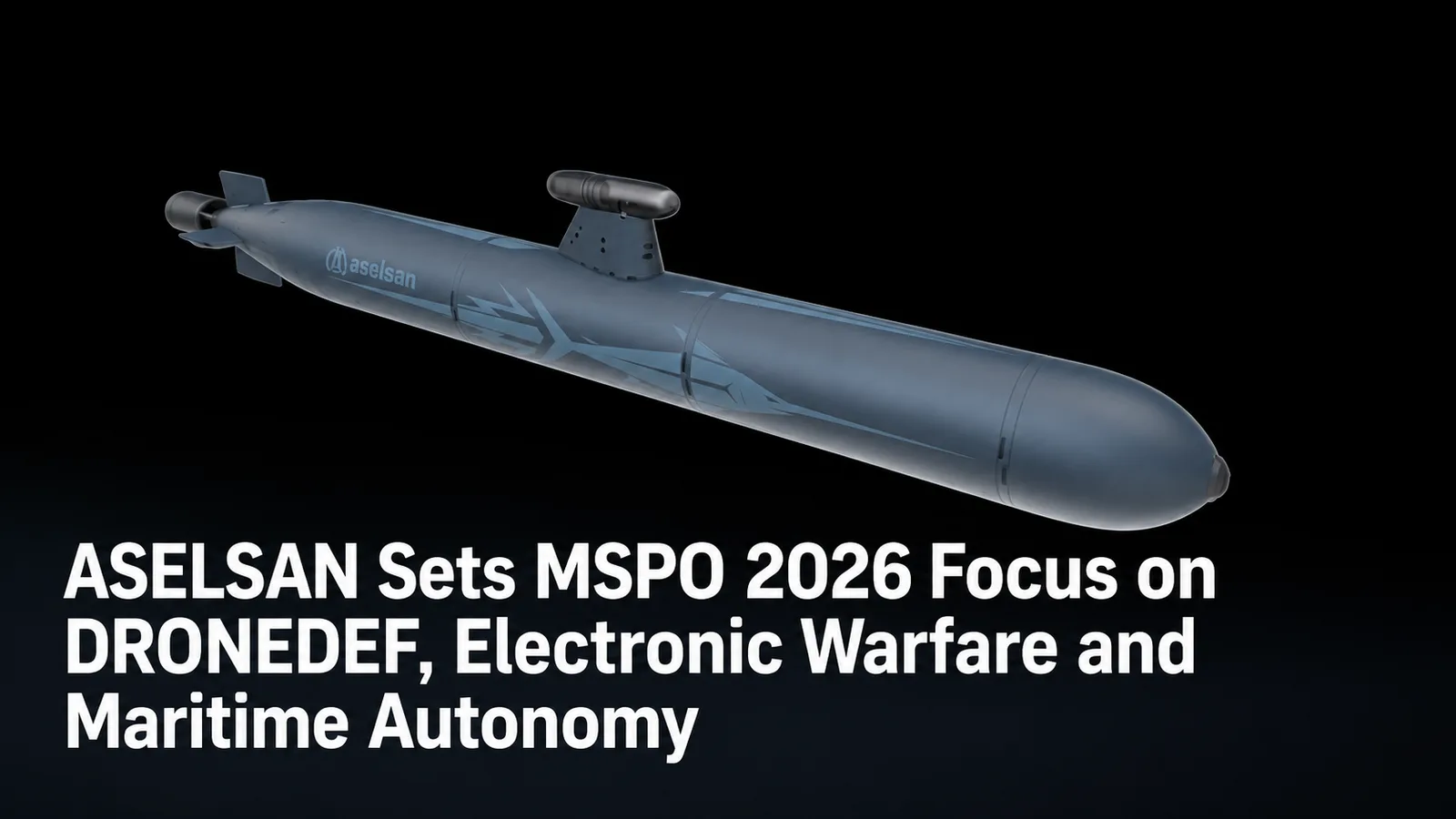
The more disruptive concept is KILIÇ, which ASELSAN describes as Türkiye’s first kamikaze autonomous underwater vehicle. Launched at SAHA 2026, KILIÇ is presented as a low-cost, rapidly producible and high-impact asymmetric attack system for the maritime domain.
Its core value lies in affordability, surprise effect and mission focus. Rather than acting as a general-purpose underwater platform, KILIÇ is designed as a purposeful strike system that can move toward hostile underwater or surface targets and destroy them through an integrated destructive payload.
This reflects a wider trend in modern warfare: cheaper expendable systems are increasingly used to narrow the operational freedom of larger and more expensive platforms.
AI-Based Targeting Gives KILIÇ Strategic Relevance
ASELSAN says the KILIÇ product family includes AI-based visual positioning and target-detection capability. This is particularly important because underwater strike systems cannot depend on continuous communications.
If the platform can continue its mission in denied-communication conditions, detect hostile underwater or surface assets and identify critical military infrastructure independently, then it becomes more than a remote weapon. It becomes an autonomous offensive capability with strategic implications.
That level of autonomy could significantly expand how naval forces think about denial, ambush and distributed undersea attack.
MUM-T Could Redefine Underwater Warfare
One of the most forward-looking themes in the ASELSAN concept is manned-unmanned teaming, or MUM-T, for the undersea battlespace. The idea is that autonomous underwater systems can function like invisible loyal wingmen for crewed submarines and other high-value naval platforms.
This approach could allow crewed assets to remain at safer stand-off ranges while autonomous systems move into forward areas for detection, monitoring, deception or attack. In anti-submarine warfare, this may help narrow the movement space of enemy submarines through cheaper and more distributed systems.
The strategic logic is similar to loyal wingman concepts in air combat, but transferred to the underwater domain where stealth and persistence are even more decisive.
Swarm Tactics Could Change Naval Attrition
ASELSAN’s future outlook also highlights swarm tactics. In this scenario, multiple kamikaze autonomous underwater vehicles would operate in a coordinated way against high-value targets such as a flagship or enemy base.
Swarm logic changes the economics and geometry of naval warfare. A large, expensive ship or protected installation could be pressured by many small, specialised and expendable underwater systems attacking together.
This trend could make future maritime defence more difficult, especially for forces that rely heavily on a limited number of high-value assets without distributed protective layers.
Network-Centric Naval Warfare Extends Below the Surface
ASELSAN’s vision is not only autonomous. It is network-centric. The company describes a future architecture in which underwater, surface and air systems act like a single nervous system.
In this model, data from UAVs, unmanned surface vessels, communication satellites or DERİNGÖZ ISR missions could identify a target, and that target could then be prosecuted by a KILIÇ autonomous underwater vehicle. This is essentially an undersea version of cross-domain kill-chain integration.
The significance is major. Underwater systems stop being isolated tactical tools and become part of a multi-domain operational network.
ASELSAN Underwater Systems Could Extend Türkiye’s Asymmetric Edge
ASELSAN explicitly links DERİNGÖZ and KILIÇ to Türkiye’s success in UAV and UCAV systems. The strategic goal is to transfer the asymmetric and doctrinal advantage achieved in the air domain into the underwater domain.
This is a meaningful ambition. Türkiye’s UAV ecosystem demonstrated that indigenous autonomy, lower-cost production and doctrine-linked innovation can create global differentiation. If a similar model is applied underwater, it could help build a distinctive national edge in undersea security and naval asymmetry.
The underwater battlespace may therefore become the next major frontier for Turkish defence-industrial innovation.
Critical Infrastructure Protection Could Drive Demand
One of the strongest near-term use cases for ASELSAN underwater systems is critical infrastructure protection. Undersea cables, energy-transfer lines, offshore platforms, ports and coastal installations require persistent monitoring that is difficult and expensive to maintain through crewed systems alone.
DERİNGÖZ-type systems are well positioned for this mission because they combine surveillance, monitoring and modular payload flexibility. As concerns about undersea sabotage rise globally, such missions could become a major driver of demand.
This gives ASELSAN’s underwater portfolio relevance beyond traditional fleet combat. It links naval technology to national resilience and maritime infrastructure security.
The Main Challenge Will Be System Integration
The most important challenge for ASELSAN’s underwater strategy will be integration. Autonomous underwater vehicles are valuable only if they operate effectively within a wider command, control, communication and sensing architecture.
Underwater communications are constrained. Target classification is difficult. Friend-or-foe discrimination is complex. Network continuity is harder than in air or land domains. Safety and mission assurance become even more demanding when strike-capable autonomous systems are involved.
Therefore, the long-term value of DERİNGÖZ and KILIÇ will depend not only on platform performance, but on how well they integrate with naval doctrine, operator workflows, ISR chains and multi-domain command structures.
The Broader Defence Implication Is Clear
ASELSAN’s concept reflects a broader defence lesson: future military advantage will increasingly come from combining AI, autonomy and networks across domains. The undersea environment may be one of the hardest places to apply that logic, but also one of the most rewarding if it works.
Subsea warfare is moving from a platform-centric model to a system-of-systems model. ISR, deception, mine warfare, infrastructure protection, anti-submarine operations and kamikaze strike can all be distributed across autonomous systems with different cost levels and mission designs.
This is why the ASELSAN portfolio is strategically interesting. It does not present one isolated underwater drone. It presents the outline of an emerging undersea combat architecture.
Conclusion
ASELSAN underwater systems are positioned around a clear strategic idea: AI, autonomy and network-centric operations will define the next phase of subsea warfare.
DERİNGÖZ addresses ISR, mine warfare, infrastructure monitoring and protection. KILIÇ adds a new asymmetric strike option through low-cost kamikaze autonomous underwater vehicles. Together, they suggest a broader Turkish effort to extend unmanned doctrinal success from airpower into the undersea domain.
If this vision is realised operationally, ASELSAN could help shape a new model of persistent subsea superiority in which crewed and uncrewed systems work together across surveillance, protection and attack missions.
For further Defence Agenda coverage, read our naval warfare, unmanned systems and artificial intelligence sections. Related analysis includes defence technology, C4ISR and defence industry.