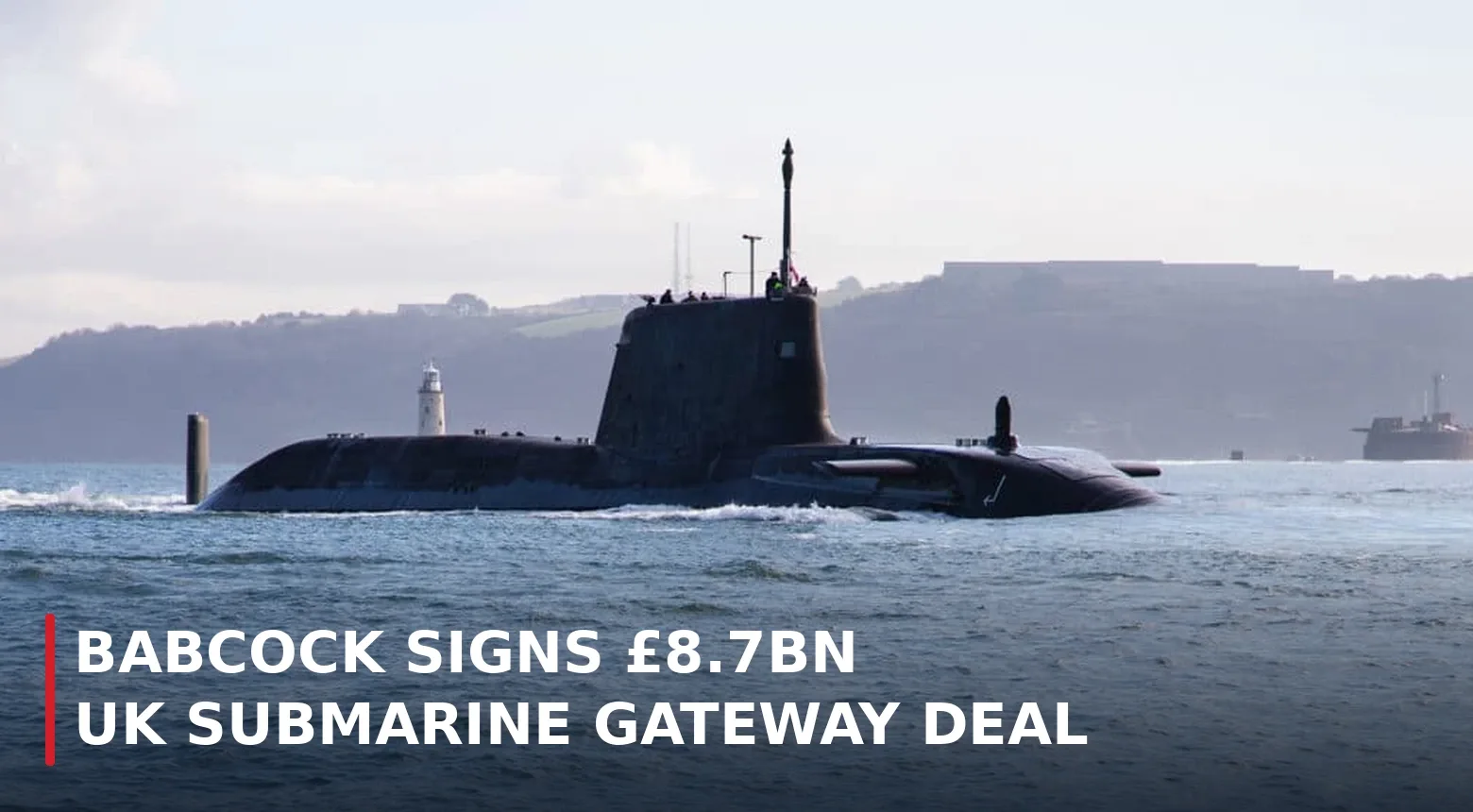
Babcock International announced on 26 November 2026 that it had signed the £8.7 billion Gateway Agreement with the UK Ministry of Defence (MOD). The five-year submarine support arrangement is intended to improve Royal Navy fleet availability and maintain continuity across Britain’s nuclear submarine enterprise. Its importance lies in the long-term provision of maintenance and industrial capacity rather than the purchase of additional submarines.
Gateway Agreement: Contract Scope and Submarine Support
According to Babcock’s announcement, the agreement takes effect on 1 December 2026, immediately after the extended Future Maritime Support Programme (FMSP) expires on 30 November. It establishes a common commercial structure for submarine engineering, upkeep and associated shore services at HMNB Devonport, Devonport Dockyard and HMNB Clyde. Babcock describes it as the largest award in its corporate history.
The financial structure requires particular care. The regulatory announcement distinguishes £8 billion of contract backlog from a further £700 million covered by a framework. The Ministry of Defence announcement uses the £8 billion figure, while Reuters’ reporting also distinguishes the two components. The total headline value of £8.7 billion should therefore not be presented as guaranteed orders for the entire framework element, cash received at signature or a commitment extending across all 15 possible years.
A five-year initial term gives both parties greater visibility than a short bridging arrangement. Extensions could bring the total duration to 15 years, but they are not equivalent to a confirmed 15-year order. A separate memorandum of understanding provides the strategic basis for the longer relationship. Future commitments should be assessed against the scope and terms actually authorised at the time.
The policy context is the UK’s Defence Nuclear Enterprise, which encompasses the organisations responsible for sustaining and renewing the national deterrent. The Gateway Agreement contributes to the support arrangements for the existing Vanguard-class fleet and the transition to Dreadnought. It is not a submarine construction contract or evidence that a new boat has been accepted into service.
For naval programme managers, the significant distinction is between the nominal size of the fleet and its availability over time. A submarine undergoing scheduled maintenance remains part of the inventory, but is unavailable for normal deployment during that period. An integrated service arrangement may improve continuity of planning and accountability for maintenance delivery. Its success, however, depends on actual outcomes rather than the number or value of contracts signed.
The public announcements do not provide a quantified baseline for fleet availability, contractual performance thresholds or an independently verified reduction in maintenance turnaround. Those omissions limit the conclusions that can be drawn from the award alone. The government’s objective of improved readiness is a programme intention, not a result already demonstrated by the new agreement.
Industrial Capacity, Programme Risks and Next Steps
Babcock expects the arrangement to protect approximately 8,500 existing nuclear-defence jobs and support 3,000 additional full-time roles. The company also anticipates more than 2,500 apprentice and graduate opportunities during the initial term. These are forward-looking employment commitments and expectations; they should not be interpreted as completed recruitment or combined with existing employment as though all categories were new permanent posts.
The scale of this effort is consistent with the wider workforce challenge set out in the 2026 Defence Nuclear Enterprise annual update to Parliament. That report places current employment at approximately 47,000 and projects demand of around 65,000 by 2030. Defence Agenda’s earlier coverage of the UK nuclear workforce expansion examined the implications of this rising demand across submarine construction, infrastructure and other nuclear programmes.
At the same time, the UK is preparing its next generation of attack submarines. The planned first SSN-AUKUS steel cut in 2027 is a separate industrial milestone. The Gateway Agreement should be understood as a sustainment arrangement within that broader enterprise, not as the procurement vehicle for SSN-AUKUS construction or a direct commitment to its delivery schedule.
Long-duration contracting can make workforce investment and supplier planning more predictable. It can also concentrate contractual responsibility with an established provider. From a public procurement perspective, the challenge is to preserve transparency over costs and outcomes while accommodating the specialised skills and regulatory requirements of nuclear submarine support. A larger agreement does not automatically establish better value for money.
One alternative to a single long-term framework would be to commission separate support packages as requirements arise. That approach could provide more flexibility in some commercial areas, but it could also introduce additional interfaces and repeated procurement cycles. The comparative merits cannot be determined from the announced headline value alone; a meaningful assessment would require contract-level performance and cost evidence.
Implications / Next: The immediate milestone is the agreement entering into effect on 1 December 2026. Subsequent evidence should include reported progress against contractual service outcomes, workforce recruitment and training, and any additional orders placed through the £700 million framework. Future extension decisions and public reporting on the wider submarine enterprise will help determine whether the new contractual model is delivering its intended benefits. As of 26 November 2026, the confirmed achievement is the signature of the agreement, not an independently measured improvement in fleet readiness.
Further Reading
- Babcock — Gateway Agreement announcement
- UK MOD — Submarine availability investment
- Babcock — Regulatory announcement
- UK MOD — 2026 Defence Nuclear Enterprise annual update
- Reuters — UK submarine facilities agreement
- Defence Agenda — UK Plans First SSN-AUKUS Steel Cut in 2027
- Defence Agenda — UK Nuclear Workforce Tops 100,000 as DNE Expands