ASELSAN naval systems investment is entering a new expansion phase, with the company starting an additional €60 million programme covering three facilities and two test infrastructures intended to accelerate the development, qualification and production of weapons, sensors and underwater systems for Türkiye’s growing naval fleet.
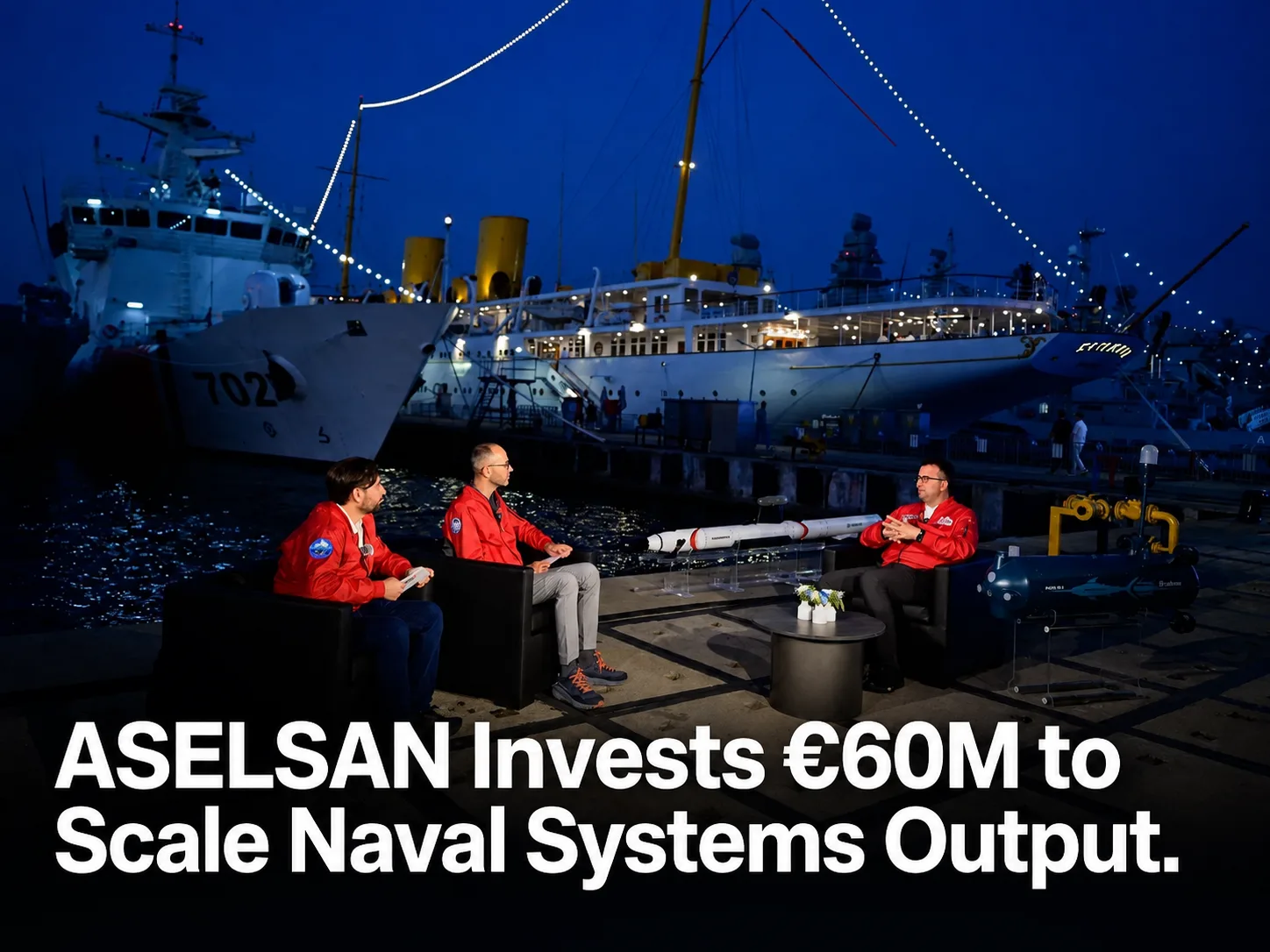
ASELSAN President and CEO Ahmet Akyol disclosed the investment during TEKNOFEST Mavi Vatan at Gölcük Naval Shipyard Command on 22 August 2026. He said the company had started the projects during August and expected many of the facilities to become operational within approximately one year.
The investment is significant because Türkiye is simultaneously expanding its frigate, destroyer, submarine, aircraft-carrier and uncrewed maritime programmes. ASELSAN says its systems are already installed aboard 69 vessels in Türkiye and more than 60 abroad, while the company is supplying systems for more than 40 ships currently under construction in Türkiye.
Key Facts
- New naval investment: €60 million.
- Scope: Three facilities and two new test infrastructures.
- Start: August 2026.
- Implementation: ASELSAN expects many of the investments to become operational within approximately one year.
- Installed base: ASELSAN systems are present aboard 69 ships in Türkiye and more than 60 ships abroad, according to Ahmet Akyol.
- Current shipbuilding workload: Akyol says ASELSAN is participating in more than 40 vessels presently under construction in Türkiye.
- Priority areas: Sonar, radar, torpedoes, electronic warfare, autonomous systems, submarine systems, AI-supported sensing and naval weapons.
ASELSAN Starts €60M Naval Expansion
Speaking to Anadolu Agency on 22 August 2026, Akyol said ASELSAN had begun a new group of investments specifically focused on maritime systems.
He identified the package as three facilities and two test systems representing approximately €60 million in additional investment.
The objective is to shorten the interval between system development, testing, qualification and delivery to the Turkish Naval Forces.
That distinction is important. Naval electronics and weapons cannot be scaled simply by adding assembly lines. Sonars, radars, torpedoes, electronic-warfare systems and underwater vehicles require specialised integration and qualification infrastructure before delivery.
ASELSAN is therefore investing simultaneously in production and test capacity.
Three New Facilities Target Naval Bottlenecks
The first major investment concerns expansion of ASELSAN’s submarine-systems integration capability at Gölcük.
Akyol said construction had started on a new facility expanding the company’s existing presence at Gölcük Naval Shipyard, where Türkiye has also begun construction of its indigenous MİLDEN submarine.
A second project is an AI sensor and data-processing centre being developed with the Turkish Naval Forces on the Istanbul side of the Sea of Marmara.
The centre is intended to bring together data generated by surface and underwater systems and apply artificial intelligence to sensor processing.
The third major element is additional test infrastructure supporting the qualification of naval sensors, weapons and underwater systems before they are handed over to operational units.
Test Infrastructure Is Becoming an Industrial Constraint
ASELSAN’s investment indicates that testing capacity has become almost as important as manufacturing capacity.
Akyol specifically referenced sonars, radars, torpedoes, electronic-warfare systems and underwater platforms that require testing before delivery.
The company is therefore establishing infrastructure where test vessels and unmanned surface vehicles can be connected to the wider development environment.
This can shorten development cycles by reducing dependence on individual operational ships for every subsystem-level test.
For an industry moving from single prototypes toward simultaneous serial-production programmes, this is critical. A bottleneck at the integration or qualification stage can delay several shipbuilding programmes even if the physical hardware has already been manufactured.
ASELSAN Systems Are Already on More Than 129 Ships
Akyol used the TEKNOFEST interview to provide a rare numerical indication of ASELSAN’s naval footprint.
He said ASELSAN products are currently installed aboard 69 ships in Türkiye and on more than 60 ships internationally.
The figures indicate an installed base exceeding 129 vessels, although the company did not publish a ship-by-ship list in the interview.
The portfolio spans radar, electronic warfare, electro-optics, communications, navigation, underwater systems, weapons and fire-control equipment.
This breadth matters because the industrial value of modern warship programmes increasingly lies in mission systems rather than hull fabrication alone.
More Than 40 Turkish Builds Include ASELSAN Systems
Akyol also said that more than 40 vessels were currently under construction in Türkiye and that ASELSAN was involved in all of them.
This statement should not be confused with the Turkish Naval Forces commander’s separate 20 August disclosure that 37 ships were being built for Türkiye and 24 for foreign customers.
The two comments use different contexts and may reflect different definitions of which construction programmes and customers are included.
The common conclusion, however, is that Türkiye’s naval order book has reached a scale where parallel system integration is becoming an industrial-capacity issue.
TCG Oruçreis Shows the Depth of ASELSAN’s Naval Portfolio
ASELSAN’s recent work on TCG Oruçreis illustrates the extent of its naval integration role.
ASELSAN announced on 9 April 2025 that it had completed temporary acceptance of the Barbaros-class frigate mid-life upgrade after renewing 21 systems aboard TCG Oruçreis.
The package included radar, electronic warfare, satellite communications, electro-optics, weapons, fire control, sonar, torpedo countermeasures and navigation equipment.
Systems included CENK surveillance radar, AKREP fire-control radar, GÖKDENİZ CIWS, FERSAH hull-mounted sonar, HIZIR torpedo countermeasures, PİRİ infrared search and track and several electronic-warfare components.
This type of whole-ship integration demonstrates why ASELSAN’s investment requirement extends beyond individual production lines.
TF-2000 Will Increase Integration Complexity Again
The next generation of Turkish surface combatants will place still greater demands on the company.
Akyol highlighted the TF-2000 air-defence destroyer, whose first ship is now under construction.
He said ASELSAN carries major responsibility for the ship, beginning with its digital AESA radar architecture and extending into air defence, close-in weapons, sonar and future directed-energy systems.
He specifically referenced SİPER, HİSAR, GÖKSUR, GÖKDENİZ, laser weapons and multistatic sonar concepts in connection with the future destroyer.
Defence Agenda’s TF-2000 Destroyer Capabilities profile examines how the ship is intended to become a fleet-level air-defence and sensor node rather than simply a larger frigate.
MİLDEN Adds a Sovereign Submarine Electronics Challenge
The underwater investment is closely connected to MİLDEN.
Türkiye has begun construction of its first nationally designed submarine at Gölcük, creating a requirement to integrate increasingly indigenous sonar, navigation, electro-optical, communications and combat-system technologies.
Akyol cited previous difficulties with foreign submarine periscope support as an example of why localisation extends beyond headline weapons.
According to Akyol, foreign suppliers had previously declined to repair imported periscopes, prompting ASELSAN to develop a national submarine periscope solution.
The lesson is broader: a submarine can lose operational availability because of dependence on a seemingly small but mission-critical foreign subsystem.
ASELSAN is therefore trying to push localisation further during MİLDEN rather than repeating dependencies embedded in earlier submarine classes.
AI Sensor Fusion Is Moving Into the Maritime Domain
The planned sensor and data-processing centre points to another transition in naval warfare.
Modern warships and autonomous platforms generate increasing volumes of radar, sonar, electronic-warfare, electro-optical and navigation data.
The operational problem is no longer only collecting information but processing it quickly enough to identify relevant contacts and support decisions.
Akyol said the new facility would bring together data from both surface and underwater systems and apply artificial intelligence to those sensors.
If integrated effectively, this could reduce operator workload and shorten the time between detection, classification and engagement.
The critical issue will be how such AI-derived outputs are integrated into operational command systems while retaining human authority over weapon employment.
KILIÇ Targets High-Volume Underwater Production
Akyol also used the interview to frame KILIÇ as part of an industrial rather than purely technological shift.
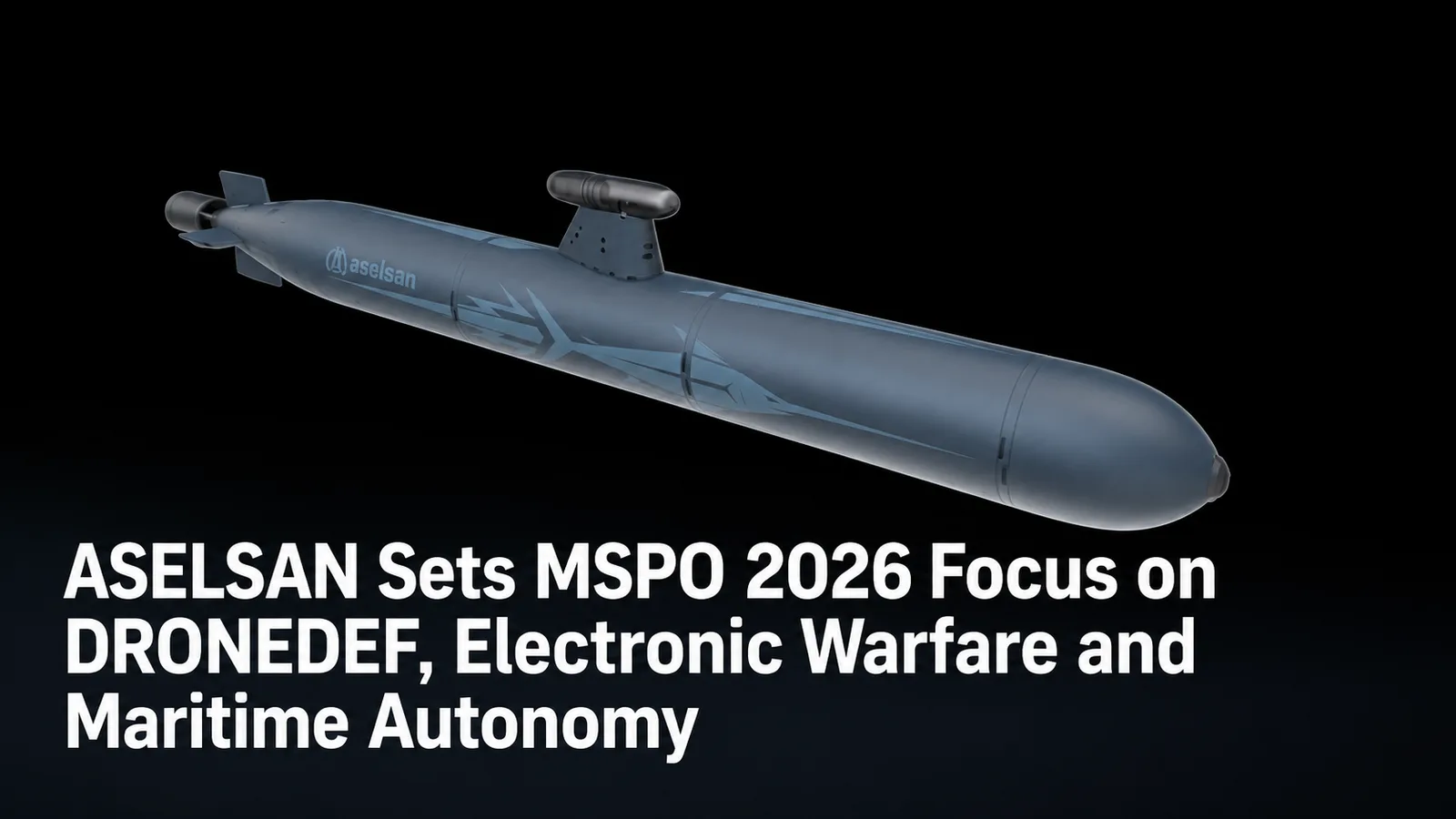
The expendable underwater system is designed around relatively low-cost, high-volume production and swarm operation.
Akyol said ASELSAN is attempting to transfer the massed kamikaze-drone model seen in the air domain into underwater warfare.
KILIÇ is intended to be deployable from ships, unmanned surface vessels or directly from shore.
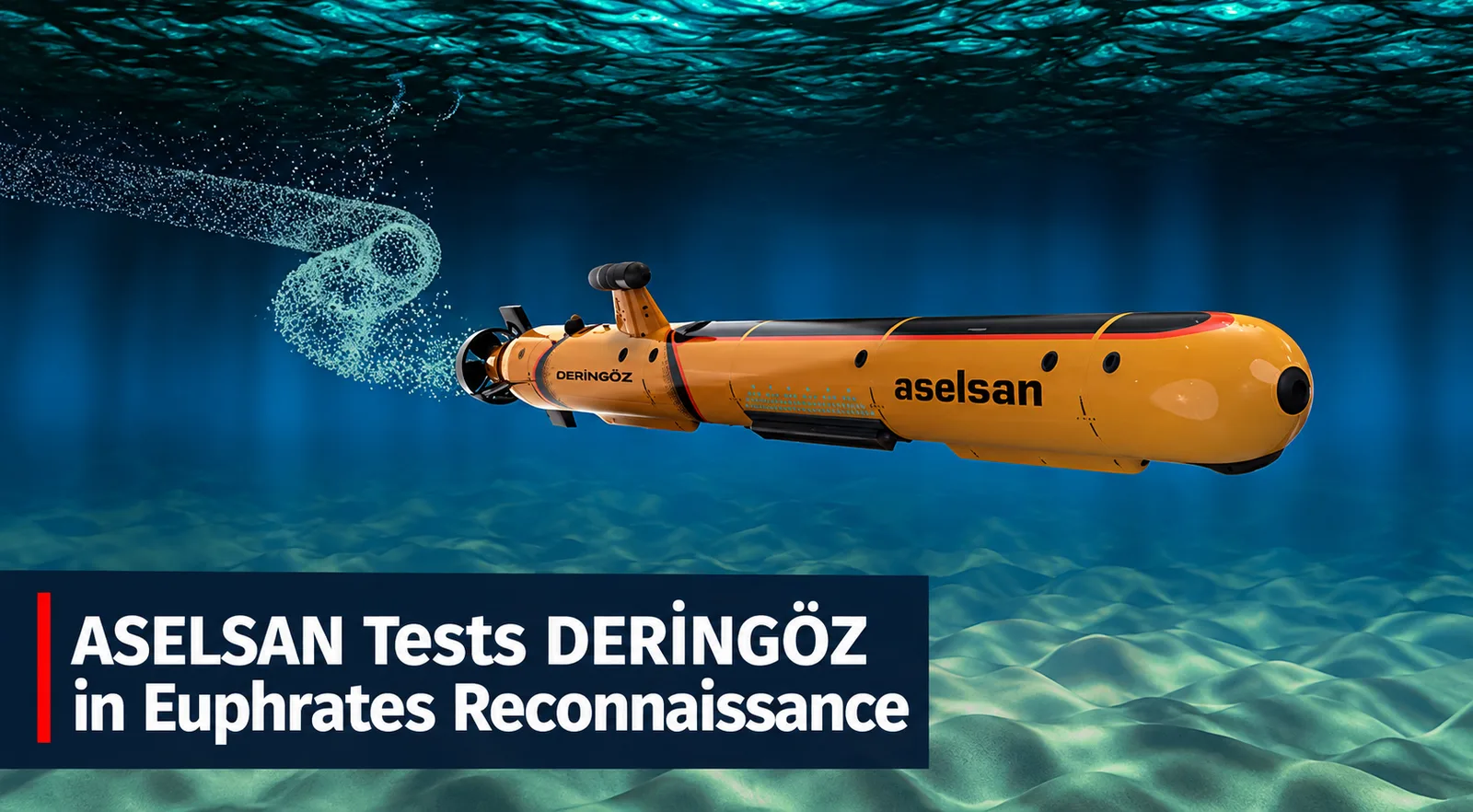
Defence Agenda has examined the platform together with DERİNGÖZ in DERİNGÖZ and KILIÇ 10 at TEKNOFEST Mavi Vatan.
The industrial challenge is now whether underwater autonomous systems can be manufactured at the scale implied by the concept while maintaining reliable navigation, sensing and communications.
TUFAN Adds the Surface Strike Layer
The same high-volume approach extends above the waterline.
Akyol described TUFAN and KILIÇ as complementary asymmetric systems providing surface and underwater strike options.
TUFAN entered the water for the first time during TEKNOFEST Mavi Vatan after being publicly introduced in May 2026.
The development is covered in Defence Agenda’s TUFAN Kamikaze USV Makes First Sea Debut.
Akyol’s comments suggest that ASELSAN sees these platforms not as boutique demonstrators but as systems that need an industrial architecture capable of delivering them in significant numbers.
MARLIN Provides the More Mature Uncrewed Baseline
Not every ASELSAN uncrewed maritime programme is at the same maturity level.
Akyol stated that MARLIN is already in the Turkish Naval Forces inventory.
MARLIN provides a reusable autonomous surface architecture that can support reconnaissance, electronic warfare and other missions, while TUFAN and KILIÇ represent more attritable strike concepts.
This combination indicates that Türkiye is developing several different unmanned maritime layers rather than seeking one universal platform.
Naval Growth Is Part of a Much Larger ASELSAN Investment Cycle
The €60 million maritime package sits inside a much larger company-wide expansion.
Akyol said ASELSAN’s current investment programme exceeds $2.5 billion.
The largest single component is the Oğulbey Technology Base, which is primarily intended to expand serial production capacity for integrated air-defence systems.
ASELSAN’s first-quarter 2026 results state that capacity-expansion investment at Oğulbey and existing campuses increased 261% year-on-year and that the first Oğulbey phase was scheduled for commissioning during the second half of 2026.
Earlier official investor documents placed the Oğulbey project itself at approximately $1.5 billion. Akyol’s latest $2.5 billion-plus figure refers to ASELSAN’s broader investment activity rather than necessarily revising the disclosed Oğulbey project value.
Steel Dome Is Driving Serial-Production Expansion
The same industrial logic applies to land-based air defence.
Akyol said ASELSAN had delivered close to 100 ÇELİK KUBBE elements during 2025 and expected the 2026 figure to exceed 100.
The company is bringing new Oğulbey facilities online in phases to support higher production volumes for air-defence radars, command systems and other components.
Defence Agenda examined this capacity build-out in ASELSAN’s Steel Dome Investment and the emerging lower-layer architecture in ASELSAN Steel Dome Adds New C-UAS Layer.
The relevance to the naval story is that ASELSAN is attempting to scale several capital-intensive technology families simultaneously rather than shifting investment from one domain to another.
Backlog Is Increasing Pressure on Delivery Capacity
Production expansion is also being driven by the company’s order book.
Akyol said ASELSAN’s backlog had increased from approximately $7–8 billion three years earlier to about $23 billion.
He added that current contract negotiations and commercial opportunities could push the figure toward $30 billion by the end of 2026.
ASELSAN also secured approximately $4.9 billion in new business during the first six months of 2026, according to the interview.
Backlog growth matters only if production capacity grows sufficiently to prevent longer customer waiting periods.
Akyol said the company can currently offer delivery schedules below two years for its product portfolio, attributing that partly to the expansion of Türkiye’s supplier ecosystem.
More Than 3,000 Suppliers Support the Expansion
ASELSAN’s scaling model extends beyond its own campuses.
Akyol said more than 3,000 companies across 46 Turkish provinces currently supply ASELSAN.
He also said the company had placed approximately $4 billion in orders with SMEs during the current period.
This supplier network is particularly important for naval systems because shipbuilding involves long bills of material and many specialised components that cannot efficiently be manufactured entirely within one prime contractor.
The resilience of that network will therefore influence whether ASELSAN can maintain delivery schedules as Türkiye’s naval and air-defence programmes expand simultaneously.
Counterargument: Infrastructure Does Not Automatically Produce Throughput
The scale of the investment is significant, but additional buildings alone do not guarantee faster deliveries.
Advanced naval electronics depend on specialised engineers, qualified suppliers, semiconductor and RF components, software integration, environmental qualification and access to suitable test assets.
Increasing production without expanding those supporting capabilities can simply move the bottleneck from assembly to testing or system integration.
This is why the €60 million package is notable for including test infrastructure alongside production facilities.
The key metric will not be how many facilities ASELSAN opens but whether delivery lead times, qualification cycles and output volumes measurably improve after those facilities enter operation.
Implications / Next
The first milestone to watch is commissioning of the three new maritime facilities. Akyol expects many of the investments to become operational within roughly one year.
The second is Gölcük submarine integration capacity. MİLDEN will increasingly require simultaneous qualification of indigenous sensors, communications, electro-optics and underwater systems.
The third is TF-2000 system integration. The destroyer will combine some of Türkiye’s most demanding radar, air-defence, sonar and electronic-warfare technologies on one surface combatant.
The fourth is high-volume autonomous production. KILIÇ and TUFAN have been designed around scale and attritability, making production economics almost as important as individual platform performance.
The fifth is AI sensor fusion. The new maritime data-processing centre will need to demonstrate that information from heterogeneous surface and underwater sensors can be turned into operationally useful outputs rather than simply accumulated as additional data.
Finally, ASELSAN’s international naval installed base should be watched closely. Moving from more than 60 foreign vessels to larger serial export programmes could turn naval electronics into an increasingly important contributor to the company’s export backlog.
Conclusion
ASELSAN’s latest maritime investment shows that Türkiye’s naval-industrial challenge is shifting from developing individual national systems toward producing and qualifying them at fleet scale.
The company already supplies equipment to 69 vessels in Türkiye and more than 60 internationally, while Akyol says ASELSAN systems are included across more than 40 ships currently being constructed in Türkiye.
The new €60 million package is designed to support that workload with additional submarine integration, AI processing and maritime test infrastructure.
At the same time, ASELSAN must support TF-2000, MİLDEN, autonomous surface and underwater systems, existing fleet modernisation and a rapidly expanding international order book.
The next measure of success will therefore be industrial rather than conceptual: whether these new facilities allow ASELSAN to shorten qualification cycles and convert Türkiye’s growing naval programme portfolio into faster, repeatable serial deliveries.
Further Reading
- Anadolu Agency: Ahmet Akyol Details ASELSAN Naval Investments
- ASELSAN: TCG Oruçreis Modernisation and Naval Systems Integration
- ASELSAN: First-Quarter 2026 Earnings and Capacity Investments
- ASELSAN: €225M Naval Systems Agreement with ASFAT
- Defence Agenda: TF-2000 Destroyer Capabilities
- Defence Agenda: ASELSAN’s Steel Dome Investment
- Defence Agenda: TUFAN Kamikaze USV Makes First Sea Debut
- Defence Agenda: DERİNGÖZ and KILIÇ 10 at TEKNOFEST Mavi Vatan