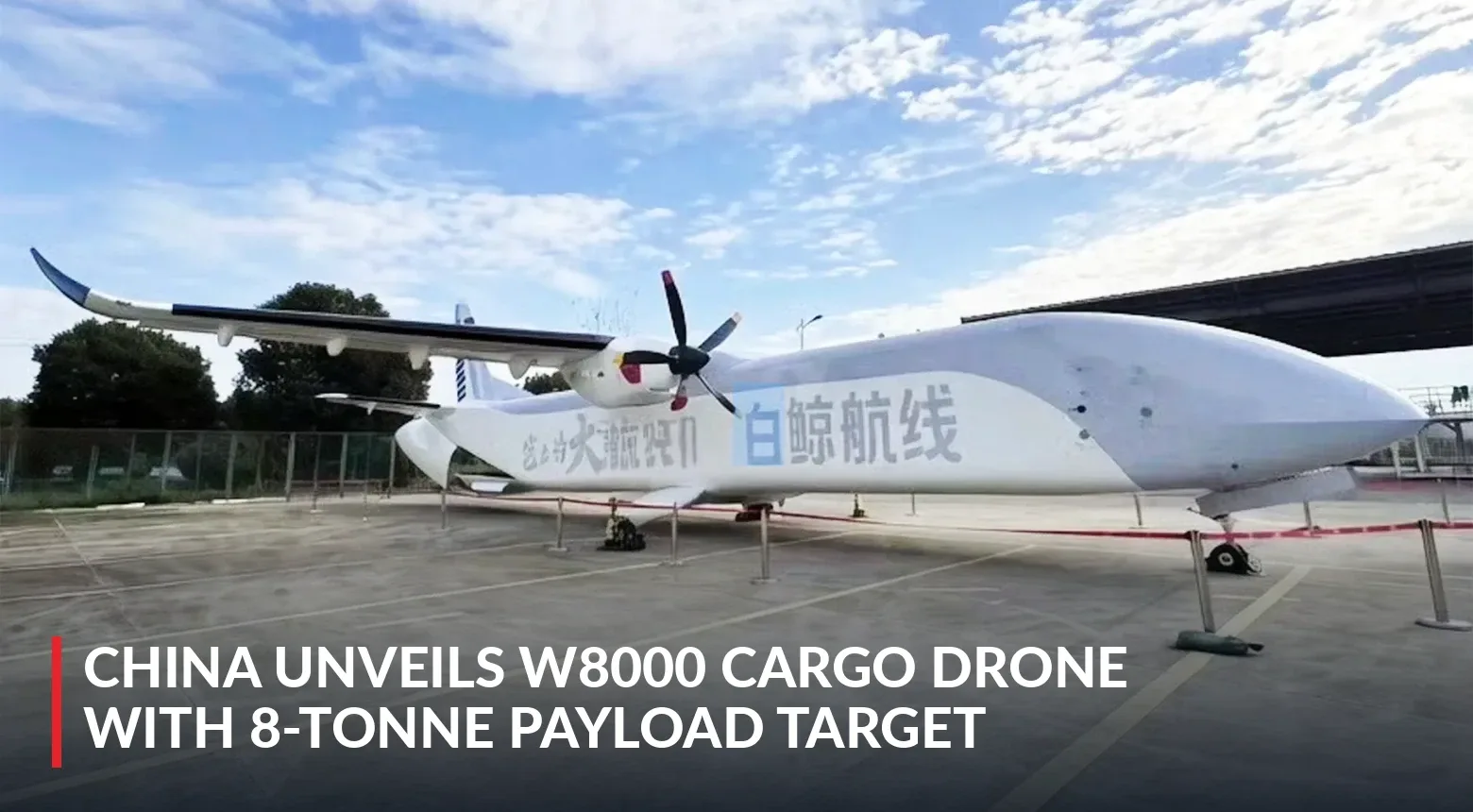
Chinese aviation developer Air White Whale has displayed its W8000 cargo drone concept in Zhuhai, with a reported payload objective of eight metric tonnes. The development, reported by The War Zone on 25 November 2026, follows the first flight of the smaller W5000 earlier in the month. It signals a move towards larger uncrewed freight aircraft, although the W8000 has not yet demonstrated its intended performance in flight.
W8000 cargo drone: a larger freight aircraft concept
The War Zone’s report describes the W8000 as a twin-turboprop concept presented ahead of Airshow China in Zhuhai. The eight-tonne objective exceeds the stated five-tonne capacity of its W5000 predecessor by 60 per cent. That comparison concerns announced design objectives, not verified payloads carried during comparable flights. Published evidence does not establish the W8000’s maximum take-off weight, range or certification schedule.
The commercial significance of this development lies in the scale of freight being considered for uncrewed aviation. Rather than treating drones solely as parcel-delivery equipment, Air White Whale is exploring aircraft that could form part of conventional regional freight networks. Such an aircraft would need to be assessed alongside existing cargo aircraft on the basis of reliability, route economics and compatibility with freight handling facilities.
The company’s existing programme offers a more concrete reference point. The Changzhou National High-Tech District authority reported that the W5000 completed a technical verification flight on 14 November 2026 at Otog Front Banner in Inner Mongolia. Aviation Week also reported the first-flight milestone on 16 November. Neither report establishes a first flight for the larger W8000.
In earlier coverage, Janes reported manufacturer-stated W5000 specifications including a maximum take-off weight of 10.8 tonnes and a five-tonne cargo capacity. These figures illustrate the intended scale of the smaller aircraft but should not be interpreted as the demonstrated conditions of the November verification flight. The larger concept would require its own evidence base and regulatory assessment.
Defence Agenda previously examined the W5000 within the wider debate about autonomous airlift development. The present announcement updates that industrial picture without establishing that the W8000 has been procured by a military customer. Air White Whale’s commercial orientation and the potential dual-use relevance of freight aviation should remain distinct from any claim of a specific defence acquisition.
Certification, market economics and the next milestones
The first flight of a development aircraft is an important engineering milestone, but it is only one step towards a commercially useful service. Certification authorities and prospective operators require evidence that a design satisfies applicable airworthiness and operating requirements. A larger aircraft brings a different set of regulatory and economic questions, even where it shares a manufacturer with an earlier product.
Removing the onboard crew does not remove the costs of providing an air transport service. Operators must still account for maintenance, insurance, dispatch, ground handling, infrastructure and regulatory compliance. The economic case will therefore depend on the actual cost of operating a certified aircraft and the volume of paying freight available, rather than its advertised capacity alone.
Commercial demand is another unresolved issue. ChinaBiz Insider reports letters of intent for 835 W5000 aircraft and an expectation of commercial service at the end of 2027. Letters of intent are not necessarily binding purchases; the number should not be treated as a firm backlog, and the expected service date remains conditional on further development. No equivalent verified W8000 order book was identified.
International developments underline that the market is not confined to one country. On 14 September 2026, Textron Aviation and Merlin introduced the Cessna SkyCourier UX concept, with a design payload objective of approximately 6,000 pounds. The different capacity targets show that developers are exploring multiple segments of autonomous freight aviation rather than converging on a single standard aircraft. Both concept announcements require caution when comparing them with certified transport aircraft already available to customers.
The aviation industry’s broader interest in uncrewed transport also extends to smaller platforms, including the ALPİN-2 unmanned helicopter previously covered by Defence Agenda. Those developments serve different market segments. A larger nominal payload does not, by itself, establish superiority across the entire freight market, where infrastructure, operating costs and demand vary considerably.
Implications / Next: Airshow China, scheduled to open on 7 December 2026 according to The War Zone, may provide additional public information. Defence Agenda’s Zhuhai airshow coverage offers context for the exhibition. The most significant evidence for the W8000 would be an official programme statement, confirmed prototype development, a documented flight milestone and a defined certification pathway. For the W5000, the immediate issue is progress from verification flight towards regulatory approval and commercial service. Until further evidence is published, the W8000 should be treated as a development concept rather than an operational transport aircraft.
Further Reading
- The War Zone — W8000 concept report
- Changzhou authority — W5000 verification flight
- Aviation Week — W5000 first flight
- Textron Aviation and Merlin — SkyCourier UX
- ChinaBiz Insider — W5000 commercial service outlook
- Defence Agenda — USAF Autonomous Airlifter Push
- Defence Agenda — China Plans Naval Showcase at Zhuhai Airshow 2026
- Defence Agenda — ALPİN-2 Unmanned Helicopter Unveiled