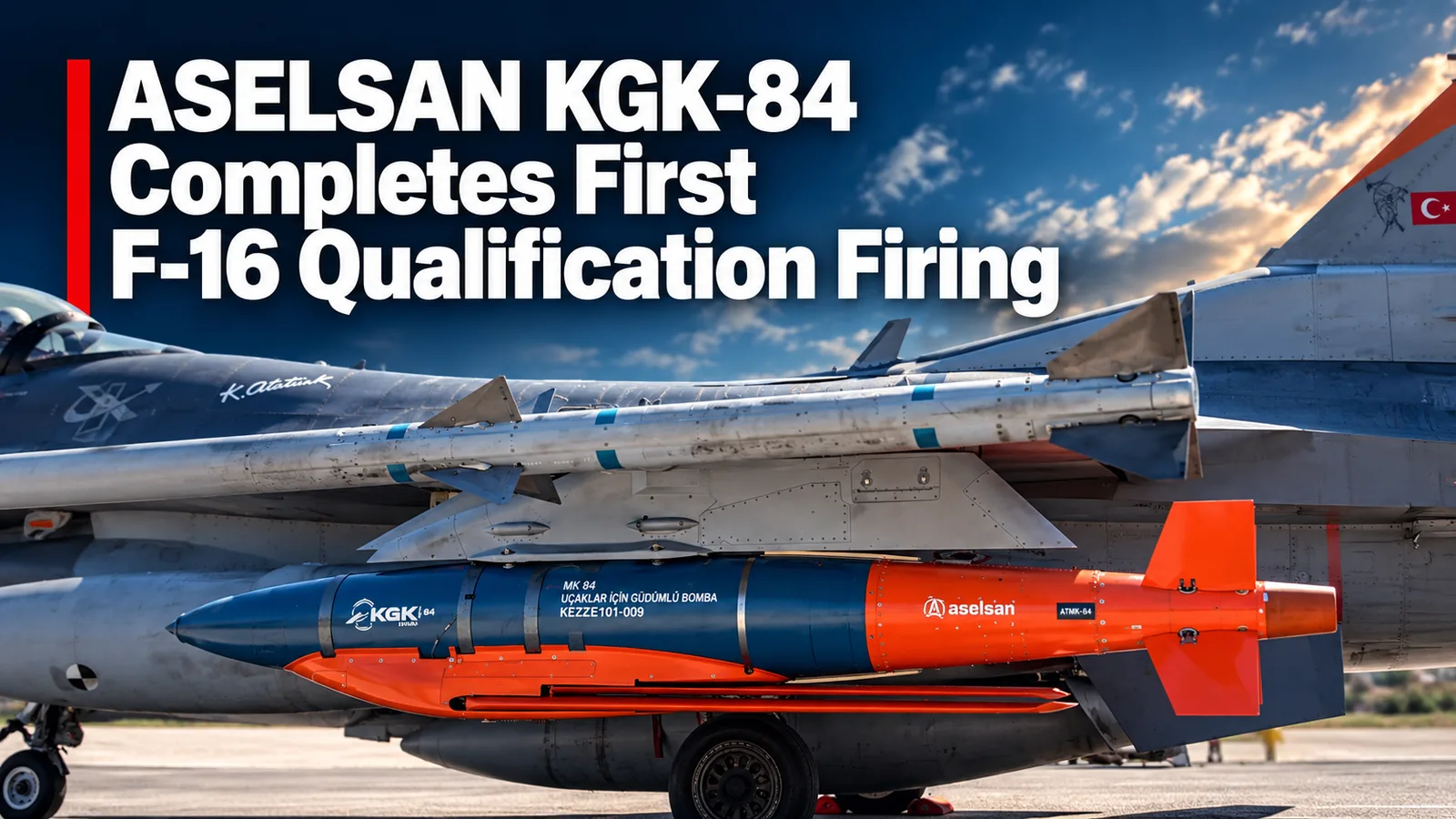
ASELSAN’s KGK-84 winged guidance kit completed its first qualification-range firing from an F-16 at the Sinop test area, striking a maritime target. ASELSAN attributes a 100 km class reach from F-16 release to the weapon; the firing does not alone establish full operational qualification. The test advances Türkiye’s domestic long-range precision-strike chain by coupling locally developed guidance and deployable wings with an existing fighter fleet.
What the test established at Sinop
ASELSAN’s KGK-84 winged guidance kit was released from an F-16 during the first qualification-range firing reported from the Sinop test area. The company and Turkish news agencies said the guided munition struck a target at sea. This is evidence of a successful named firing, not evidence that the entire qualification programme has concluded or that operational squadrons have received a defined number of kits. A qualification campaign typically covers multiple conditions, interfaces and acceptance gates. Public reporting does not disclose the actual release altitude, test range, aircraft configuration, environmental conditions or whether the full operational envelope has been cleared by the relevant authority.
Why deployable wings change the strike geometry
A conventional free-fall bomb loses energy rapidly after release and requires an aircraft to fly relatively close to the intended impact point. KGK-84 adds a deployable wing and guidance package that allow the weapon to glide and follow preplanned waypoints. ASELSAN attributes a reach of about 100 kilometres when launched from an F-16, but this is a manufacturer-described capability and should not be substituted for the undisclosed distance flown in the Sinop demonstration. Actual range varies with aircraft release conditions, trajectory and aerodynamic factors. The kit is described as fire-and-forget, enabling an aircraft to move away after weapon release rather than continuously designating the target.
A national integration and sustainment challenge
The test is industrially meaningful because Türkiye is developing guidance, control and weapon-integration expertise that can be sustained without depending on each imported guided weapon’s original production line. Even so, a kit that has passed an initial firing still needs repeatable manufacture, reliable wing deployment, robust navigation and compatibility with aircraft carriage and weapons-management software. Verification against electronic interference is particularly relevant to long-range glide weapons. The public statement gives broad capabilities but does not publish a detailed jamming test report, reliability statistics or a full schedule for fleet delivery. Those details remain important for assessing procurement maturity and cost-effective deployment.
Next qualification and procurement milestones
Follow-on evidence should cover repeat firing under different conditions, confirmed integration documentation, completion of qualification, funded production and customer acceptance. An operationally useful weapon also depends on mission planning, updated target information, trained personnel and sustainment capacity rather than on the guidance kit alone. Published reporting does not establish a new export order or disclose a total production quantity associated with this test. A separate Defence Agenda report on AKINCI’s LGK-82 and GÖZDE tests concerns different weapons and must not be treated as additional KGK-84 firing evidence. The correct description of the October event is a successful first F-16 qualification-range milestone.
Industrial and programme assessment
Long-range weapons also change how an air force plans a mission. Stand-off distance can reduce some exposure to defended areas, while increasing dependence on accurate navigation, target coordinates and predictable weapon behaviour over a longer flight path. The presence of deployable wings does not independently demonstrate penetration against a modern integrated air-defence system, and a single impact does not yield a credible probability-of-hit figure. Fleet use requires planning and certification processes that remain distinct from a successful range event.
Care is needed with the word qualification. The October event is described as the first qualification-range shot; this does not equate to a certificate that every military requirement has passed. Neither the number of test firings still planned nor the acceptance authority’s schedule is public in the cited reporting. Future Defence Agenda coverage should record each new demonstrated condition and procurement award independently so that a proven impact is not mistaken for completion of the full capability pipeline.
Implications / Next
For procurement and industry stakeholders, the critical future evidence will be primary-source confirmation of funded work, validated technical progress and a demonstrable transition to delivered or operational capability. In this case the immediate checkpoint is specific: remaining qualification results and evidence of funded deliveries. The disclosed milestone should be updated only when those events occur, not assumed from the present announcement.
Further Reading
AKINCI integration of LGK-82 and GÖZDE
F-16 ÖZGÜR modernisation programme