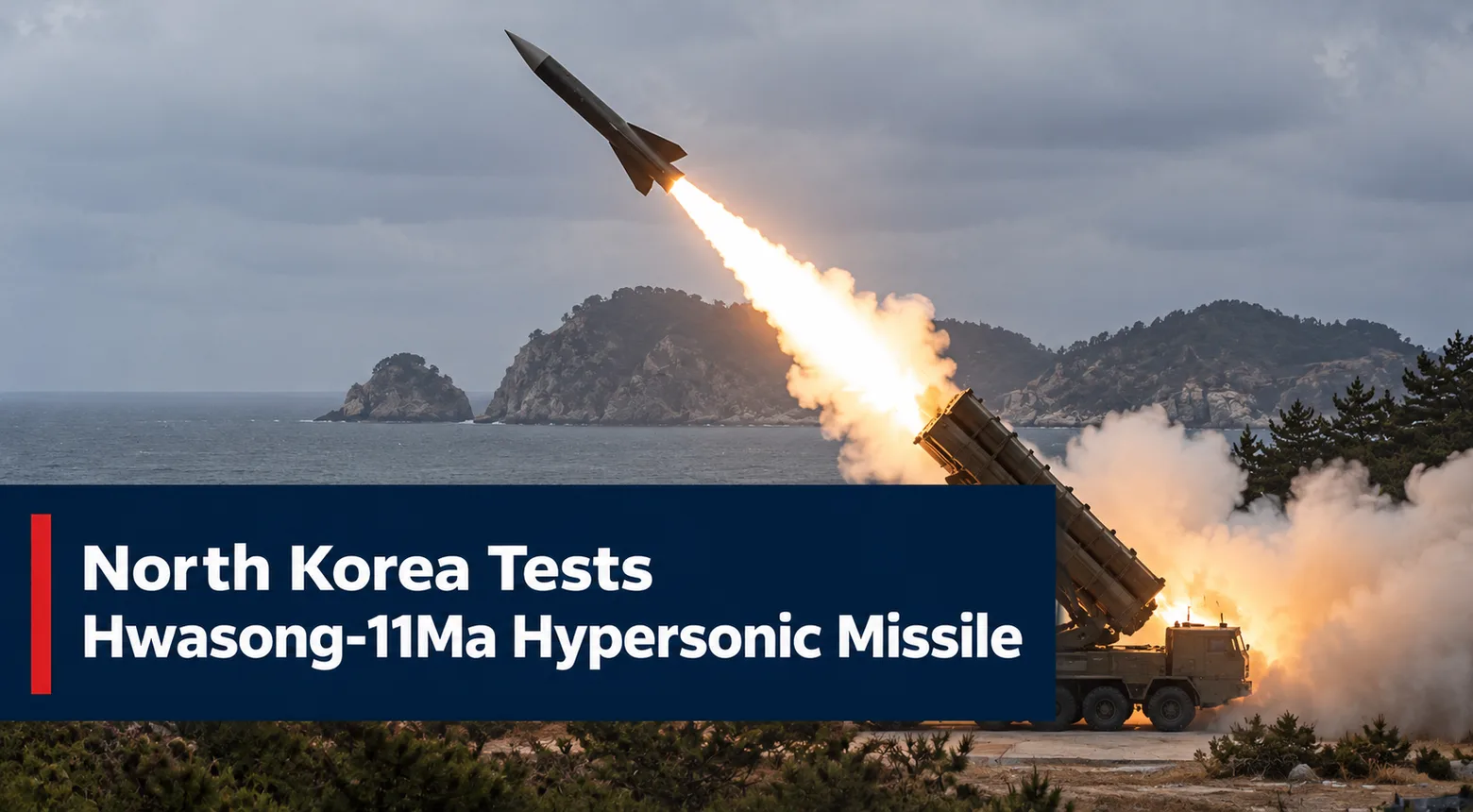
North Korea has tested a missile identified in state-media display material as Hwasong-11Ma-1, with imagery indicating a manoeuvring hypersonic-type payload. The event is a confirmed flight-test milestone, but public evidence does not establish operational fielding or independently verify every performance claim made by Pyongyang.
The test adds a new data point to the Hwasong-11 family
North Korea has carried out a new missile flight test involving a weapon identified in released display material as Hwasong-11Ma-1. USNI News reported that the launch occurred on 20 September and that images published by Korean Central News Agency showed a sharp, manoeuvring payload shape associated with the system Pyongyang has described as hypersonic. South Korea separately detected two short-range ballistic-missile launches from the Wonsan area, providing independent confirmation that a missile event took place even though the two governments reported different levels of technical detail.
The distinction between a test and a fielded capability is important. State media presented the event as evidence of rapid weapons development, while outside reporting focused on the apparent configuration and trajectory. Neither body of public evidence establishes how many rounds exist, whether a military unit has accepted the weapon, or whether the guidance and manoeuvre performance demonstrated in the test can be reproduced under operational conditions. Defence Agenda therefore treats the event as a development and flight-test milestone.
Hypersonic labels require technical caution
The term hypersonic is often used broadly, but speed alone does not define the operational challenge. Ballistic missiles can exceed Mach 5 during parts of flight. What changes the defence problem is sustained high-speed flight combined with a manoeuvring trajectory that reduces predictability and compresses engagement timelines. North Korean imagery appears to show a payload intended to manoeuvre after boost, but public sources do not provide the complete telemetry needed to independently characterise the vehicle’s flight envelope.
Associated Press reported North Korean claims of high velocity and extended travel distance, while South Korean measurements cited shorter distances for the two launches. Those differences are one reason not to translate state claims directly into a fixed range or assured penetration capability. For procurement offices, the more reliable signal is that North Korea continues to invest in trajectories and payload configurations designed to make tracking and interception more demanding.
Regional missile defence must plan for mixed threat sets
The practical challenge for regional air and missile defence is not one missile type in isolation but a mixed raid containing ballistic missiles, cruise missiles, drones and potentially manoeuvring high-speed weapons. Such a threat set stresses sensors, command-and-control, interceptor allocation and magazine depth simultaneously. Systems such as Patriot, Aegis and South Korea’s domestic air-defence architecture are therefore judged increasingly by their ability to operate as layered networks rather than as single interceptors matched to single threats.
The latest North Korean test does not prove that any particular defence system has been rendered ineffective. Claims that a weapon sits inside a specific “blind spot” or is inherently unstoppable require far more evidence than public launch imagery provides. What the test does demonstrate is continuing investment in designs intended to challenge tracking and engagement geometry, which will keep pressure on regional sensor coverage and interceptor inventories.
The next meaningful milestone is operational evidence
The programme becomes more consequential if future evidence shows repeated launches with consistent manoeuvre profiles, deployment to identified operational units, serial production indicators or integration into established command structures. Repetition matters because one successful demonstration can validate a design objective without proving manufacturing quality, reliability or readiness at scale.
For now, the safest assessment is narrower: North Korea has tested another Hwasong-11Ma configuration and is publicly signalling continued development of manoeuvring high-speed strike systems. The result should be tracked as a test milestone, while range, accuracy, survivability against modern interceptors and operational availability remain unresolved.
Implications / Next
Watch for subsequent launches, clearer designation data, unit-level deployment imagery and South Korean or Japanese tracking assessments. Those indicators will show whether Hwasong-11Ma is moving from episodic testing toward a repeatable operational capability.