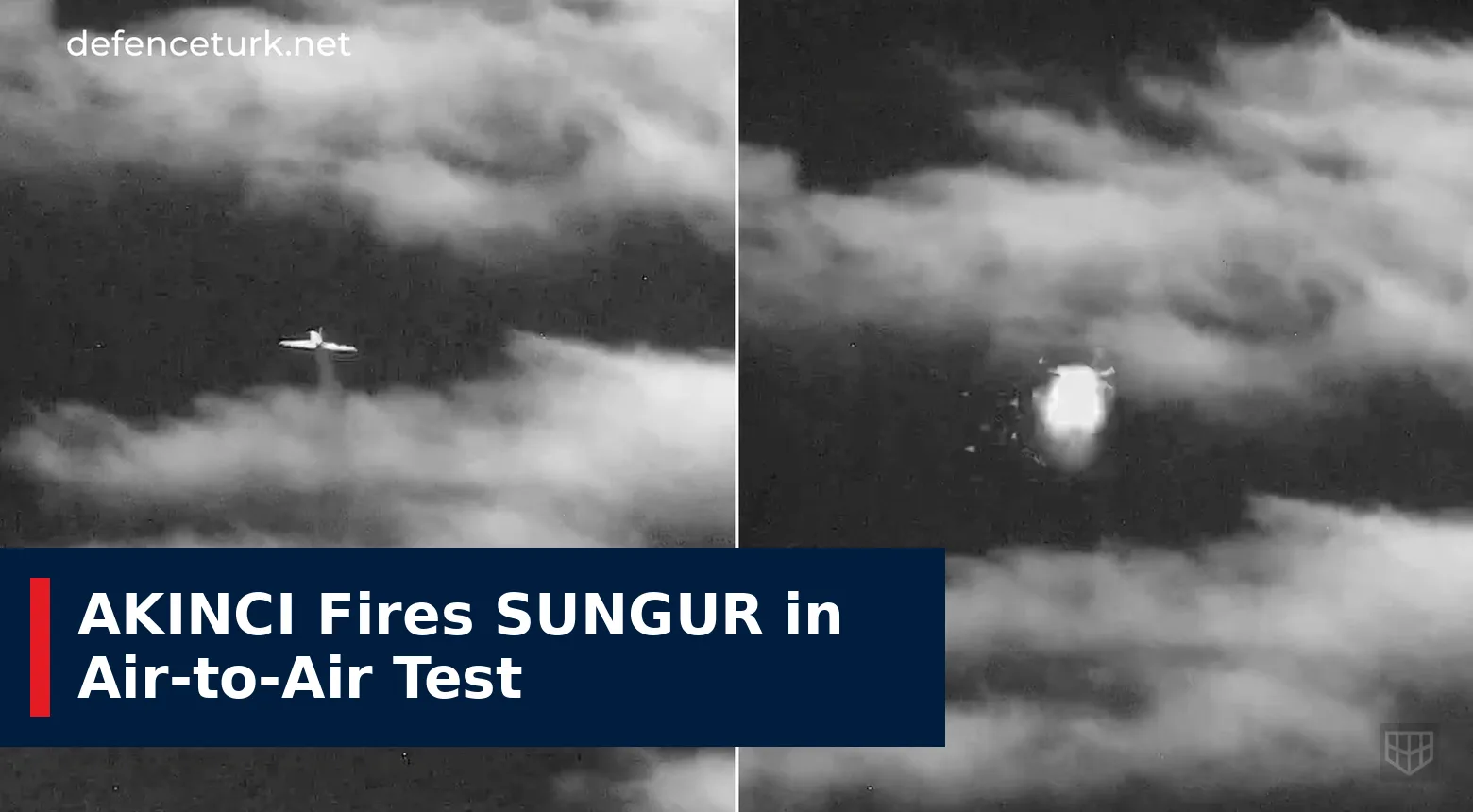
Bayraktar AKINCI has struck an airborne target with ROKETSAN’s SUNGUR missile in a test that advances Türkiye’s work on unmanned air-to-air capability.
A live-fire integration milestone
Bayraktar AKINCI has fired ROKETSAN’s SUNGUR missile against an airborne target, with Defence Turk reporting a successful hit on 15 September 2026. Imagery released with the report shows the engagement sequence, while the result adds a live-fire data point to Türkiye’s broader effort to equip unmanned aircraft with weapons intended for aerial targets. The disclosure did not provide the launch altitude, target type, separation distance or detailed test conditions.
That distinction matters. A successful firing verifies that a specific aircraft, launcher, missile and test architecture can work together under the conditions demonstrated. It does not by itself confirm that the combination has completed qualification, entered service or received an unrestricted operational clearance. Neither Baykar nor ROKETSAN had published an operational fielding declaration for the AKINCI–SUNGUR pairing at the time of writing.
From ground-based missile to airborne weapon
SUNGUR was developed as a short-range air-defence missile with an imaging infrared seeker. Its advertised characteristics in the ground-launched role cannot simply be transferred to an air launch: altitude, speed, carriage configuration and release conditions can materially change the achievable engagement envelope. No verified air-launched range was disclosed with the latest test, so any numerical comparison would be premature.
Baykar and ROKETSAN announced an integration agreement in 2022 covering SUNGUR for Bayraktar TB2 and AKINCI. The 2026 firing therefore represents a concrete test milestone within an integration path that has been public for several years. AKINCI has also been used to test other Turkish weapons, including the EREN air-launched munition against an aerial target in February 2026, illustrating how the platform is being employed as a test and carriage node for an expanding domestic weapon set.
Operational promise and integration limits
An unmanned aircraft able to engage other unmanned systems could contribute to counter-UAS patrols, protection of high-value assets and defence of airspace where a crewed fighter is not the most economical response. AKINCI’s endurance and payload capacity may allow it to remain on station with a mixed sensor and weapon load, while a heat-seeking missile offers a different defeat mechanism from guns, electronic warfare or surface-based interceptors.
The difficult work extends beyond carrying and releasing the missile. An operational system needs reliable target detection, track quality sufficient for a weapon solution, positive identification, command authority and secure data links. It also needs tactics for targets with small infrared signatures and irregular flight profiles. The latest report confirms a hit, but it does not answer how the engagement was cued, whether the aircraft’s own sensors generated the track or how the system performed against manoeuvring and low-signature targets.
What comes next
The next meaningful indicators will be repeat firings across different altitudes, aspects and target profiles, followed by a formal qualification or acceptance statement. Disclosures on launcher configuration, carried quantity, sensor-to-shooter workflow and the role of ground controllers would also clarify how the capability is intended to be used.
Until those steps are documented, the prudent description is a successful air-to-air test rather than an operational capability. Even at that maturity level, the firing is strategically relevant: it links a domestically produced unmanned combat aircraft with a domestically produced guided missile and gives Turkish industry a practical route for refining unmanned aerial interception concepts.
A useful follow-on campaign would also separate the contribution of each part of the engagement chain. Tests using the aircraft’s own sensors, external cueing and different control arrangements would show whether the combination is a self-contained interceptor or one node in a wider air-defence network. Night, adverse-weather and electronic-warfare conditions would add evidence about reliability beyond a single successful shot. Procurement authorities will also need data on missile carriage life, maintenance and safe separation before deciding how many aircraft should receive the integration. None of those questions diminishes the reported hit; they define the evidence required to convert a promising demonstration into a repeatable military capability.