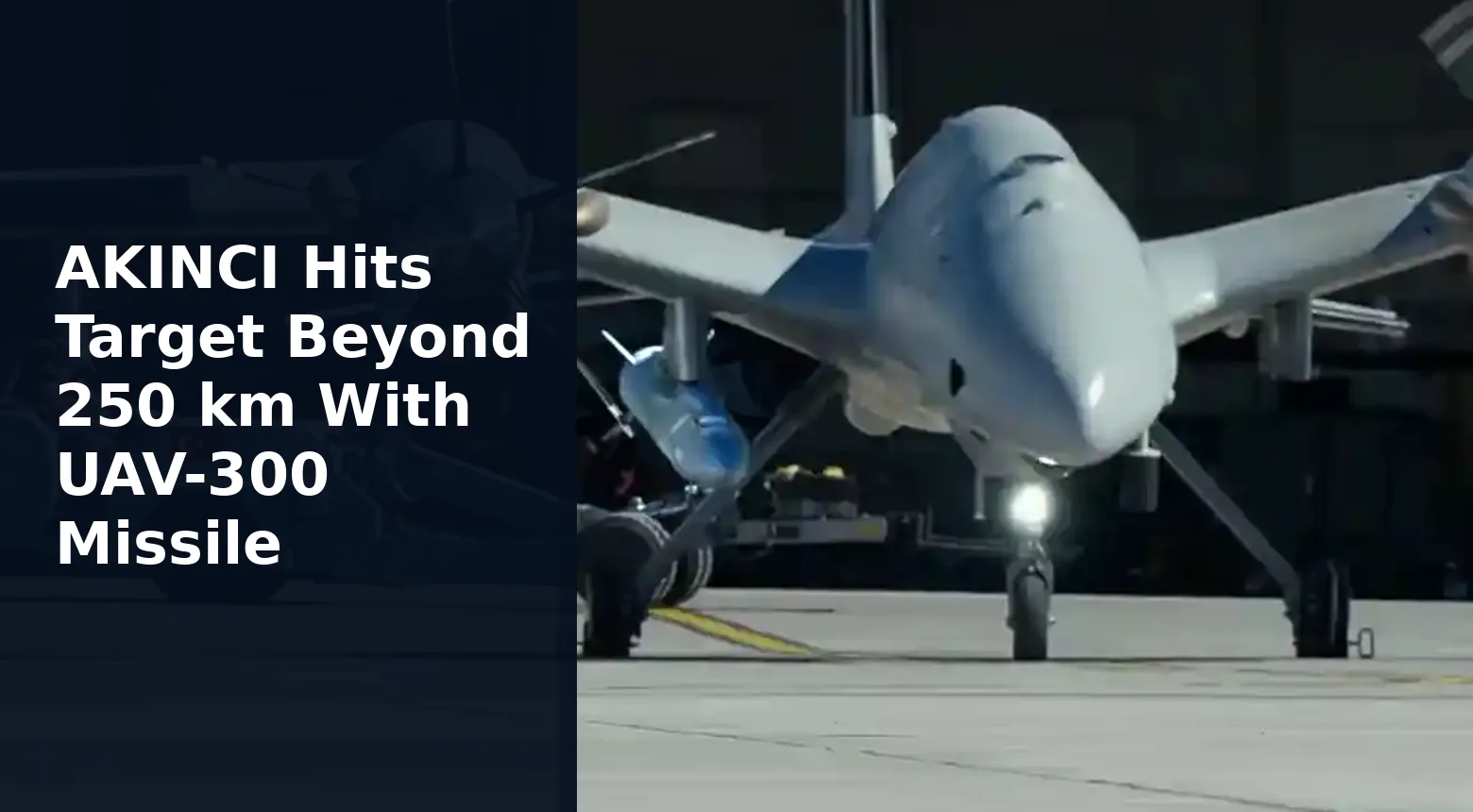
Bayraktar AKINCI has completed the first firing of ROKETSAN’s UAV-300 aeroballistic missile, striking a maritime target at a reported distance beyond 250 kilometres. Baykar states that the missile can exceed 300 kilometres when launched from AKINCI; the test is a significant integration milestone but not evidence of fleet-wide operational fielding. UAV-300 materially extends AKINCI’s standoff reach and gives Türkiye a domestically controlled air-launched ballistic option. Operational value will depend on target updates, seeker performance, weapon production and formal user acceptance.
The event advanced from carriage to a live firing
Two days after the missile was observed on an AKINCI hardpoint, TurDef reported that the aircraft fired UAV-300 and hit a maritime target beyond 250 kilometres. That is a stronger maturity signal than a display or captive-carry image. It still represents one public test event rather than a completed qualification campaign.
Launch-platform performance shapes maximum range
ROKETSAN had previously associated the 300 ER designation with a range above 500 kilometres, while Baykar now cites more than 300 kilometres from AKINCI. The difference can reflect aircraft speed, altitude, release conditions and mission profile. The article therefore uses the platform-specific claim and avoids presenting the larger figure as demonstrated by AKINCI.
A maritime target highlights the targeting chain
A TV seeker can support terminal guidance, but engaging a moving ship at long range also requires reliable mid-course target information. The publicly described event does not establish performance against a manoeuvring target under electronic attack. Sensor, datalink and command integration are central to the complete capability.
Industrial readiness is separate from technical success
Baykar and ROKETSAN control the aircraft and weapon integration within Türkiye’s domestic ecosystem. Moving from test to fielded inventory requires serial production, aircraft software release, training and accepted storage and handling procedures. Export availability should not be assumed before official approvals and contracts.
Programme and procurement context
This development must be read at its exact maturity level. Bayraktar AKINCI has completed the first firing of ROKETSAN’s UAV-300 aeroballistic missile, striking a maritime target at a reported distance beyond 250 kilometres. Baykar states that the missile can exceed 300 kilometres when launched from AKINCI; the test is a significant integration milestone but not evidence of fleet-wide operational fielding. Defence programmes pass through distinct stages: policy announcement, requirement definition, competition, contract, testing, production, delivery, acceptance and operational fielding. Collapsing those stages into a single claim can overstate both near-term military utility and industrial certainty.
For acquisition teams, the decisive evidence is funded scope, customer acceptance, integration responsibility and a supportable schedule. UAV-300 materially extends AKINCI’s standoff reach and gives Türkiye a domestically controlled air-launched ballistic option. Operational value will depend on target updates, seeker performance, weapon production and formal user acceptance. Public announcements rarely resolve every dependency. Training, secure data, range access, infrastructure, export approval and supplier capacity can delay useful capability even after a technically successful milestone.
Source discipline is equally important. Company releases naturally emphasise momentum; government notices may describe only funded scope; exercise reports show activity without proving full readiness. Values should be labelled as contract ceilings or estimates when appropriate, performance figures as manufacturer claims until independently demonstrated, and dates as targets unless a customer confirms completion. Later primary records should replace early reporting as the programme matures.
The operational question is not whether the technology can be shown once, but whether users can employ it repeatedly under representative conditions. That requires realistic testing, configuration control, trained personnel, spares and an accountable command chain. Industrial significance also depends on repeatable production and quality assurance rather than prototype output alone.
Implications / Next
Track further firings, moving-target trials, seeker and datalink disclosure, Turkish service acceptance and production orders. Use UAV-300 as the current name while noting its earlier 300 ER designation where needed.
This item remains a draft pending final image-rights review, CMS media assignment and canonical publication data. A later report should be treated as a separate update only if it materially changes the programme status described here.
Further Reading
Bayraktar KALKAN DİHA Operates From TCG Anadolu