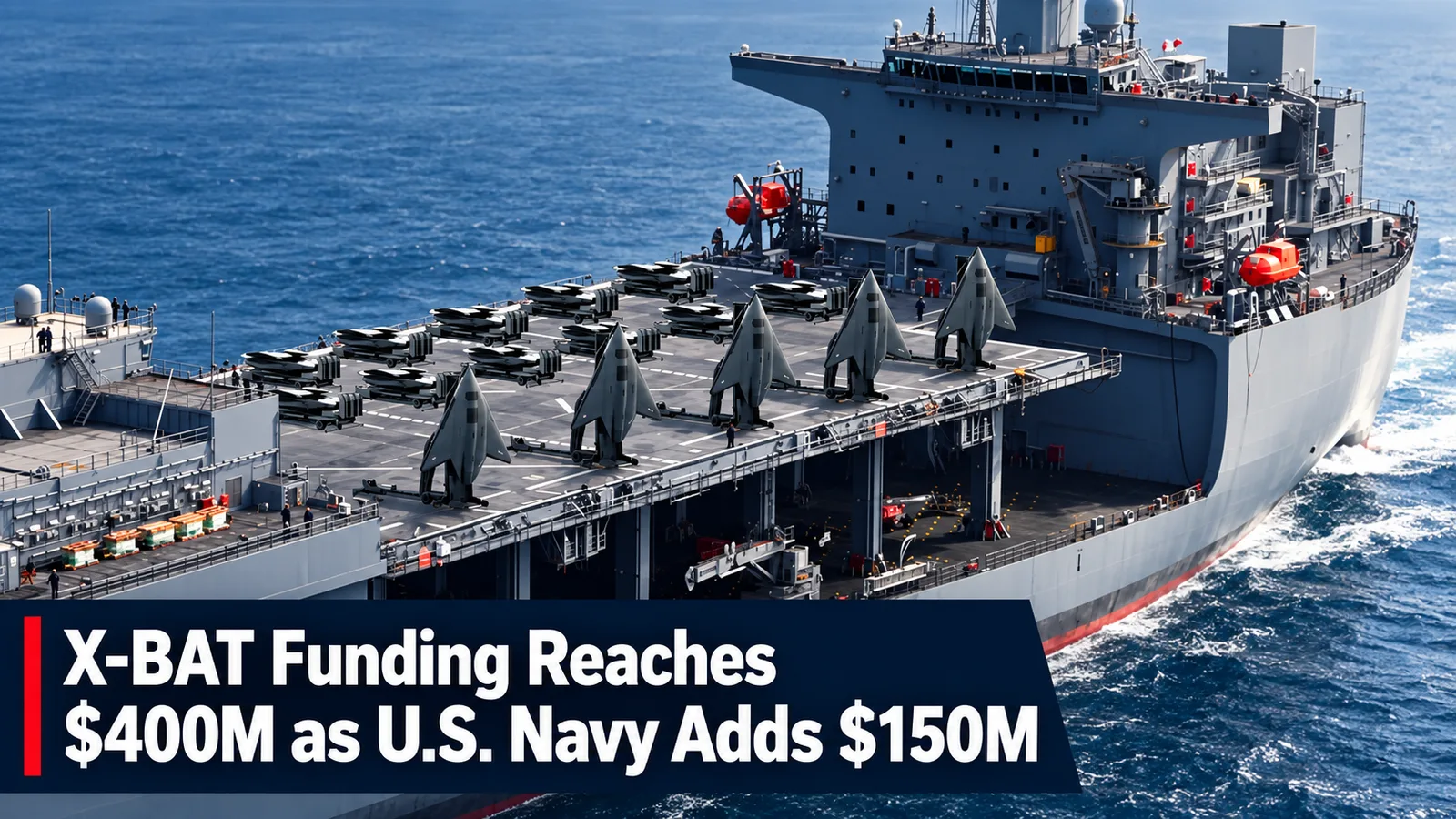
Shield AI says announced public and private commitments to its X-BAT autonomous VTOL fighter have reached $400 million after the U.S. Navy executed a $150 million modification to an existing Other Transaction agreement and Shield AI matched that amount with $150 million of its own capital.
The new modification is funded through the Defense Exportability Features programme. It follows a separate $50 million government action announced in August under the Runway Independent Maritime Expeditionary Strike effort, which Shield AI also matched with $50 million in private capital.
The $400M Total Is a Public-Private Commitment, Not a Single Government Award
The headline figure combines four separate funding components: the new $150 million Navy modification, $150 million in matching Shield AI capital, the earlier $50 million RIMES government action and the company’s $50 million match to that effort. Shield AI therefore describes the total as announced public and private commitments to the X-BAT programme rather than a $400 million government contract.
This distinction matters because it changes how the programme’s financial backing should be interpreted. Government funding is material, but Shield AI is also putting significant private capital at risk, giving the programme a hybrid financing structure more typical of venture-backed defence technology than a conventional fully government-funded aircraft development effort.
The Latest Modification Adds Exportability to the Development Path
The new $150 million government modification is funded through the Defense Exportability Features programme, while the earlier $50 million action sits under the Navy and DIU’s RIMES effort. The two funding streams therefore address related but distinct objectives: runway-independent maritime strike on one side and exportability on the other.
That pairing suggests the programme is being developed with overseas adoption in mind before flight testing is complete. Shield AI has already signed industrial cooperation arrangements in Poland and Greece, reinforcing the view that export-market access, sustainment and local industrial participation are being developed alongside the aircraft itself.
RIMES Gives X-BAT a Clear Naval Mission Path
The Department of the Navy’s Portfolio Acquisition Executive Aviation Rapid Capability Cell and the Defense Innovation Unit announced the earlier $50 million investment in August to advance Runway Independent Maritime Expeditionary Strike capabilities. The requirement centres on long-range strike assets that can operate from ships, islands and austere locations without fixed runways.
X-BAT is designed specifically around that problem. Shield AI describes the aircraft as a low-observable, multirole VTOL platform intended to operate from carriers, amphibious ships, expeditionary sea bases, remote islands and other constrained sites, extending airpower where conventional runways may be unavailable or vulnerable.
Shield AI Says Key Ground Milestones Are Already Complete
Shield AI says a roughly 500-person engineering team across the company and key suppliers, including GE Aerospace, is building flight-test aircraft. The programme has completed engine light-off, integrated the thrust-vectoring nozzle and validated weapons-bay aerodynamics through low- and high-speed wind-tunnel testing.
Those are meaningful development milestones, but they do not equate to a completed flight-test programme. X-BAT remains a pre-flight aircraft, and the company says flight testing is scheduled to begin later in 2026. Vertical launch and recovery, transition flight, ship compatibility and autonomous mission execution will all require separate validation.
Hivemind Remains Central to the Operational Concept
Shield AI’s Hivemind autonomy software is intended to serve as X-BAT’s AI pilot. The company says the software is designed to support operations in GPS-denied and communications-constrained environments, allowing the aircraft to execute missions with greater autonomy when external control links are limited.
That autonomy stack is central to the aircraft’s value proposition. Runway independence alone would create a flexible VTOL aircraft, but the combination of autonomous mission execution, long-range strike and a low-observable airframe is what positions X-BAT as a combat-air system rather than simply an unmanned vertical-lift demonstrator.
Industrialisation Is Moving in Parallel With Flight Development
Shield AI named Newton, Kansas, as X-BAT’s flight-test and sustainment home and Des Moines, Washington, as the programme’s production location in September. The company says every production aircraft is intended to complete acceptance testing in Newton before delivery, with the site also supporting development flying and fleet MRO.
Building production and sustainment infrastructure before first flight increases execution risk if the design changes substantially during testing, but it can shorten the transition from prototype to production if the aircraft performs as expected. Shield AI says it is deliberately working on aircraft development, mission systems, ship suitability and production in parallel to reduce schedule.
Export Partnerships Are Expanding Before Flight Test
Shield AI has already begun building potential international industrial pathways around X-BAT. In September it signed a five-year letter of intent with Poland’s PGZ and WZL-2 covering potential design, production, delivery and sustainment cooperation, while an October agreement with GEK TERNA targets parts production, aircraft integration and long-term sustainment in Greece.
The Defense Exportability Features funding now adds a formal U.S. government mechanism to that effort. The existence of export-focused funding does not mean an export sale has been approved or completed, but it does indicate that foreign-operability and releasability are being treated as engineering and programme requirements rather than as afterthoughts.
What Remains Unproven
The programme has not yet completed a publicly confirmed first flight, vertical recovery, shipboard launch or autonomous combat mission. Shield AI has also not disclosed a final government procurement quantity, operational unit assignment, production contract or service entry date tied to the new funding modification.
The next critical milestone is flight testing later in 2026. That campaign will determine whether the propulsion, thrust-vectoring, autonomy and VTOL architecture demonstrated on the ground can translate into a viable combat aircraft, and whether the current $400 million commitment base is sufficient to move X-BAT toward an operational procurement programme.