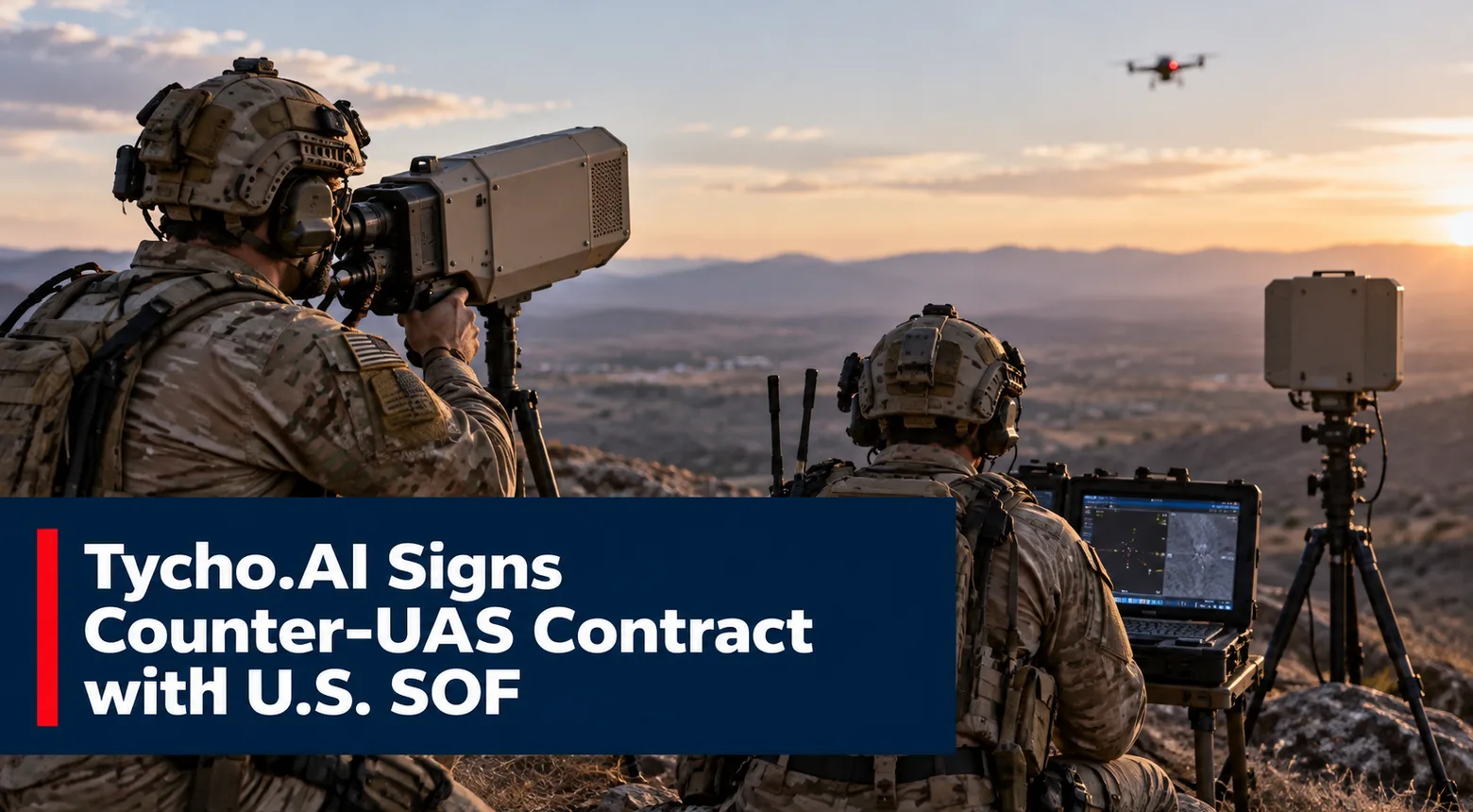
Tycho.AI has won a $900,000 U.S. Special Operations Command contract to design, test and deliver a small-form-factor counter-UAS interceptor for dismounted special operations forces. Announced on 23 September 2026, the 12-month ANCHOR Other Transaction Agreement covers 10 prototype systems, training and live-fire warfighter evaluations rather than a production-scale fielding order.
The requirement is built around dismounted point defence
Tycho.AI describes the interceptor as a man-packable quadcopter designed to defeat Group 1 and Group 2 unmanned aircraft. The company says its autonomy stack is intended to support launch-to-intercept operation in communications-denied or degraded environments, reducing the burden on operators who cannot rely on a large fixed sensor-and-command architecture.
The concept is notable because many counter-UAS systems are vehicle-mounted, site-based or dependent on larger radars and effectors. USSOCOM’s prototype effort instead focuses on a compact system that can move with dismounted teams. That does not mean the system has been fielded operationally; the contract is specifically for development, testing and evaluation.
Ten prototypes will support training and live-fire evaluation
Military Embedded Systems reported that the agreement calls for 10 prototype interceptors along with new-equipment training and multiple live-fire warfighter evaluations. The 12-month period gives Tycho.AI a defined path to put hardware in front of operators and collect feedback under a formal acquisition mechanism.
Tycho.AI says the interceptor will use open-architecture standards and a modular payload bay. Those features could ease future integration or payload changes, but the public announcement does not identify the sensor package, defeat mechanism, unit cost or follow-on procurement quantity. Those details should therefore remain treated as undisclosed.
The award fits a wider shift toward lower-collateral counter-drone effectors
U.S. defence organisations are rapidly expanding the range of counter-UAS effectors available to deployed forces. Defence Agenda has tracked the Joint Interagency Task Force 401 counter-UAS marketplace, U.S. Marine Corps procurement of V2X Tempest vehicles and other layered systems that combine detection, jamming and kinetic or non-kinetic defeat.
Tycho.AI’s prototype occupies a different part of that architecture: a portable autonomous interceptor for small units. The next test will be whether live-fire evaluations generate enough performance evidence for follow-on procurement. Until then, the award should be described as prototype development under an OTA rather than a programme of record.
Prototype evaluation will determine whether portability survives operational trade-offs
A man-packable counter-UAS interceptor has to balance several competing requirements: weight, endurance, sensor quality, speed, autonomous guidance, defeat effectiveness and operator burden. Reducing size can improve mobility but can also constrain battery capacity and payload. USSOCOM’s live-fire evaluations are therefore important because they will test whether the small-form-factor concept remains useful under realistic mission conditions rather than only in controlled demonstrations.
The open-architecture approach may also matter if operators need to adapt the interceptor to different sensors or effectors over time. Small UAS threats evolve quickly, and a closed design risks becoming obsolete if it cannot accept software, seeker or payload changes. Tycho.AI’s stated modularity is intended to address that problem, but operational evidence is still required.
The 10-prototype quantity should be understood as an evaluation fleet. It provides enough hardware for training and multiple events without representing a service-wide inventory decision. If the programme succeeds, a follow-on award could expand quantities or transition the technology into a broader acquisition pathway. If it does not, the OTA structure allows USSOCOM to collect lessons without committing to large-scale production. This makes the award useful as a capability experiment even before any future procurement decision is taken.
Implications / Next
The main milestones are prototype delivery, operator training, live-fire evaluation results and any USSOCOM follow-on award. No production quantity beyond the 10 prototypes has been confirmed.