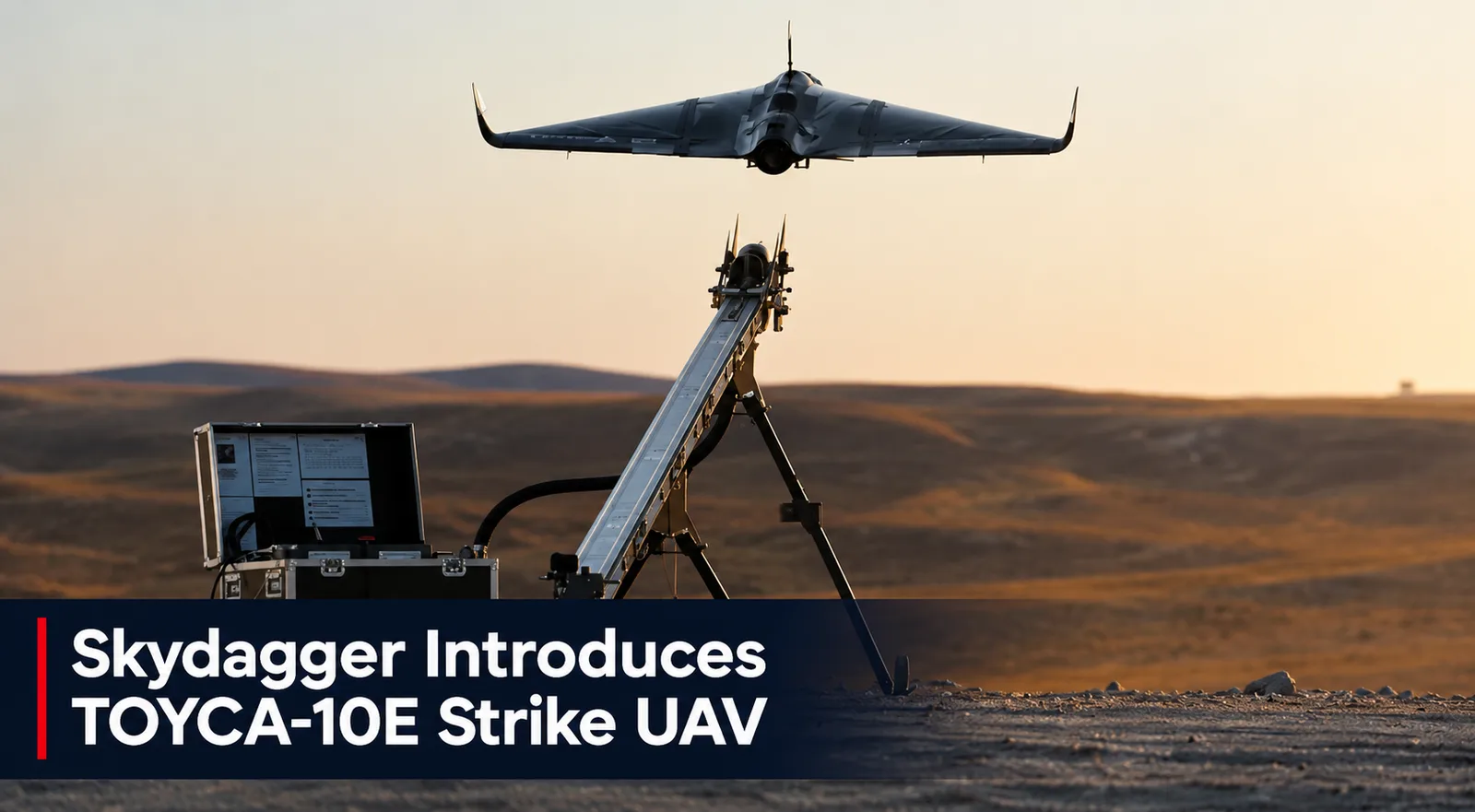
Turkish unmanned-systems company Skydagger has introduced TOYCA-10E, an electrically powered fixed-wing strike UAV with a manufacturer-stated mission range of up to 250 km and capacity for a 10 kg warhead. The design combines catapult launch, anti-jam features and autonomous mission functions, but no customer, procurement quantity or serial-delivery schedule has been announced.
The published configuration combines range and a 10 kg warhead class
Anadolu Agency reported on 20 September 2026 that TOYCA-10E had joined Skydagger’s growing unmanned-systems portfolio. The company publishes a range of up to 250 km and a 10 kg warhead capacity for the new system, positioning it in a medium-range strike segment between very small first-person-view systems and larger reusable UCAVs.
Those figures are manufacturer specifications and should be attributed accordingly. Public reporting does not provide the test profile used to derive maximum range, the exact warhead configuration, cruise speed, endurance or environmental conditions. They are therefore useful for defining the intended class of the platform but not a substitute for independently observed operational performance.
Catapult launch removes the requirement for a conventional runway
TOYCA-10E uses electric propulsion and is launched by catapult. That configuration allows the system to begin missions from sites without a runway, increasing flexibility for dispersed land operations. A fixed-wing layout is intended to support the longer-range mission profile, while the electric propulsion system simplifies some aspects of field handling compared with combustion-powered aircraft.
The design also reflects the growing importance of launch and logistics simplicity in expendable strike systems. A platform that can be moved, assembled and launched from a compact site can be harder to suppress than one tied to established airfield infrastructure. Skydagger has not, however, disclosed the launcher footprint, crew size or reload time.
Anti-jam capability is a central part of the sales proposition
Skydagger says TOYCA-10E is designed to continue mission flight under heavy electronic jamming. The company has not publicly described the navigation architecture in enough detail to assess how that resilience is achieved, so claims about specific satellite-navigation-denied performance would be premature.
What is public is the emphasis on mission continuity in an electronic-warfare environment. That reflects lessons from current conflicts, where strike-UAV effectiveness depends not only on range and payload but also on the ability to navigate, receive mission updates or complete terminal attack when radio-frequency conditions are contested.
Skydagger Flight Planner supports autonomous mission phases
According to Anadolu Agency, the system uses Skydagger Flight Planner for autonomous take-off, flight and terminal-dive functions. The platform can therefore execute multiple phases of the mission according to a pre-planned route rather than relying entirely on continuous manual control.
Autonomy does not by itself establish target-recognition or engagement policy, and the company has not publicly detailed the level of operator involvement in target selection. The more defensible description is that TOYCA-10E includes autonomous flight-management functions from launch through the terminal phase.
TOYCA-10E broadens Skydagger’s unmanned portfolio
Skydagger is building a product family spanning drones, interceptor systems and fixed-wing platforms for different operational requirements. TOYCA-10E represents the medium-range strike portion of that portfolio, combining a larger warhead class and longer reach than very small tactical drones.
Its introduction also reflects the increasing depth of Türkiye’s unmanned-systems ecosystem. The market is no longer limited to large MALE UCAVs; companies are developing specialised expendable aircraft, interceptors and electronic-warfare-resistant systems aimed at different cost and mission bands.
Implications / Next
The most important next evidence will be public flight-test results, representative-warhead trials, documented navigation testing under jamming, production-capacity data and a named customer evaluation. Those milestones would show whether the system is moving from product introduction into qualification and procurement.
Until then, TOYCA-10E should be reported as a newly introduced strike UAV with published specifications of up to 250 km range and a 10 kg warhead capacity. Its architecture is operationally relevant, but fielding, survivability and repeatable mission performance remain to be demonstrated through testing and customer use.