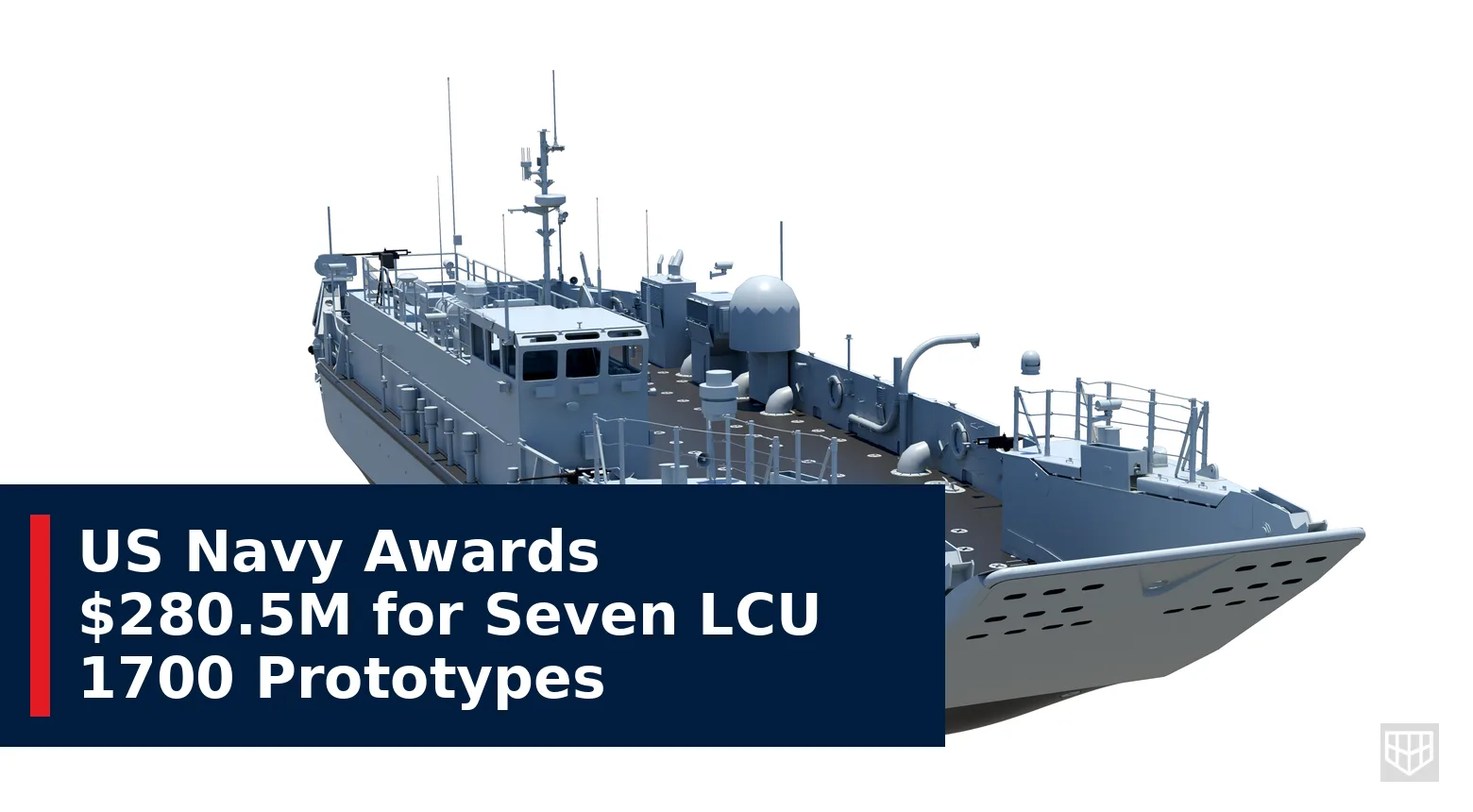
The US Navy has awarded three shipyards agreements worth an initial $280.5 million to build seven LCU 1700 prototype craft.
Three yards, seven prototype craft
The US Navy has awarded competitive prototype Other Transaction agreements to Conrad Shipyard in Orange, Texas; Master Boat Builders in Coden, Alabama; and Saronic in Brownsville, Texas. Announced on 15 September 2026, the agreements cover a combined seven LCU 1700 craft, with each yard assigned two or three vessels. The total initial construction obligation is $280,521,389.
The prototype label is significant. The agreements use authority under Title 10, Section 4022 of the US Code to test whether a government-controlled technical data package can be executed by multiple builders. They are not a single conventional serial-production award for the Navy’s full requirement. Follow-on production decisions will depend on performance, testing, funding and the Navy’s assessment of the industrial approach.
A production strategy as well as a ship programme
Building the same craft at three yards gives the Navy an opportunity to compare production methods, quality and schedule while establishing parallel supply lines. It may reduce dependence on one shipyard and create additional capacity for a class that is intended to replace ageing connectors. It also introduces configuration-control risk: drawings, specifications and engineering changes must be interpreted consistently across separate facilities.
The Navy described the awards as a way to validate a production-ready technical data package. That means success will be judged not only by whether seven craft are delivered, but by whether the design can be transferred and reproduced without extensive yard-specific redesign. Supplier qualification, government-furnished equipment and common acceptance standards will be central to that assessment.
Replacing an exceptionally old fleet
LCU 1700 is intended to replace LCU 1610-series landing craft whose average active service exceeds 50 years. The vessels move vehicles, cargo and personnel between amphibious ships and shore, giving naval forces a heavy-lift connector that can operate where port infrastructure is unavailable. Austal USA delivered the first LCU 1710 in August 2026 under a separate construction arrangement.
USNI News reports that the new craft are about 139 feet long, displace approximately 425 tons at full load and use a crew of 13. Reported capacity is equivalent to two M1A1 tanks or 350 combat-loaded troops, with an 11-knot top speed and a range of about 1,200 nautical miles at eight knots. Those figures describe the class design; the prototype awards still require each builder to demonstrate compliant construction and performance.
Delivery schedule and follow-on choices
Deliveries from the three new yards are planned between late 2028 and 2029. The programme of record is 32 craft, according to specialist reporting, but the seven prototypes do not by themselves fund that complete quantity. The Navy will need to decide how the new builders, Austal’s existing work and future production lots fit into a coherent procurement plan.
The next indicators will be detailed yard allocations, keel or construction-start events, acceptance trials and any competitive follow-on award. Cost performance will be especially important because distributing work can improve resilience while duplicating some start-up expense. If the technical package proves portable, the Navy will gain more than seven landing craft: it will gain options for scaling a strategically useful but often overlooked part of the amphibious fleet.
Prototype success should be assessed against common thresholds. Delivery date and price are visible, but weight control, cargo capacity, endurance, reliability and the results of acceptance trials will determine whether craft from different yards are genuinely interchangeable. The Navy must also control engineering changes so that a fix introduced at one builder is evaluated and distributed to the others without fragmenting the class. A shared spares and training system becomes more difficult if yard-specific variations grow. Conversely, a stable technical package and common supplier data could create competition for later lots without imposing a new design effort. That is the industrial hypothesis the seven-craft experiment is positioned to test.