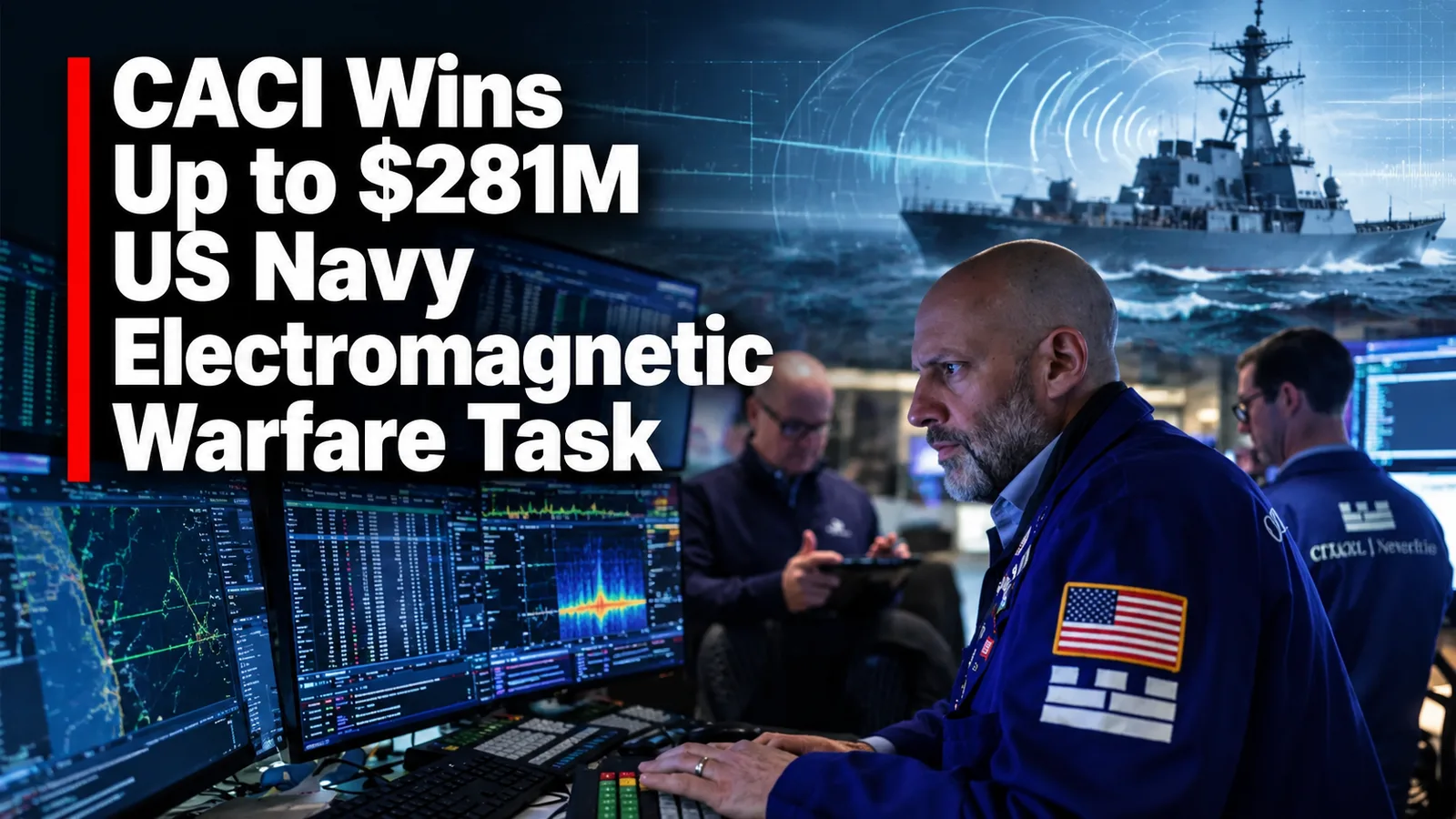
CACI announced a five-year Naval Surface Warfare Center Crane task order valued at up to $281 million covering electromagnetic spectrum research, analysis, testing and prototype development. The maximum value is not evidence that the full amount was obligated at award. Electromagnetic dominance increasingly depends on sensing, data processing and rapid prototyping across joint forces rather than a single jammer or platform.
What NSWC Crane has contracted
CACI described a five-year US Navy task order worth up to $281 million to support next-generation electromagnetic warfare across the US defence enterprise. The Naval Surface Warfare Center at Crane is the contracting customer identified in the announcement. Work includes research, analysis, assessment, prototype development, test and evaluation, and infrastructure and capability enhancements at locations matched to customer requirements. This should be characterised as a task order with a stated maximum, rather than a fixed purchase of a particular aircraft-mounted system, shipboard jammer or number of deployed units. CACI has not publicly supplied a comprehensive funded-task breakdown or committed annual expenditure schedule for the entire ceiling.
A spectrum problem larger than electronic attack
Electromagnetic spectrum operations include the ability to detect emitters, characterise their behaviour, manage friendly emissions, protect communications and respond to hostile interference. That makes software, data structures, processing speed and testing capacity as significant as the radio-frequency hardware itself. CACI referred to advanced spectrum technologies and AI-enabled decision tools, but did not disclose a specific operational algorithm, deployment configuration or quantified effectiveness improvement. A research-and-prototype task order can develop several options in parallel; an individual laboratory result must later be integrated with real platforms, security requirements and training arrangements. The award therefore supports capability maturation without confirming the fielding of a finished system.
Why a five-year ceiling does not equal immediate revenue
A ceiling sets a limit on potential contract activity. Actual obligations depend on funded orders and the work authorised under the contract, while recognition of revenue follows performance and applicable accounting rules. Buyers and analysts should avoid converting the headline maximum directly into a guaranteed five-year cash flow or an implied yearly amount. The five-year span can provide a stable mechanism for recurring research requirements, yet programme priorities and the pace of prototype validation may still change. For industry partners, the relevant questions are the scope of particular statements of work, government-furnished interfaces, production transition opportunities and access to test infrastructure.
Transition from prototype to operational system
A credible transition path will involve laboratory verification, operationally representative spectrum conditions, platform integration, cybersecurity assessment and military acceptance criteria. Adversary radio-frequency behaviour evolves rapidly, so the test architecture must support repeated updates rather than certify a system only once. Public reporting does not identify new delivered quantities, a ship or aircraft type that will receive this work, or an initial operating capability date. Subsequent obligations, named prototype demonstrations and production contracts would be more informative markers of progress than the ceiling alone. Until those appear, this is an important research-and-development award and not a declaration of a newly fielded electronic-warfare capability.
Industrial and programme assessment
The Navy contracting organisation is positioned to draw on technical specialists, existing test facilities and joint customer requirements. That environment can accelerate the movement of concepts into comparative experiments, although results still require objective verification. Electromagnetic dominance is not a property of a single box: sensing, information-sharing, electronic protection and operational command all have to work together. Readers should distinguish early research funding from the procurement of a deployable system and judge progress against disclosed tests and funded transition decisions.
The current record does not identify named battlefield users, a fleet rollout, a demonstrated increase in detection performance or a production batch. Those absences are normal at the research-and-prototype stage, but they matter in programme accounting. Analysts following this award should monitor official task-order obligations, subsequent prototype descriptions and independent operational trials. Each would represent a separately verifiable transition from a contractual capability-development vehicle toward a useful deployed tool.
Implications / Next
For procurement and industry stakeholders, the critical future evidence will be primary-source confirmation of funded work, validated technical progress and a demonstrable transition to delivered or operational capability. In this case the immediate checkpoint is specific: individual funded task orders and evaluated prototype outcomes. The disclosed milestone should be updated only when those events occur, not assumed from the present announcement.
Further Reading
US Navy Growler electronic-attack production
BAE Systems Shadow electronic warfare family