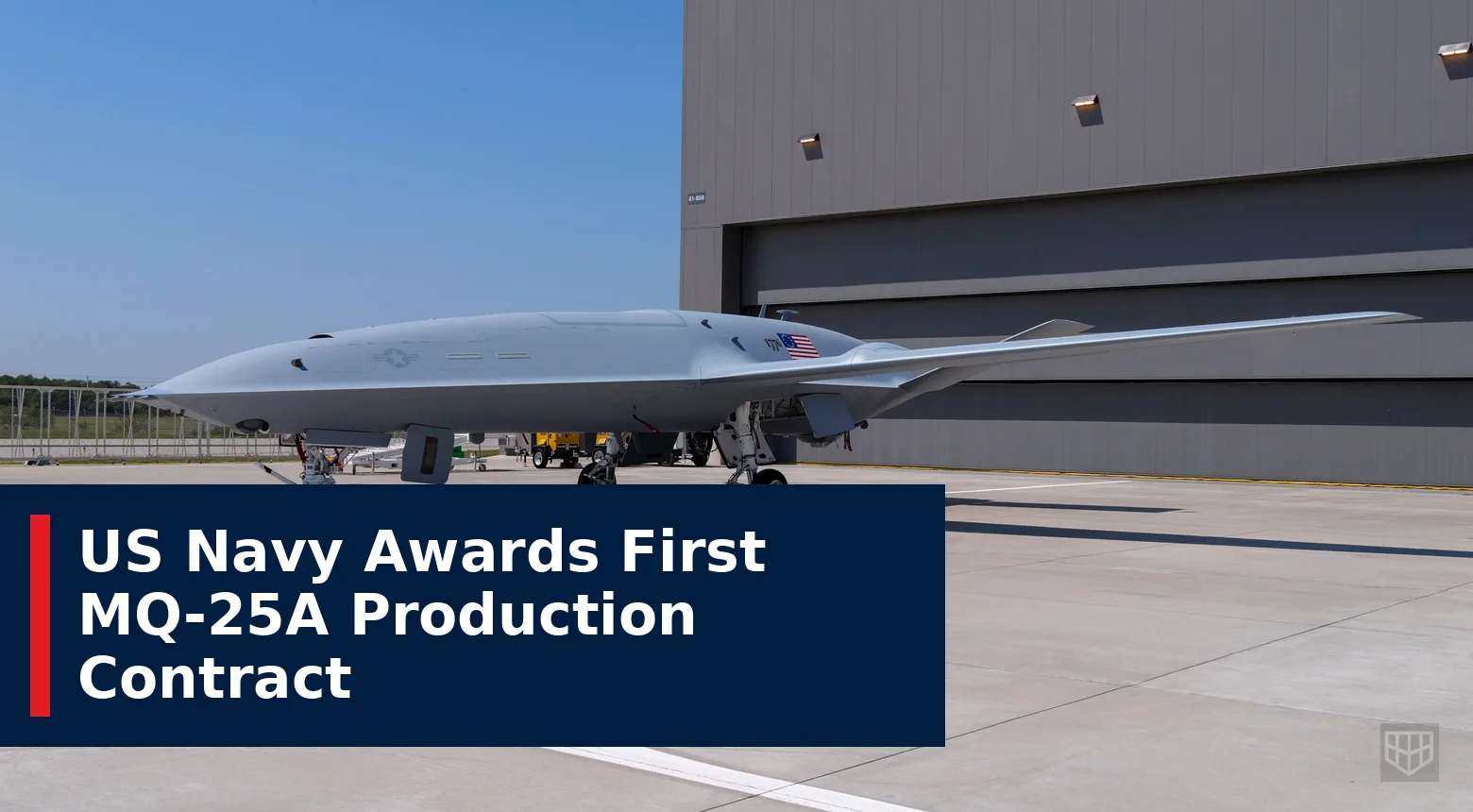
The US Navy has awarded Boeing its first MQ-25A production contract for three Lot 1 aircraft and long-lead material for three Lot 2 aircraft.
What the first production award covers
The US Navy has awarded Boeing its first production action for the MQ-25A Stingray carrier-based uncrewed tanker. Announced on 14 September 2026, it funds three aircraft in Low-Rate Initial Production Lot 1 and long-lead components for three additional aircraft planned for Lot 2. The Navy expects deliveries from the first production lot to begin in 2029.
Two official records give different values. The Navy programme release describes a $562 million fixed-price incentive contract, while the federal contract notice records a not-to-exceed $552.053 million undefinitized fixed-price-incentive modification. The latter says $164.428 million was obligated at award and work is expected to finish in July 2031. The $9.947 million difference may reflect scope or reporting treatment, but the public records do not explain it; final publication should retain the distinction unless the Navy reconciles the figures.
Low-rate initial production is an acquisition milestone, not a declaration that the system is fully operational. It allows the service to begin building representative aircraft while testing, training and support preparations continue. The incentive and not-to-exceed terms also matter because the final negotiated price and cost-sharing arrangement are more constrained than an open-ended development effort.
From Milestone C to fleet aircraft
The programme received Milestone C approval in May 2026, authorising entry into production and deployment. The Navy’s programme of record is 76 air vehicles, a figure that includes four engineering and manufacturing development aircraft and five test articles. Seven test aircraft were in production in the St Louis and Mascoutah area when the latest award was announced.
Those numbers should not be read as 76 operational fleet aircraft already on order. The Lot 1 contract covers three production aircraft, while the Lot 2 element is limited to long-lead material for another three. Later lots will require separate contracting decisions, funding and satisfactory programme performance. The 2029 delivery target likewise marks arrival of production hardware, not necessarily immediate carrier deployment.
Why carrier-based refuelling matters
MQ-25A is designed to provide organic aerial refuelling from the carrier air wing. Today, F/A-18E/F Super Hornets can be configured for the tanker mission, but every aircraft assigned to that task is unavailable for strike, air defence or other combat roles. A dedicated uncrewed tanker could release those fighters and increase the usable range and persistence of the air wing without adding a crewed aircraft type.
The programme also establishes infrastructure for routine uncrewed operations from an aircraft carrier. Deck handling, launch and recovery, mission control, data links and integration with crewed aircraft all have to work in a congested and safety-critical environment. That makes MQ-25A relevant beyond fuel transfer: its operational architecture may shape how the Navy introduces later uncrewed aircraft to the carrier air wing.
Testing and schedule risks remain
The production decision follows extensive work with the T1 demonstrator, but production-representative aircraft still need to complete developmental and operational testing. Carrier suitability, software maturity, maintainability and the performance of the ground control and communications system will influence the rate at which the Navy can expand procurement. The industrial transition from test articles to repeatable production is another schedule driver.
The next indicators will be delivery and first flight of production-representative test aircraft, completion of carrier integration events and award of Lot 2. Until then, the Lot 1 contract should be understood as the first controlled production step. It is nevertheless a material change in programme status, converting years of development into a funded path toward fleet aircraft.
Fleet introduction will require more than air vehicles. Carrier squadrons need trained maintainers and operators, deployable control equipment, spares, technical publications and procedures that fit the flight-deck cycle. The Navy must also demonstrate that the tanker can meet sortie-generation and fuel-offload expectations without creating a disproportionate maintenance burden. Those support elements can become pacing items even when aircraft production is on schedule. Lot-by-lot disclosures on unit cost, test progress and support content will therefore be useful measures of whether the programme is moving from a small development community towards a sustainable carrier capability rather than simply increasing the number of airframes owned by the service.