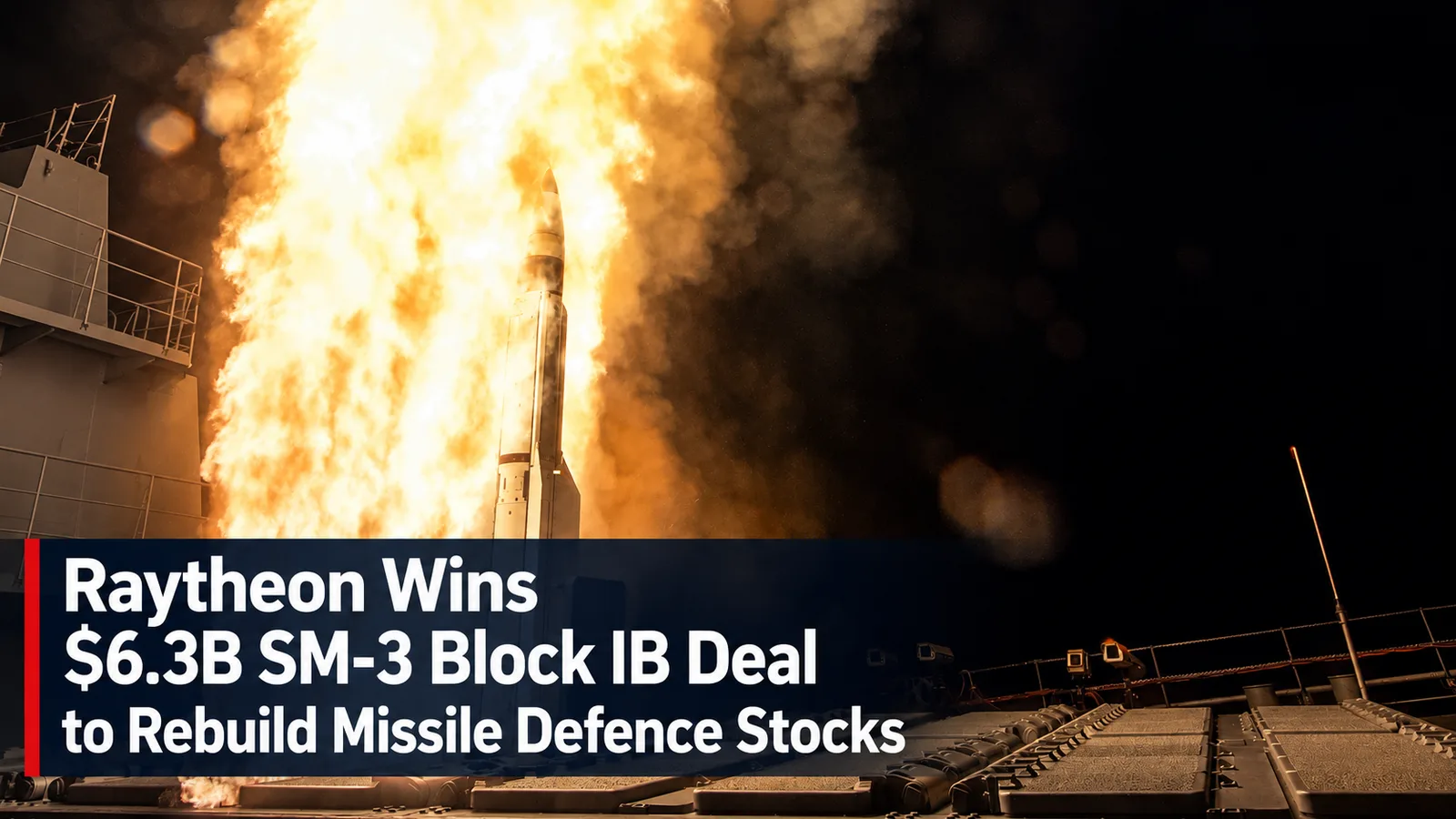
RTX’s Raytheon has secured a five-year contract, with two additional option years, valued at up to $6.3 billion for the production and sustainment of Standard Missile-3 Block IB interceptors. The award supports urgent replenishment of U.S. ballistic-missile defence inventories and provides a longer planning horizon for Raytheon’s missile-production base.
Production under the contract will be concentrated primarily at Raytheon facilities in Tucson, Arizona, and Huntsville, Alabama. RTX describes the SM-3 Block IB as a ship- and land-based interceptor designed to defeat short- to intermediate-range ballistic missiles during the midcourse phase of flight.
The Award Turns a Production Framework Into a Long-Term Contract
The October award follows the February 2026 framework agreements between Raytheon and the U.S. Department of War covering several high-demand munitions, including SM-3 Block IB, SM-3 Block IIA, SM-6, AMRAAM and Tomahawk. Those agreements were designed to create the demand visibility needed for industry to expand production capacity and accelerate deliveries.
The SM-3 Block IB award now establishes a five-year production and sustainment vehicle with two option years. Pentagon contract reporting cited by specialist defence media places the base value at approximately $4.432 billion before options, while the overall ceiling can rise to roughly $6.3 billion. The number of interceptors covered has not been publicly disclosed.
SM-3 Block IB Defeats Ballistic Missiles Outside the Atmosphere
SM-3 Block IB is built for exo-atmospheric midcourse interception. Unlike blast-fragmentation interceptors, the SM-3 family destroys ballistic targets through kinetic impact, using a kill vehicle to collide directly with the threat vehicle outside the atmosphere.
RTX says the Block IB can launch from both ships and land-based sites and is designed against short- to intermediate-range ballistic missiles. In operational terms, that places the interceptor inside the Aegis Ballistic Missile Defense architecture at sea and Aegis Ashore on land, complementing other Standard Missile variants that address different engagement zones and threat sets.
Combat Use in 2024 Changed the Replenishment Equation
Raytheon says SM-3 Block IB was first used in combat in April 2024 against Iranian ballistic missiles headed toward Israel. That operational use moved the interceptor from a primarily deterrence, test and contingency inventory into an actively consumed missile-defence resource.
The October contract is therefore partly a replenishment story. Recent Middle East operations increased demand for expensive missile-defence interceptors across several U.S. inventories, including SM-3, SM-6, Patriot and THAAD. Long-term contracts are intended to give suppliers enough demand certainty to invest in workforce, facilities and lower-tier suppliers rather than treating each replenishment action as an isolated annual buy.
Production Stability Is as Important as the Headline Value
The industrial significance of the award lies in duration as much as value. Missile production depends on qualified motors, guidance hardware, electronics, energetics, test equipment and specialised sub-tier vendors. Short procurement horizons make it harder for those suppliers to justify expansion, especially when additional factories or capital equipment require years to bring online.
The Department of War has framed its multiyear munitions strategy around reducing that friction and driving investment into assembly lines and critical domestic suppliers. Raytheon has already said it invested in Standard Missile capacity before the award, and the new contract provides a longer runway over which that capacity can be used.
SM-3 Block IB Sits Beside the More Capable Block IIA
The new contract does not replace SM-3 Block IIA. The Block IIA is a separately developed interceptor created through U.S.-Japan cooperation, with larger rocket motors and an enhanced kinetic warhead compared with earlier SM-3 variants. Raytheon is also expanding Block IIA production under a separate industrial framework.
Maintaining both variants allows the U.S. and its partners to balance inventory, mission requirements and production capacity across the Standard Missile family. The October award specifically covers Block IB production and sustainment and should not be combined with separate Block IIA or SM-6 contract values.
The Contract Fits a Much Larger Missile-Production Expansion
The SM-3 Block IB award is one of several very large missile contracts placed with Raytheon in 2026. The company has separately announced a contract valued at up to $24.4 billion for SM-6 and another worth up to $20.7 billion for AMRAAM, while its February framework also covers Tomahawk and SM-3 Block IIA production.
Taken together, the awards show the scale of the U.S. effort to rebuild inventories while increasing surge capacity for future demand. They should not, however, be added together as if every ceiling value is immediately obligated expenditure. Each contract has its own options, funding actions, production quantities and delivery schedule.
What Remains Unknown
The public award does not identify the number of SM-3 Block IB interceptors to be delivered, annual production rates, unit prices, fiscal-year quantities or the exact value that will be obligated under each option. RTX also does not state how production will be divided year by year between replenishment and other customer requirements.
The next meaningful indicators will be annual procurement quantities, obligation data, production-rate disclosures and evidence that sub-tier bottlenecks are being removed. Until then, the verified takeaway is that the U.S. government has created a long-term vehicle worth up to $6.3 billion to sustain and replenish a combat-proven ballistic-missile interceptor.