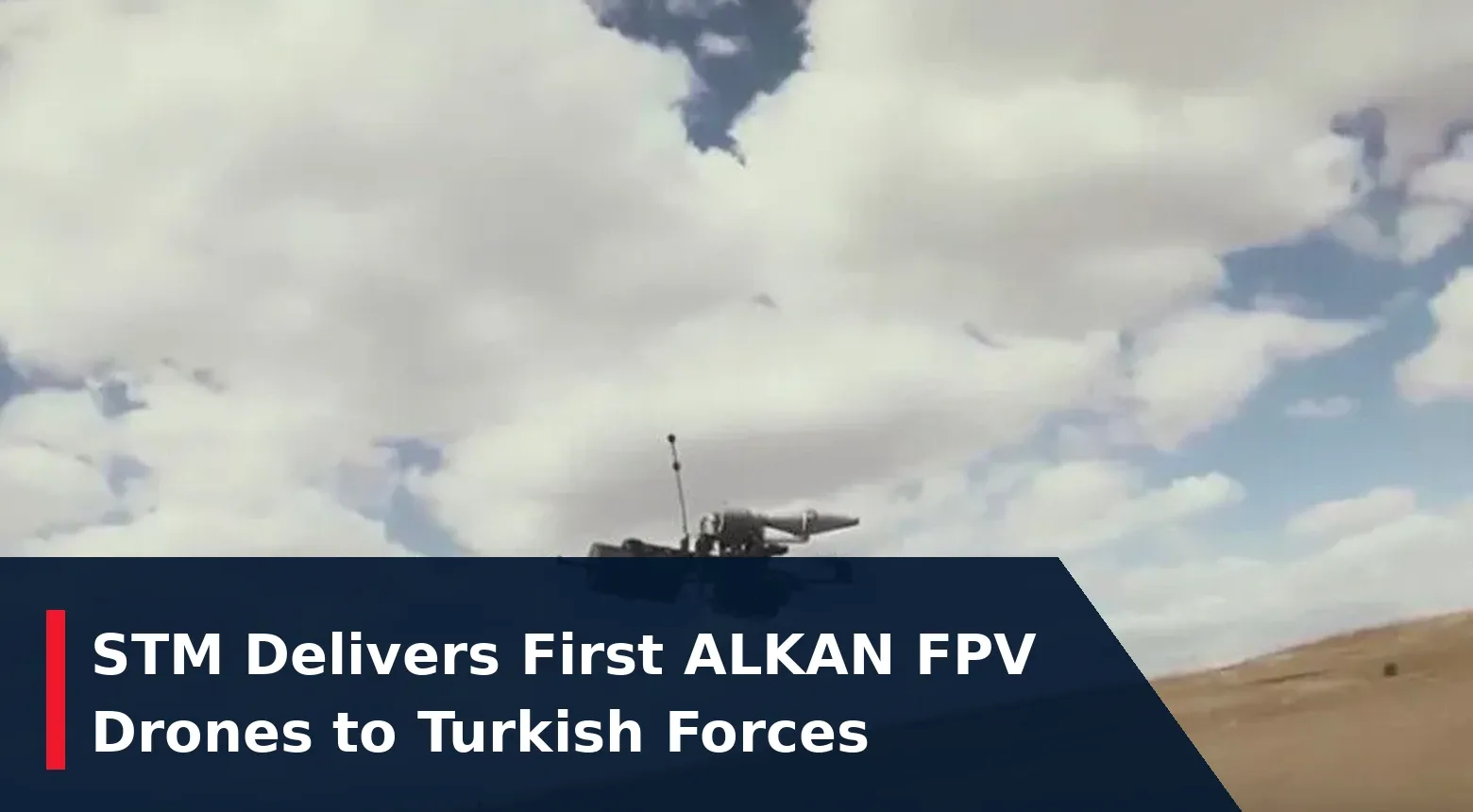
STM ALKAN FPV kamikaze drones have entered the inventory of Turkish security forces following the completion of acceptance activities and the first deliveries announced by Turkish defence engineering company STM on 23 November 2026. The first-person-view (FPV) aircraft combines operator-directed reconnaissance and engagement with computer-vision-assisted terminal guidance and an alternative fibre-optic control link. The handover marks the transition of a previously demonstrated FPV development into an accepted inventory item, but STM did not identify the receiving security organisation, disclose an exact batch quantity or publish a contract value. Its significance lies in expanding Türkiye’s range of tactical uncrewed strike systems while introducing additional questions about training, sustainment and electronic-warfare resilience.
STM ALKAN FPV: First Deliveries and Declared Capabilities
The company’s 23 November announcement said multiple ALKAN FPV aircraft were delivered after successful acceptance procedures. Anadolu Agency also reported the first batch, but neither account gives an exact number or separately identifies the recipient unit. Consequently, the announcement confirms an initial delivery and stated inventory entry, not a quantified acquisition programme or evidence of how many air vehicles are already operationally available. Further deliveries are planned according to STM general manager Özgür Güleryüz, without a published schedule or production rate.
ALKAN FPV is the updated name for a product previously promoted as KARGU FPV. That change is important when tracing its development record: earlier public test announcements and technical materials under the former name should not automatically be interpreted as separate aircraft programmes. STM says the latest configuration is designed for real-time, operator-controlled FPV operations, with computer vision supporting an autonomous terminal dive after an operator designates a target. The description supports an assisted terminal-engagement function; it does not establish that the system independently selects targets without human involvement.
The current STM specification statement gives a 10 km mission range, 140 km/h maximum speed, 500 m mission altitude and 5,500 m maximum altitude above mean sea level. Its declared endurance is more than 20 minutes in the armed kamikaze configuration and up to 44 minutes when used for observation without the munition and fuze. These are different mission configurations, not two simultaneous performance characteristics; adding a warhead affects the useful payload and energy margins of a small aircraft.
There is a source-chronology issue in the speed figures. STM’s earlier KARGU FPV test coverage cited 160 km/h as the maximum speed, whereas the 23 November 2026 ALKAN FPV announcement cites 140 km/h. The later manufacturer release is the appropriate baseline for reporting the newly delivered designation. Public material does not explain whether this difference reflects an updated aircraft configuration, revised operating parameters or a specification correction; presenting the two values as directly comparable test results would therefore be misleading.
STM says the system can use radio-frequency communications or a fibre-optic link. The latter offers an alternative control path in electromagnetic environments where a conventional radio link may be jammed or disrupted. It should not, however, be treated as proof of universal immunity to battlefield interference or guaranteed mission success. Reliability also depends on the aircraft, sensors, mission environment and communications integrity. The publicly released materials do not include a detailed independently observed acceptance-test campaign for this capability.
The aircraft can be equipped with anti-personnel or armour-piercing warheads. STM states that its military-grade safety fuze is developed in conformity with MIL-STD-331 requirements and supports safe handling and mission execution. The manufacturer also describes a selectable proximity function and a day-and-night sensor capability. These features define the claimed equipment architecture, but the announcement does not disclose acceptance thresholds, safety-certification documentation, unit cost or an inventory-wide operational qualification.
Commonality with KARGU, Procurement and Operational Implications
One notable industrial feature is the reported common munition and fuze architecture with STM’s KARGU rotary-wing loitering munition. STM says the relevant warheads and fuzes can be used on both aircraft without redesign. This may support economies in inventory management, technical documentation, storage and maintenance, particularly if operators already support KARGU. Still, interchangeable components alone do not establish identical platform operating costs, training requirements or mission performance. Those factors would need to be evaluated separately.
The development also illustrates how STM is broadening its tactical uncrewed-systems offering rather than replacing its existing line. Defence Agenda has covered STM’s 20-aircraft KARGU live-fire swarm demonstration and ALPAGU’s completed domestic deliveries. Those are different programme milestones: a coordinated demonstration concerns a test scenario, while a delivery confirms a handover subject to its own contractual and acceptance conditions. ALKAN FPV’s entry into inventory adds another type of tactical platform but does not imply that it possesses the same swarm functionality or operating radius as its stablemates.
From an acquisition perspective, the ability to sustain small systems at scale can be as important as their advertised flying characteristics. Customers need adequate stocks of replacement airframes, batteries, sensors, ground-control equipment, safely stored munitions and trained operators. They also need documented maintenance and acceptance procedures suited to a platform that may be consumed during a mission. The STM announcement does not specify those supply arrangements, the overall order quantity, the price per aircraft or a framework contract. For that reason, the new batch should not be translated into a claimed production rate or assumed future export sales.
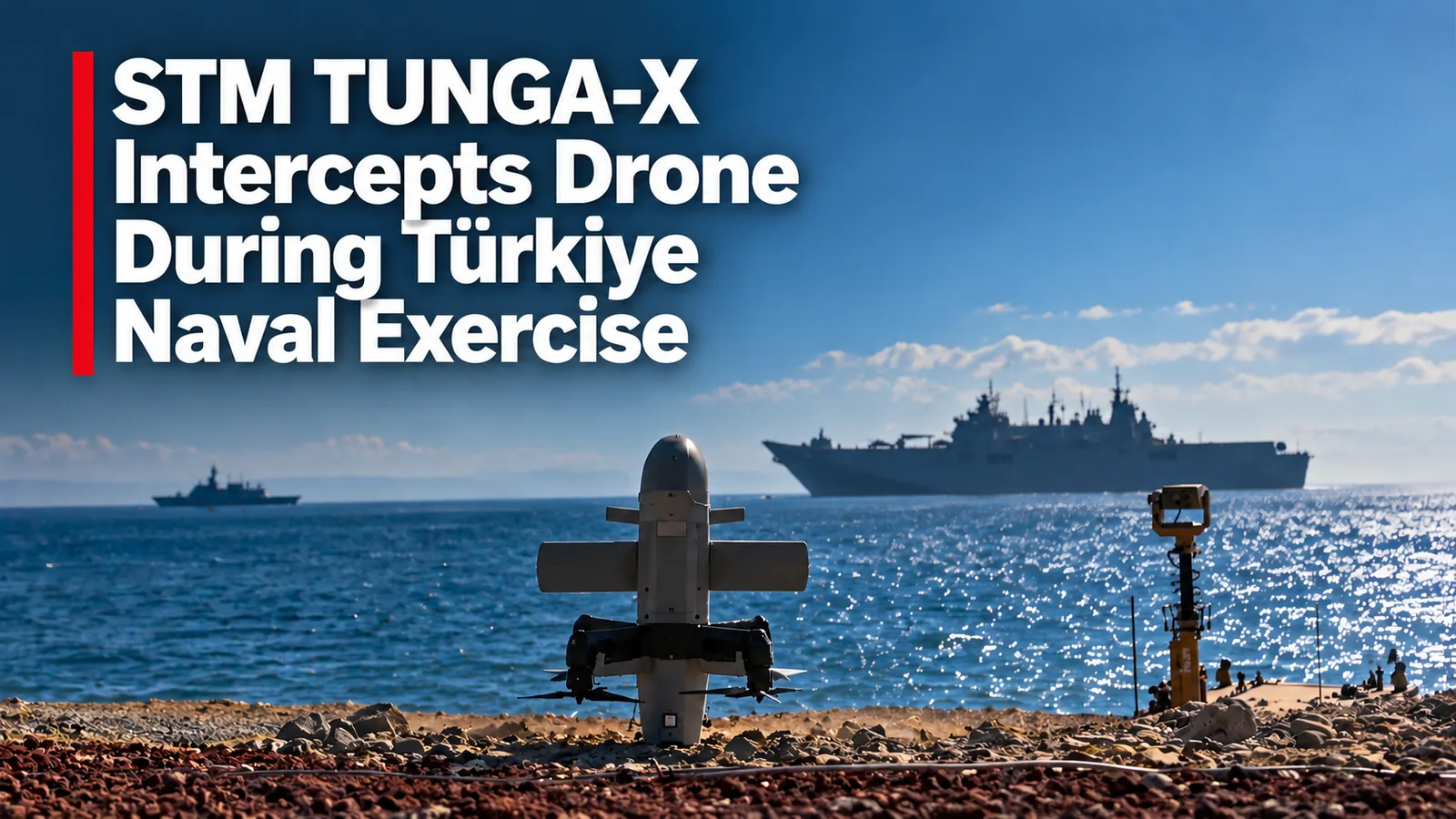
There is a wider interoperability question as well. STM’s TUNGA-X and TOGAN-NEST field-test programme illustrates a portfolio that includes counter-UAS and intelligence, surveillance and reconnaissance functions beyond expendable FPV aircraft. That portfolio breadth may help customers coordinate sensing, decision-making and engagement across different systems. However, no public evidence in the ALKAN announcement demonstrates a unified command-and-control integration with those platforms or confirms performance in a contested multi-system deployment. Capability overlap should not be confused with an accepted joint architecture.
The market rationale for fibre-optic FPV aircraft is closely connected to operational demand for systems able to function when radio navigation or control links are unreliable. Yet physical control links also introduce their own practical constraints and require evaluation in representative field conditions. There is no single solution that guarantees immunity to all threats or ensures a successful engagement across every terrain, weather and electronic-warfare situation. Users and programme managers will be interested in how the delivered configuration performs in realistic exercises, not solely in advertised maximum figures.
Another caution concerns the status of the reported customer. STM and AA’s English-language report both use the broad description Turkish security forces. Without an identified service branch or unit, it would be premature to assign the batch to the Turkish Land Forces, a specific gendarmerie formation or another organisation. Equally, STM’s statement that its wider unmanned-systems portfolio has reached customers in more than 15 countries does not establish an international export order for ALKAN FPV itself.
Implications / Next: The next verifiable programme milestones would include an identified receiving organisation, confirmed numbers delivered, a procurement or sustainment arrangement, subsequent acceptance batches and documented field evaluations of its RF and fibre-optic operating modes. Independent evidence of repeatability, maintenance performance, operator workload and electronic-warfare resilience would help determine the system’s practical value. As of 24 November 2026, the supported conclusion is narrower but significant: STM has completed the first ALKAN FPV acceptance and delivery milestone, with follow-on deliveries anticipated but not yet quantified publicly.
Further Reading
- STM — ALKAN FPV Enters Turkish Security Forces Inventory, 23 November 2026
- Anadolu Agency — Turkish STM Delivers First Batch of ALKAN Drones, 23 November 2026
- Joint Forces News — STM ALKAN FPV Enters Inventory, 23 November 2026
- STM — FPV Drone First Test Firing (previous KARGU FPV designation)
- STM — KARGU Rotary-Wing Loitering Munition Product Profile
- Defence Agenda — STM Demonstrates 20-Drone KARGU Swarm Strike
- Defence Agenda — STM Completes ALPAGU Loitering Munition Deliveries
- Defence Agenda — STM Validates TUNGA-X and TOGAN-NEST in Field Tests