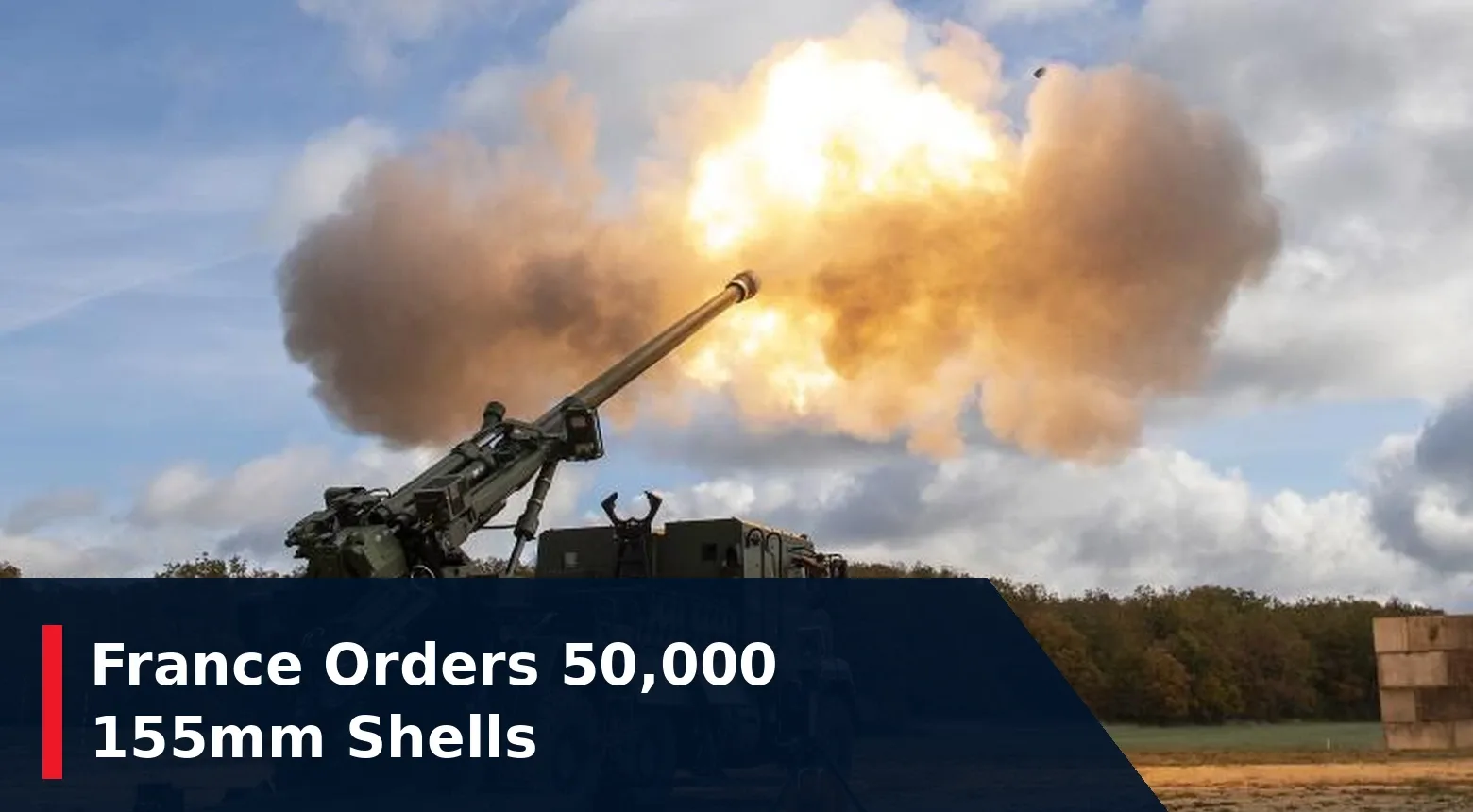
France has placed a new 50,000-round order for 155mm artillery shells with KNDS Ammo France while backing a substantial expansion of domestic ammunition manufacturing capacity. The French Directorate General of Armaments (DGA) placed the order on 12 November 2026 and disclosed the arrangement in a 19 November statement, subsequently published on its website on 20 November 2026. Deliveries are scheduled for 2029 and 2030, while the La Chapelle-Saint-Ursin plant is expected to increase its annual production capability from 60,000 to 150,000 shells by 2029. The development matters to European land forces because procurement commitments and industrial investment must progress together if governments are to replenish ammunition stocks and sustain high-intensity artillery operations.
France's 50,000-Round Order and 2029 Production Target
The French DGA announcement describes a double order in the sense of two linked measures: a commitment to expand production infrastructure and an accompanying purchase of 50,000 shells. It does not mean that a previously disclosed order for 50,000 rounds has been doubled to 100,000. KNDS independently confirmed the 50,000-round quantity and 2029–2030 delivery horizon in its 20 November 2026 announcement. Neither public statement provides the monetary value of the shell contract. Distinguishing the industrial investment from the ammunition purchase is therefore essential when assessing the scale of France's defence expenditure.
The industrial programme is concentrated at La Chapelle-Saint-Ursin, in the Cher department of central France, which has already been the focus of a post-2022 ammunition production ramp-up. The DGA reports that annual production capacity doubled from 30,000 shells in 2022 to 60,000 in 2025. Its new objective of 150,000 rounds per year by 2029 represents an increase of 90,000 rounds, or 150% above the 2025 baseline. The 2029 target would be five times the 2022 capacity. These figures describe rated annual capacity; they do not establish annual realised production, the number of shells presently in storage, or the exact number available for operational deployment.
The DGA says the planned transformation includes a new explosives-filling facility and two new large-calibre machining and driving-band production units. KNDS says the programme will be funded equally by the French state and the company. Although the two sides have committed to a shared investment model, the announcements do not disclose the amount each will pay, the value of the full industrial package, the financing milestones or a detailed factory commissioning schedule. The creation of additional equipment and production stages must still be followed by validation, staffing, process qualification and sustained output before the headline capacity can be treated as fully available.
According to the DGA's official statement, the time needed to manufacture a shell has been reduced by about 40%, from 21 months to 12 months, during the earlier production acceleration. This is a reported manufacturing lead-time change and should not be interpreted as the time required for each individual machining operation or as a contractual delivery guarantee for the new order. The difference between faster production lead times, rated factory capacity and accepted stock is important for military planners attempting to estimate replenishment cycles.
The new order is expected to strengthen the French Army's holdings of 155mm ammunition used by artillery systems including CAESAR. The Ministry highlights the calibre's relevance to France's self-propelled artillery, while KNDS links the expansion to rising demand among French forces and international partners. The 50,000 rounds scheduled for 2029–2030 are an identifiable procurement commitment, but they cannot automatically be counted as 50,000 additional shells available in 2026. The annual 150,000-round goal, in turn, is a factory capacity measure, not an additional French Army purchase of that quantity.
Industrial Capacity, European Demand and Procurement Risks
KNDS says the investment supports its ongoing recruitment campaign at the site, where it reports more than 150 skilled vacancies alongside an existing workforce of approximately 500 employees. The manufacturer also notes that the factory expansion has been classified under France's Major National Interest Project framework. Such measures may help accelerate industrial planning, but physical production capacity depends on maintaining qualified personnel, subcontracted inputs, approved processes and customer acceptance procedures over time. Hiring intentions should not be added to workforce totals as if all recruits had already joined.
France's arrangement comes within a wider European effort to rebuild artillery ammunition supply chains. Le Monde's industry reporting previously identified manufacturing constraints linked to growing defence orders, including pressure on suppliers and plant utilisation. These conditions provide context for the DGA's new decision, rather than evidence that this particular order has already overcome those constraints. Critical industrial issues include stable supplies of metal components, explosives and other inputs, production-line qualification, transportation, workforce retention, maintenance and sufficient testing capacity. These elements affect whether a nominal capacity target can translate into an enduring delivery rate.
One commercial advantage of combining a shell purchase with an industrial-capacity project is greater demand visibility. Suppliers may have more justification to invest in dedicated equipment and workforce expansion when procurement commitments extend several years ahead. The risk is that future orders, export demand and production capacity do not necessarily grow together. If the market for a particular ammunition configuration changes, or if investment runs late, a factory could face excess capacity, delayed deliveries or an altered product mix. The current official announcements do not identify any firm export customer within the 50,000-round French procurement.
Comparable programmes show how Europe's ammunition expansion is proceeding through different contractual structures. Defence Agenda has covered MKE's planned 155mm capacity expansion in Türkiye, a Rheinmetall order with 2027 deliveries and Poland–Türkiye ammunition industrial cooperation. These are distinct companies and projects; their reported percentages, quantities and delivery schedules cannot be aggregated into one verified European output figure without checking the definitions of capacity, complete rounds, shell bodies and deliveries. Procurement officers should also account for differences in projectile types, qualification requirements and national production frameworks.
The DGA says the new procurement and investment measures form part of an update to France's Military Programming Law (LPM). The relevant industrial outcome is whether the project strengthens the country's ability to deliver munitions at scale during sustained military demand. The facility expansion can potentially support both national stock replenishment and deliveries to partners, but the precise division of future output between domestic and external buyers has not been announced. It would be incorrect to infer a specific Ukrainian allocation or a new NATO procurement contract from the public release.
Implications / Next: The principal milestones now to monitor are the commissioning and qualification of the new filling and machining units, the progress of recruitment and supply-chain preparation, evidence of sustained annual output, and formal deliveries against the 2029–2030 shell order. Publication of a contract value, clearer public acceptance milestones or programme revisions would materially improve financial and schedule assessments. As of 24 November 2026, the DGA and KNDS have confirmed the 50,000-round order and planned rise to 150,000 rounds per year, not the completed achievement of that 2029 target.
Further Reading
- French DGA — 155mm double order and plant expansion, 20 November 2026
- KNDS — France orders 50,000 shells and expands La Chapelle-Saint-Ursin, 20 November 2026
- French Ministry of Armed Forces — Original press statement, 19 November 2026
- Le Monde — European defence industry production constraints, 13 March 2025
- French DGA — 2025 industrial and acquisition programme booklet
- Defence Agenda — MKE Plans 5,400% Increase in 155mm Ammunition Capacity
- Defence Agenda — Rheinmetall Wins New 155mm Ammunition Order for 2027 Delivery
- Defence Agenda — Poland and Türkiye Advance Ammunition Production Partnership