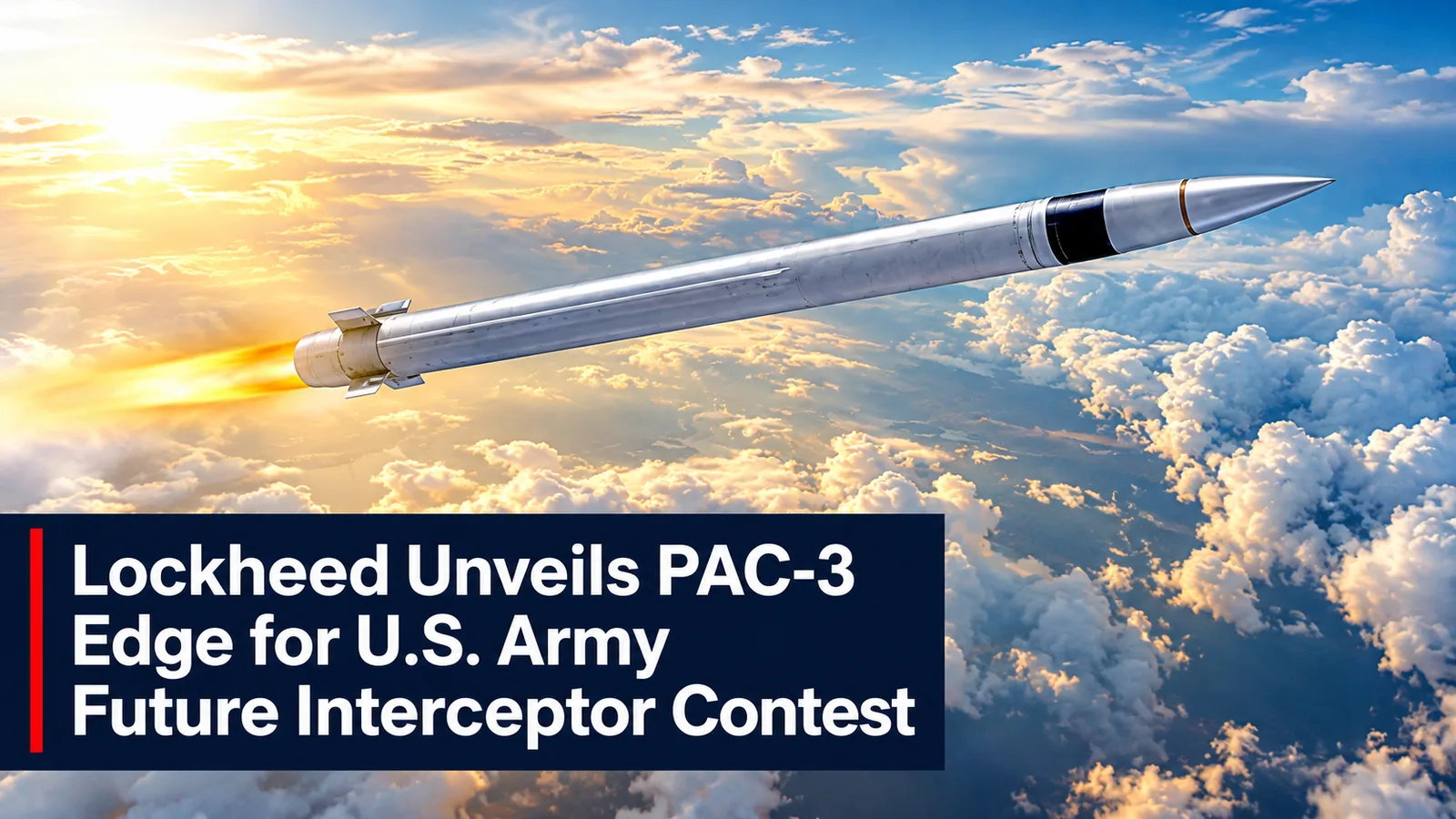
Lockheed Martin has unveiled PAC-3 Edge, its candidate for the U.S. Army’s competitive Future Interceptor programme. The company says the Army has advanced Lockheed Martin into the next stage of development, with testing planned from 2027 and a company objective of preparing the interceptor for rapid deployment by 2031.
PAC-3 Edge builds on the PAC-3 Missile Segment Enhancement lineage but introduces a new Lockheed Martin-built seeker, a multi-pulse solid rocket motor from Northrop Grumman and control-system upgrades intended to improve performance at greater range and altitude. The company is positioning the design against advanced air, missile and hypersonic threats.
Future Interceptor Is a Competitive Army Programme, Not a PAC-3 Edge Award
Lockheed Martin’s announcement is an important programme milestone, but it is not a production award or final Army selection. The company says the Army has moved its design into the next phase of the Future Interceptor competition. The programme remains competitive, and the public announcement does not identify the other participants, final acquisition structure or production quantities.
The Army’s FY2026 budget justification describes Future Interceptor as a lower-tier air and missile defence effort intended to improve velocity, altitude and manoeuvrability against current and emerging air, missile and hypersonic threats. The budget document also frames the effort as rapid prototyping and capability maturation, reinforcing that the programme remains in development rather than operational service.
PAC-3 Edge Reuses the PAC-3 Architecture but Changes Critical Subsystems
Lockheed Martin is deliberately building PAC-3 Edge from the PAC-3 family rather than proposing an entirely separate air-defence architecture. The company says the interceptor leverages PAC-3 MSE technology while introducing a new seeker, a new propulsion solution and control-system changes designed to extend engagement performance.
This derivative strategy could reduce integration risk because PAC-3 Edge is intended to work with existing and future Army Integrated Air and Missile Defense elements. Lockheed lists IBCS, the M903 launcher, containerized launchers and HIMARS Flex among the planned integration pathways. Compatibility claims remain design objectives until demonstrated through Army testing.
A New Lockheed Seeker Is Central to the Edge Architecture
The new seeker is being developed by Lockheed Martin through its Strigo Product Center. The company says it has invested $250 million in the centre to support advanced seeker technology and improved precision and manoeuvrability against increasingly complex threats.
The industrial significance is notable because current PAC-3 MSE seekers are supplied by Boeing. PAC-3 Edge therefore introduces a different seeker architecture and potentially a different supplier structure inside the PAC-3 family. That could create additional industrial flexibility, but qualification, test maturity and production scalability will determine whether the new seeker becomes an advantage in practice.
Northrop Grumman’s Multi-Pulse Motor Targets Greater Range and Altitude
PAC-3 Edge also replaces the current propulsion approach with a multi-pulse solid rocket motor designed by Northrop Grumman. Lockheed says the motor is intended to provide precision thrust throughout the interceptor’s flight and support higher-altitude and longer-range engagements.
The public release does not disclose motor dimensions, pulse timing, total impulse, maximum interceptor velocity or engagement envelope. Those omissions matter because the programme’s performance gains are currently described qualitatively rather than through independently verifiable range or altitude figures.
The 2031 Deployment Goal Is Aggressive but Fits the Army’s Rapid-Prototyping Approach
Lockheed Martin plans to begin PAC-3 Edge testing in 2027 and says it is preparing for rapid deployment by 2031. The Army budget justification supports an accelerated development philosophy, describing competitive industry contracts and total-effector rapid prototyping intended to deliver capability to the warfighter as quickly as possible.
Still, the 2031 milestone should be treated as a programme objective rather than a guaranteed fielding date. Flight testing, seeker and motor qualification, launcher integration, software certification, Army evaluation and production decisions all remain between the current development stage and an operational interceptor.
PAC-3 Edge Adds a High-End Layer Beside MSE and Lower-Cost ACE
Lockheed Martin is now presenting a broader PAC-3 family that includes the legacy PAC-3 CRI, the current PAC-3 MSE, the lower-cost PAC-3 ACE and the new PAC-3 Edge. This creates a portfolio logic in which different interceptors can be matched to different threat and cost tiers while sharing parts of the same fire-control and launcher ecosystem.
The distinction is important because PAC-3 Edge is not being marketed as a cheaper substitute for MSE. Reuters reported that Lockheed expects Edge production cost to be broadly comparable to PAC-3 MSE, while ACE is explicitly designed as the lower-cost effector in the family. Edge therefore occupies the high-performance end of the architecture, particularly for more demanding missile and hypersonic targets.
Production Scale Could Benefit From the Existing PAC-3 Expansion
Lockheed Martin is already expanding PAC-3 MSE annual capacity from roughly 600 to about 2,000 interceptors under a seven-year production framework. The company has also announced multibillion-dollar capital investments, new facilities and supplier expansion across its missile portfolio.
Breaking Defense reported that Lockheed intends to manufacture PAC-3 Edge on the existing PAC-3 line in Camden, Arkansas. If the Army selects the system, using an already expanding industrial base could reduce the need to create an entirely separate production enterprise, although the new seeker and motor will still require qualified supply chains and production maturity.
What Remains Unknown
Lockheed Martin has not disclosed PAC-3 Edge’s range, maximum altitude, velocity, unit cost, warhead or lethality architecture, test-article quantity or planned production quantity. The Army has also not publicly announced final selection, fielding quantities or a procurement value for the interceptor.
The most important next milestones are the start of flight testing in 2027, evidence that the seeker and multi-pulse motor meet Army performance requirements, and any down-select or acquisition decision within the Future Interceptor programme. Until then, PAC-3 Edge should be treated as an advanced competitive prototype rather than a future interceptor already selected for U.S. Army service.