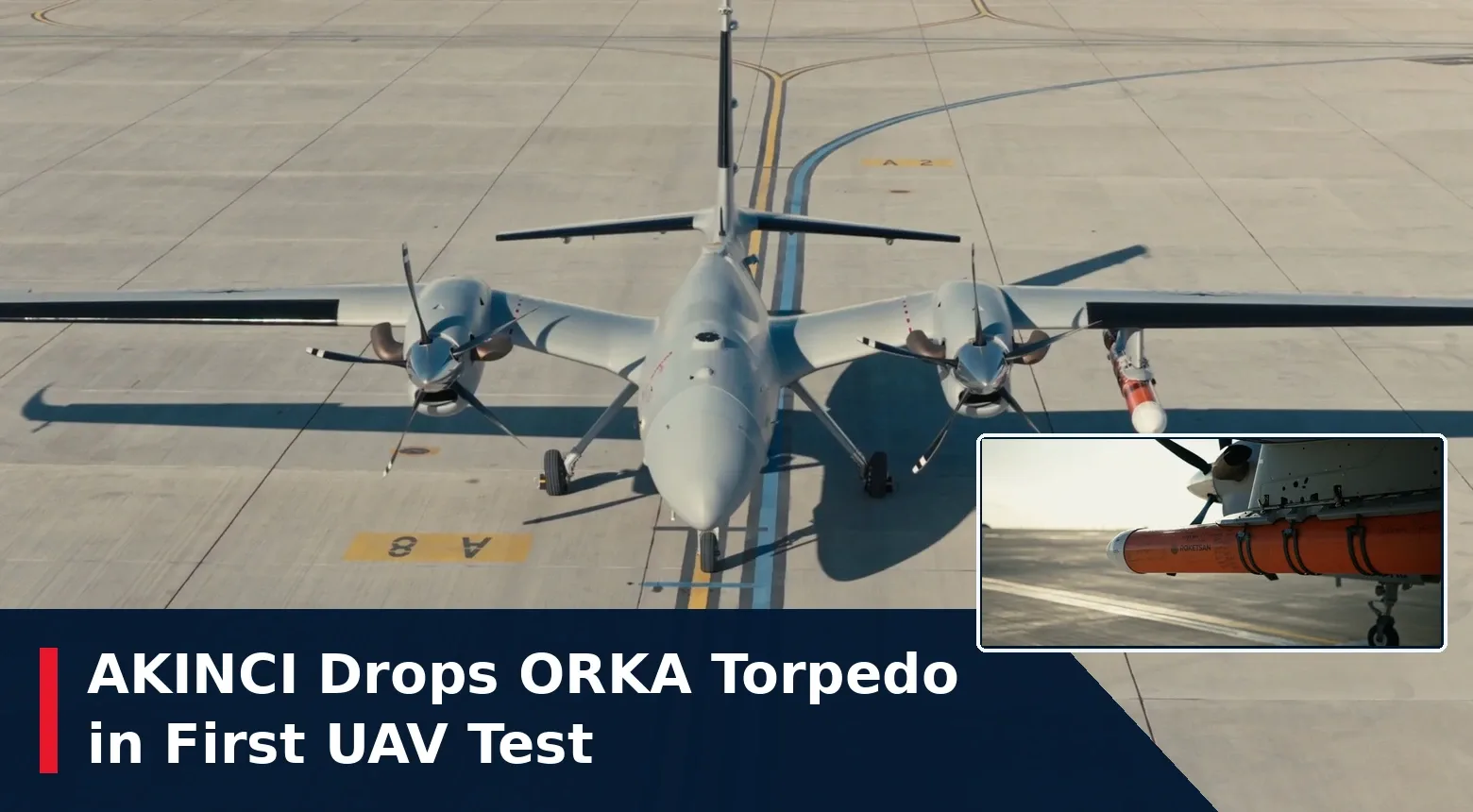
Bayraktar AKINCI has completed the first reported drop of ROKETSAN’s ORKA lightweight torpedo from an unmanned aircraft, marking a new test milestone in Türkiye’s development of remotely operated anti-submarine warfare capabilities. According to an Anadolu Agency report published on 22 November 2026, the AKINCI took off from Baykar’s Çorlu Flight Training and Test Centre in Tekirdağ, released ORKA over the Gulf of Saros and returned to base. The torpedo separated safely from the aircraft and entered the water at a designated location. The trial establishes an important airborne launch-integration result, but does not by itself establish a successful underwater target engagement, fleet-wide operational readiness or a procurement award.
AKINCI–ORKA Test Confirms Air Release and Water Entry
The Anadolu Agency report dated 22 November 2026 describes a planned flight from the Çorlu Flight Training and Test Centre to the Gulf of Saros in northwestern Türkiye. Baykar’s twin-turboprop AKINCI carried the torpedo beneath its wing, released it above the designated maritime area and returned to Çorlu after the test. Agency footage and photographs show the platform with an orange test article carried externally. The visible colour and markings should not be treated as proof of the configuration of a live-warhead round.
A follow-up English-language account published by Anadolu Agency on 23 November identifies this as the first drop of ORKA from an unmanned air platform. The statement is an important distinction from previous work on torpedo launch from manned aircraft and surface platforms. In the immediate test sequence, the supported observations are external carriage, separation, transition into the maritime environment and the carrier aircraft’s recovery. The account does not report a submarine target, an underwater intercept or the completion of the weapon’s full air-to-underwater qualification programme.
The engineering significance lies in handling a specialised weapon at the air–sea boundary. A lightweight torpedo is designed to operate underwater, whereas aircraft integration must accommodate aerodynamic loads, external-store separation and a controlled transition into the sea. Demonstrating that the store can be carried and released safely is therefore a necessary step towards an operational air-delivered anti-submarine capability. It is not equivalent to showing that the torpedo can acquire, classify and engage a moving submarine after entry into the water. Separate qualification evidence would be needed for those subsequent functions.
ROKETSAN’s current ORKA product specification describes a fully autonomous, lightweight anti-submarine torpedo with active/passive acoustic homing and internal guidance. The manufacturer lists a 15 km range, 2.85 m length, 275 mm diameter and 220 kg weight, with an insensitive high-explosive blast warhead as the stated product configuration. These are published product characteristics, not parameters measured or independently confirmed during the AKINCI release event. Public information does not identify the exact internal configuration of the orange test article shown in the supplied imagery.
The platform extension is notable because ORKA’s intended family of launch platforms already includes surface vessels and aircraft. The manufacturer also lists uncrewed air and surface vehicles among its possible launch platforms. However, a product page’s compatibility description should not be read as evidence of a deployed system on every listed platform. Publicly documented aircraft integration requires separate tests, acceptance activity and sustainment arrangements for the aircraft and weapon combination.
Naval Aviation Implications and Programme Milestones
The test expands the set of potential launch arrangements for Türkiye’s emerging maritime uncrewed-aircraft portfolio. A relevant complementary development was the Bayraktar TB3 sonobuoy launch from TCG Anadolu, which demonstrated deployment of equipment used to collect underwater acoustic information. Sonobuoy deployment and torpedo release are distinct tasks: the former supports the detection and localisation problem, while the latter addresses the delivery of a potential underwater effector. The November release does not establish that TB3 and AKINCI have already been connected in one operationally validated anti-submarine targeting network.
An operational anti-submarine warfare mission involves more than carrying an expendable weapon. It requires reliable acoustic data, contact classification, command approval, timely communications and an aircraft able to reach an appropriate engagement area. When separate uncrewed aircraft are proposed for sensing and weapon delivery, the practical question is how those functions are coordinated, protected from misleading data and supported during long deployments. The current public record provides no measured detection-to-engagement timeline, real submarine exercise result or certification statement covering such a networked mission.
AKINCI’s growing weapons portfolio provides relevant integration context. Baykar previously reported a first firing with the Morfoz Guidance Kit on 9 October 2026, while Defence Agenda has covered an AKINCI firing of the SUNGUR air-defence missile and guided engagements using LGK-82 and GÖZDE. These events show an aircraft being tested with weapons for differing roles. They do not remove the separate requirements for maritime target detection, torpedo separation and underwater engagement validation.
ROKETSAN has continued to present ORKA alongside its larger AKYA torpedo within its undersea portfolio, including at UDT 2026 in London. The distinction between a lightweight, air- or surface-launched torpedo and a heavyweight submarine-launched system matters for comparing missions, carriers and acquisition pathways. Defence Agenda’s AKYA–ORKA programme hub tracks those separate developments. The November AKINCI test is a platform-integration milestone in ORKA’s development, not a public announcement of mass delivery or a new customer order.
There is also a procurement and readiness dimension. A successful airborne release can reduce technical risk in a future integration programme, but production aircraft still require compatible support equipment, approved handling procedures, platform-specific training, maintained mission systems and the ability to sustain sorties. Without public details on qualification, inventory allocation, training stock, delivery quantities or an initial operational capability date, the financial and fleet-level impact of the test cannot yet be quantified.
The main counterargument to treating every aircraft integration as a decisive anti-submarine breakthrough is straightforward: a torpedo is useful only after an underwater target has been identified and the weapon can be delivered and employed within an effective engagement sequence. Surface combatants, helicopters and maritime patrol aircraft already serve complementary roles in anti-submarine operations. An uncrewed platform might expand persistence or provide different deployment options, but it must be assessed against the reliability, survivability, acoustic integration and logistics of those existing approaches. Publicly available footage does not settle that comparison.
Implications / Next: The next meaningful milestones would include documented underwater performance after air release, acoustic acquisition and homing evidence, aircraft/weapon qualification, repeatable trials across representative conditions and any formal procurement or operational acceptance announcement. As of 24 November 2026, the verified achievement is the first publicly reported ORKA drop from Bayraktar AKINCI, with safe separation and water entry over the Gulf of Saros. An underwater target hit, operational fielding date, signed contract value and new export customer have not been established by the cited reports.
Further Reading
- Anadolu Agency — Original Turkish report, 22 November 2026
- Anadolu Agency — English account, 23 November 2026
- ROKETSAN — ORKA current technical specifications
- ROKETSAN — Undersea portfolio at UDT 2026
- Defence Agenda — AKYA and ORKA torpedo programme hub
- Defence Agenda — TB3 sonobuoy trials from TCG Anadolu
- Defence Agenda — AKINCI and SUNGUR air-to-air test
- Defence Agenda — AKINCI LGK-82 and GÖZDE firing tests