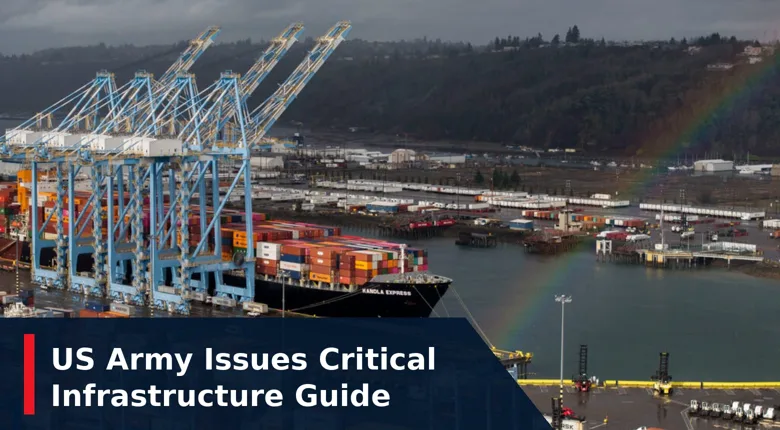
The US Army critical infrastructure guide, made available in November 2026, sets out a new framework for cooperation between military installations and the civilian organisations that keep them operating. The Defense Critical Infrastructure (DCI) Community Coordination Guide is intended for Army commanders, garrison staffs, local authorities, utilities and emergency responders, with an emphasis on agreements and shared planning before a cyberattack, physical disruption or natural disaster occurs. The development matters because essential services supporting troop readiness and force projection often extend outside an Army installation’s perimeter and are owned by commercial or municipal operators. The guide is a coordination resource, not a new procurement programme or an operational order authorising military control of civilian infrastructure.
US Army Guide Links Base Readiness to Civilian Infrastructure
The document was prepared by the Principal Cyber Advisor to the Secretary of the Army, in coordination with the Army Cyber Institute. Its full title is the Defense Critical Infrastructure Community Coordination Guide. The Army’s Principal Cyber Advisor webpage presents the guide alongside four supporting annexes and identifies utility operators, local government, law enforcement and emergency services as central partners. The release was also covered by Breaking Defense, which stressed that infrastructure needed for bases and military movement is frequently outside direct federal ownership. These sources establish the guide’s purpose, but they do not document new contracts or equipment purchases.
The Army explains that a post or base can depend on commercial electrical networks, municipal water systems, fuel logistics, fibre networks, rail and road connections, and externally operated emergency services. A failure in one network may propagate into others, disrupting functions that appear unrelated at first. The guide therefore asks installations and civilian stakeholders to map the services supporting mission-essential functions, identify ownership and responsibility, and understand which recovery priorities and communications channels apply. This is not a public inventory of the vulnerabilities of particular named installations.
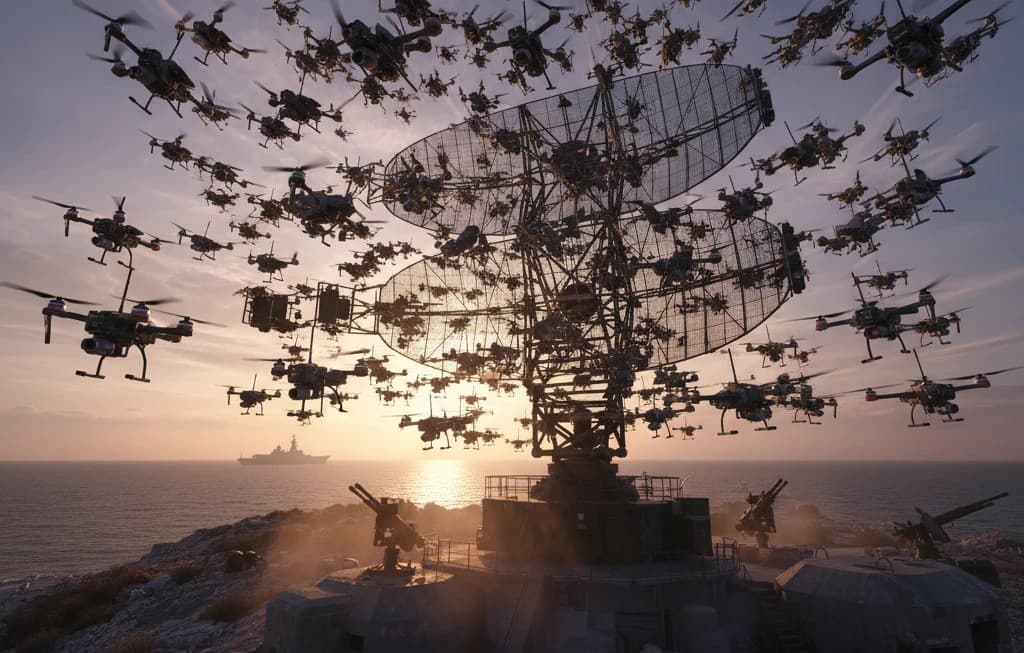
The guide addresses a broad set of hazards. Cyber incidents affecting operational technology can interrupt physical services; storms, fires and accidental cable damage can have similarly consequential effects. Small uncrewed aircraft and other physical threats are included in the wider risk environment. The Army calls attention to the interaction between cyber and physical dependencies rather than restricting the problem to a single protective technology. It also warns that cascading disruption can be more serious than the initial failure itself, particularly if several infrastructure sectors are already under stress.
Its five-step coordination sequence is deliberately practical: identify the relevant stakeholders; map infrastructure dependencies; establish relationships and forums; create a resilience plan; and exercise and validate that plan. Those steps aim to generate current contact arrangements, more realistic assumptions about service availability, formalised cooperation and opportunities to test how organisations communicate. The Army explicitly states that the publication is not a first-hour incident-response playbook. Established mechanisms, including the National Incident Management System and Incident Command System, remain applicable when incidents occur.
Four annexes support implementation. The Army lists Annex A: Resource Menu, Annex B: Integration Playbook, Annex C: Definitions, Acronyms, and Legal Authorities, and Annex D: Operation Silent Siege. The guide encourages local users to adapt templates and examples rather than apply identical arrangements to every base. This distinction is operationally important: a training installation, an aviation hub and an installation responsible for mobilising heavy equipment will have different dependencies, service thresholds and community counterparties.
The initiative follows earlier outreach. In a 15 May 2026 US Army report, the service described a Defense Critical Infrastructure Summit held at Fort Bragg on 14 May 2026. Participants included Army leaders, local officials, utility providers and federal agencies. Discussions focused on drone threats, cyber effects, force-projection dependencies and delayed information sharing. The new guide can be understood as an effort to make that coordination more repeatable at installation level; however, the Army has not publicly presented it as a funded rollout with fixed costs, compliance scores or completion deadlines for every site.
Resilience Planning, Industry Roles and Programme Risks
The procurement significance is indirect but material. Electricity suppliers, communications companies, water operators, ports, rail providers, engineering contractors and emergency-service organisations may be asked to participate in planning, agreements and resilience exercises. Possible investment needs include redundant service capacity, maintenance and restoration arrangements, better coordination platforms and staff training. These are potential categories of demand, not contracts attributable to the new guide. The document provides neither a nationwide programme value nor a requirement that every installation buy a new cyber-security or counter-drone product.
The Army’s framework is closely related to wider civilian infrastructure practice. The Cybersecurity and Infrastructure Security Agency’s Infrastructure Resilience Planning Framework provides methods for local and regional stakeholders to assess critical services, prepare for multiple hazards and understand dependencies across jurisdictions. That guidance supplies useful context rather than proof that the Army’s 2026 document creates new statutory powers. The Army guide itself notes that private utilities face customer, regulatory and commercial obligations, while military commanders operate under specific fiscal and legal authorities.
Formal agreements are therefore central. The publication discusses memorandums of agreement, memorandums of understanding and mutual-aid arrangements to clarify expectations before a crisis. A military installation cannot simply compel a private utility to restore its service first or use local command authority to bypass the established civilian emergency-management chain. The guide describes exceptional immediate-response authority as limited by applicable law. This creates a practical planning constraint: the most useful relationships are those negotiated and understood before an emergency rather than assumed during one.
A second constraint is information handling. Local stakeholders need enough visibility into service requirements to plan restoration, but operational details about military missions, facilities and sensitive dependencies cannot automatically be shared without restriction. The Army recommends a balanced approach, describing minimum operational needs at an appropriate level while preserving security. Similarly, infrastructure operators will need to define what information they can provide consistently and under what conditions. Trust, clear contacts and regular exercises may be more consequential than a new dashboard if those foundations are absent.
The guide’s broad resilience approach also differs from installation-specific force-protection acquisitions. Defence Agenda has reported on the US European Command’s vigilance campaign amid hybrid threats and reported strike damage affecting US-linked military sites in the Middle East. Those accounts concern separate threats and incidents; neither establishes that the new DCI guide was prompted by a specific attack or that it introduces a new military alert level. Likewise, initial purchases through a US counter-UAS marketplace are a distinct acquisition initiative rather than a contract associated with the guide.
For defence programme managers, the central measure of effectiveness will not be the publication of the document alone. Better indicators would include verified partner contact procedures, updated cross-agency agreements, completed and regularly reviewed dependency assessments, joint exercises and the closure of identified planning gaps. These indicators should be assessed without publishing site-specific vulnerabilities or sensitive infrastructure maps. The Army document does not include a nationwide quantitative baseline that could demonstrate an immediate reduction in disruptions or prove increased military readiness across all installations.
There are competing implementation risks. Local partnerships can become administrative exercises that generate paperwork without improving response performance. Conversely, highly detailed central requirements can exceed the capacity of small municipalities or local utilities and may duplicate existing emergency-management processes. The guide acknowledges these differences, describing its framework as adaptable and emphasising relationship-building rather than a rigid uniform standard. Success will depend on sustained participation, realistic rehearsals and clear ownership of actions between civilian and military partners.
Implications / Next: Army installation leaders and community partners can use the published guide and its annexes to review existing responsibilities, align resilience assumptions and test coordination in advance of disruption. The next verifiable developments would be documented local adoption, public exercise findings, updated cooperation agreements and any separately announced funding or acquisition measures. As of 23 November 2026, the public record supports the publication of the coordination guide and its planning objectives; it does not establish newly awarded defence infrastructure contracts, universal compliance requirements or measurable operational improvements resulting from the guide.
Further Reading
- US Army — Defense Critical Infrastructure Community Coordination Guide (PDF)
- US Army — Office of the Principal Cyber Advisor
- US Army — Defense Critical Infrastructure Summit, 15 May 2026
- Breaking Defense — Army publishes guidebook for local installations
- CISA — Infrastructure Resilience Planning Framework
- Defence Agenda — EUCOM vigilance campaign and hybrid threats
- Defence Agenda — Iran strikes damage US military-linked sites
- Defence Agenda — US counter-UAS marketplace first purchases