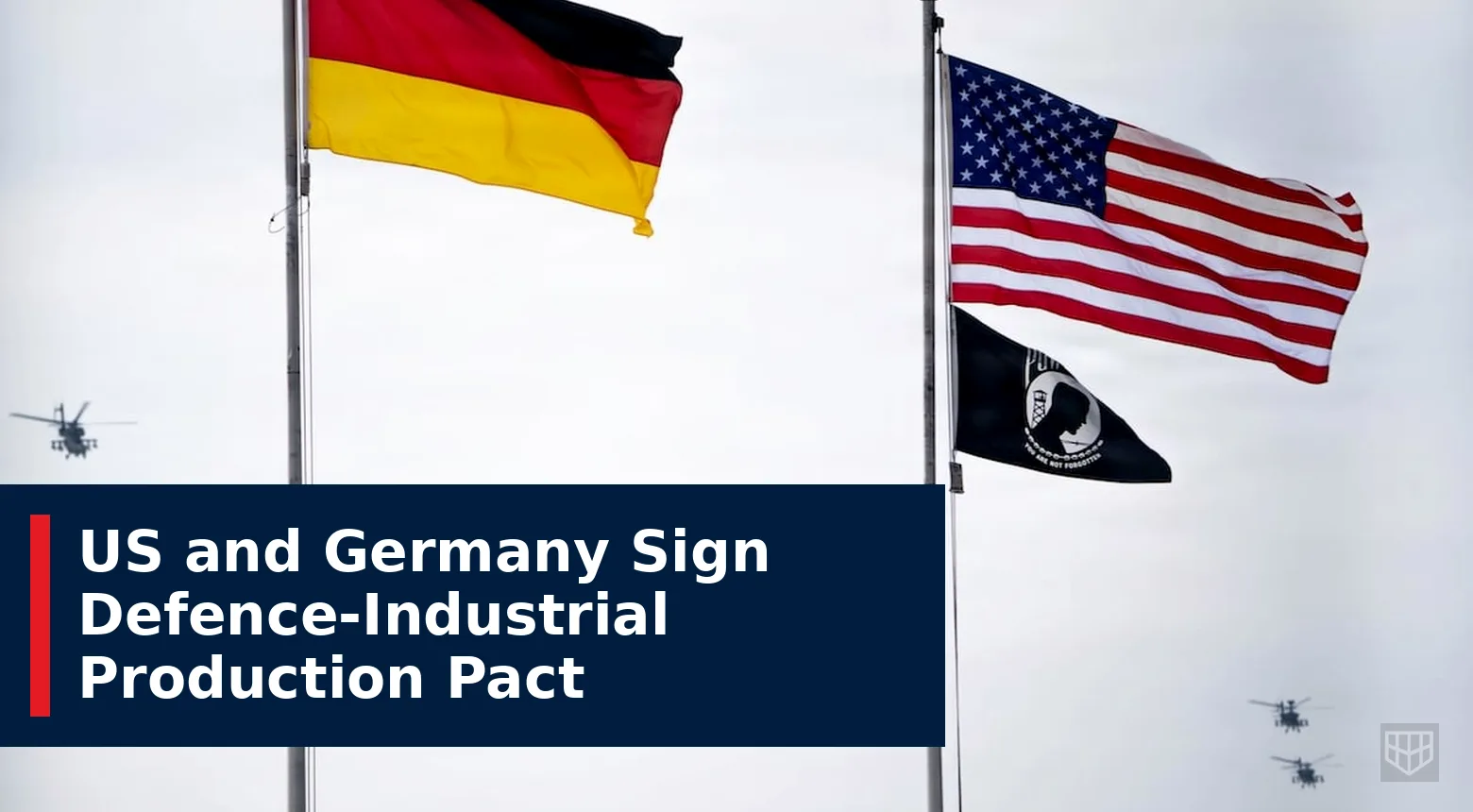
Washington and Berlin have signed a Statement of Intent to expand joint weapons production, licensed manufacturing and defence sustainment.
A framework for joint production
The United States and Germany have signed a Statement of Intent aimed at expanding defence-industrial cooperation between the two countries. US Secretary of War Pete Hegseth and German Defence Minister Boris Pistorius signed the document in Washington on 15 September 2026. Their public remarks placed joint development, production, licensed manufacturing, maintenance and sustainment within the scope of the initiative, with NATO supply capacity presented as the strategic objective.
The instrument should be described carefully. A Statement of Intent records political direction and areas for cooperation; it is not a purchase order, a binding production contract or evidence that a named weapon will be built in a particular factory. No programme list, delivery quantity, investment schedule or division of industrial work was released with the signing. Those details will require separate government decisions and commercial agreements.
Aligning acquisition reform
The two governments linked the pact to changes in their acquisition systems. Hegseth said the United States wants to align its acquisition transformation with Germany’s Procurement Acceleration Act and its Security and Defence Industrial Strategy. The intended result is a more responsive transatlantic market in which requirements, licensing and sustainment arrangements can be addressed earlier rather than after a crisis has exposed a shortage.
That ambition reflects a wider NATO problem. European and North American forces often operate common or closely related systems, yet national contracting rules, export controls, security requirements and certification processes can slow cross-border production. A framework that allows designs, components and maintenance work to move through approved channels could improve resilience, but only if the policy language is translated into repeatable procurement mechanisms.
Germany’s investment signal
Pistorius used the meeting to emphasise the scale of Germany’s defence build-up. He said German defence spending had reached about $147 billion, roughly 25 per cent above the 2025 level, and referred to around $50 billion in purchases and investments in the United States. He also identified approximately €35 billion for space capabilities. These were ministerial disclosures rather than new awards announced by the Statement of Intent.
The figures matter because industrial cooperation needs demand that is large and durable enough to support tooling, workforce expansion and additional suppliers. Germany can offer a major European customer, established manufacturers and maintenance infrastructure; the United States brings large programmes and production networks. The challenge is to distribute work in a way that adds capacity instead of simply shifting existing orders between plants.
What implementation will require
The next evidence should come at programme level. Useful indicators would include co-production licences, government-to-government agreements, qualified German or US second sources, common technical standards and contracts that identify where final assembly or component manufacture will occur. Changes in lead time, annual output and repair turnaround would show whether the pact is creating operationally relevant capacity.
Export policy will remain a constraint. Licensed production can still depend on approvals for controlled technology, re-export and third-country sales. Intellectual-property terms and access to technical data may determine whether a partner can perform meaningful manufacture and sustainment or only a narrow assembly task. Workforce availability, energetic-material supply and long-lead electronics are further practical limits that a political declaration cannot remove on its own.
The signing is therefore a consequential policy milestone, but not the end state. It establishes a bilateral route for matching US acquisition reform with German industrial expansion and provides senior-level backing for joint work. Its success will be visible when specific programmes gain funded orders, additional production lines and measurable improvements in delivery and readiness. Until then, the correct maturity label is an enabling defence-industrial framework.