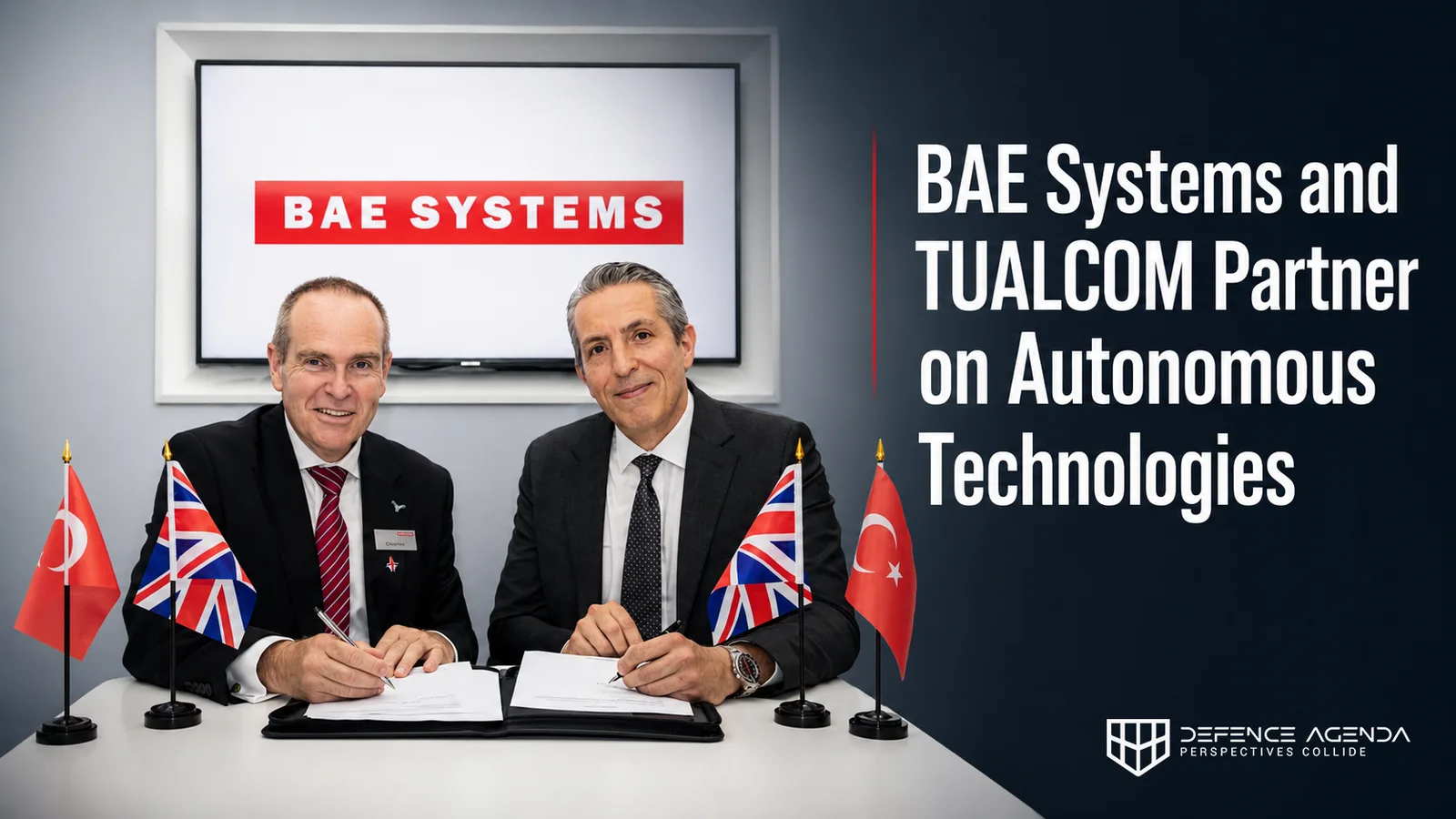
BAE Systems TUALCOM autonomy collaboration will bring together British combat-air and autonomous-systems expertise with Türkiye-based TUALCOM’s capabilities in resilient navigation, secure communications and radio-frequency technologies for future autonomous applications.
BAE Systems announced the collaboration as defence companies increasingly focus on autonomous platforms that can continue operating when satellite navigation, communications and other elements of the electromagnetic environment are disrupted.
The strategic relevance goes beyond adding another supplier to an unmanned platform. Modern military autonomy increasingly depends on resilient positioning, secure data exchange and electronic-warfare awareness. These are precisely the technology layers that determine whether an autonomous system can continue its mission when GPS is jammed or communication links become unreliable.
Key Facts
- Companies: BAE Systems and Türkiye-based TUALCOM.
- Focus: Collaboration on autonomous technologies.
- BAE Systems capability: Autonomous mission systems, uncrewed air systems, combat-air integration and collaborative autonomy.
- TUALCOM capability: GNSS anti-jamming, resilient positioning and navigation, secure data links, telemetry and electronic warfare technologies.
- Operational driver: Autonomous platforms increasingly need to operate in GPS-denied and electronically contested environments.
- Industrial significance: The agreement adds another UK–Türkiye technology link in advanced combat-air and uncrewed-system development.
- Status: The announcement establishes a technology collaboration; the sources used for this article do not confirm a specific jointly developed operational platform or procurement award.
BAE Systems TUALCOM Autonomy Collaboration Links Complementary Capabilities
The partnership brings together two different but increasingly connected parts of the autonomous-systems technology stack.
BAE Systems has been expanding its work in uncrewed aircraft, mission autonomy, collaborative combat aircraft and artificial intelligence. Its FalconWorks advanced research organisation has become a central part of that effort, working with large defence companies, specialist technology firms and smaller suppliers to accelerate future combat-air capabilities.
TUALCOM approaches the autonomy problem from the RF and communications layer.
The Ankara-based company develops electronic warfare systems, GPS/GNSS anti-jamming equipment, data links, telemetry products and other RF technologies used across aerospace and defence applications.
Those capabilities are increasingly important because autonomy cannot depend on uninterrupted satellite navigation or a permanent command link.
GPS-Denied Operations Are Becoming a Core Autonomy Requirement
One of the most important lessons from recent conflicts is that GNSS cannot be treated as continuously available.
Electronic warfare systems can jam satellite-navigation signals over significant areas. Spoofing can create another problem by feeding a receiver misleading positioning information rather than simply denying the signal.
BAE Systems has itself identified GPS denial and disrupted communications as fundamental challenges for future autonomous systems.
In a February 2026 assessment of battlefield autonomy, the company argued that unmanned systems need resilient navigation and robust autonomous decision-making if they are to continue operating when electronic warfare disrupts conventional control and navigation methods.
This makes resilient positioning, navigation and timing a core enabling technology rather than a secondary subsystem.
TUALCOM Brings a Broad Anti-Jamming Portfolio
TUALCOM has built a substantial product portfolio around GNSS resilience.
The company’s TUALAJ family combines controlled reception pattern antenna technology and anti-jamming processing for defence platforms exposed to GNSS interference.
TUALCOM describes its portfolio as covering GPS/GNSS anti-jamming, electronic warfare, telemetry, data links and RF systems, with products designed for integration across different platform classes.
Compact size, weight and power are particularly important for autonomous systems because smaller UAVs have limited payload, electrical power and internal volume.
A resilient navigation system that requires a large antenna array or heavy processing package may be suitable for a major aircraft but impractical for smaller attritable systems. Miniaturisation therefore directly affects how broadly anti-jamming capability can be distributed across an unmanned force.
Secure Data Links Are the Second Part of the Problem
Navigation resilience alone does not create an effective autonomous platform.
Uncrewed systems also need secure communications for command, intelligence exchange, mission updates and coordination with other platforms.
TUALCOM develops L-, S- and C-band data-link systems, including mesh-network architectures designed for airborne platforms and UAVs.
The company’s S-band TDMA mesh architecture supports point-to-point and point-to-multipoint communication and can provide relay functions through self-forming and self-healing network structures.
This type of architecture is relevant to collaborative autonomy because future uncrewed forces may operate as distributed networks rather than individual remotely piloted aircraft connected directly to one ground station.
Autonomy Reduces Dependence on the Communications Link
The long-term objective is not to make military data links impossible to disrupt. It is to reduce the operational consequences when disruption occurs.
A remotely piloted aircraft that loses its command link may be forced to abort, return to base or follow a limited predefined procedure.
A more autonomous platform can potentially continue executing approved mission objectives, navigate around threats, coordinate with other platforms and adapt to environmental changes while remaining within defined human-authorised boundaries.
This is the connection between communications resilience and autonomy: better autonomy reduces dependence on constant connectivity, while resilient communications improve the information available to the autonomous system when connectivity exists.
BAE Systems Is Building a Wider Autonomous Air Portfolio
The agreement with TUALCOM comes during a significant expansion of BAE Systems’ uncrewed-air activities.
Through FalconWorks, BAE Systems has established multiple industrial collaborations focused on autonomous and uncrewed air systems.
The company has agreements with Lockheed Martin Skunk Works, QinetiQ, SURVICE Engineering and Turkish Aerospace, among others, covering different areas of autonomous airpower.
FalconWorks says it now works with more than 60 industry and academic partners as it develops affordable and adaptable uncrewed-air capabilities.
The addition of an RF specialist such as TUALCOM therefore strengthens the enabling-technology side of this wider ecosystem.
Brontanax Shows Where BAE Systems Is Heading
BAE Systems provided a visible indication of its autonomous combat-air direction at the Farnborough International Airshow in July 2026 when it unveiled Brontanax, the UK’s first British-designed autonomous Collaborative Combat Aircraft.
The aircraft is intended to complement crewed combat aircraft and provide additional combat mass at lower cost.
BAE Systems identifies electronic warfare and precision strike against air and ground targets among the intended mission areas.
The TUALCOM collaboration should not be interpreted as confirmation that its products will be integrated into Brontanax. No such integration is established by the sources used for this article.
However, platforms in this category illustrate why resilient PNT, communications and electromagnetic-spectrum technologies are increasingly important to future autonomous combat-air architectures.
Türkiye Is Becoming More Embedded in BAE Systems’ Autonomy Network
The TUALCOM agreement also has a wider UK–Türkiye industrial dimension.
BAE Systems and Turkish Aerospace signed a memorandum of understanding on 6 November 2025 to explore collaboration on uncrewed air systems.
The agreement brought together Turkish Aerospace’s existing unmanned-aircraft portfolio with BAE Systems’ combat-air and autonomy expertise.
The TUALCOM announcement adds another Turkish company to BAE Systems’ expanding advanced-technology network, but at a different point in the value chain.
Rather than focusing primarily on the air vehicle, TUALCOM contributes technologies associated with navigation, communications and the electromagnetic spectrum.
The Partnership Reflects a Shift From Platforms to Technology Ecosystems
The structure of these partnerships reflects an important change in defence procurement.
Autonomous combat capability increasingly depends on a network of specialised technologies rather than one vertically integrated platform manufacturer.
Airframes, propulsion, sensors, autonomy software, data links, electronic warfare, navigation, weapons and mission-management systems can all evolve at different speeds.
Large defence primes are therefore building ecosystems that allow specialist technology companies to contribute individual layers to a wider mission architecture.
For smaller companies, this creates access to major international programmes without requiring them to design a complete aircraft or weapon system.
Electronic Warfare and Autonomy Are Converging
The partnership also sits at the intersection of two rapidly converging defence technology areas: electronic warfare and artificial intelligence-enabled autonomy.
Electronic warfare was historically treated mainly as a way to detect, deceive or disrupt hostile emitters.
For autonomous systems, the electromagnetic environment becomes part of the navigation and decision problem itself.
A platform may need to recognise that GPS has become unreliable, determine whether a data link is being jammed, switch navigation modes and adapt its behaviour without waiting for a remote pilot to intervene.
BAE Systems has described this relationship directly in its work on AI-enabled electromagnetic warfare, arguing that autonomy can help uncrewed platforms continue missions when communications signals are denied.
Resilient Navigation Is Also Becoming a U.S. Priority
The wider market for resilient navigation is expanding beyond autonomous aircraft.
On 17 July 2026, the U.S. Air Force Life Cycle Management Center announced agreements with BAE Systems and Trimble Military and Advanced Systems for development work on the next-generation Maritime and Aviation Receiver Card.
The effort is intended to provide maritime and aviation platforms with more resilient military GPS capabilities in contested environments.
This is separate from the TUALCOM collaboration, but it demonstrates why resilient PNT has become a strategic investment area across Western defence programmes.
Smaller Autonomous Platforms Increase the SWaP Challenge
One area where TUALCOM’s portfolio could be particularly relevant is size, weight and power optimisation.
Large combat aircraft can carry sophisticated navigation, EW and communications suites. Smaller uncrewed systems face much tighter limits.
Every additional antenna, processor and power requirement competes with fuel, payload and endurance.
TUALCOM markets several of its RF and anti-jamming systems specifically around compact dimensions and low SWaP, including solutions intended for UAV applications.
That design philosophy aligns with a defence market increasingly interested in smaller, cheaper and more numerous autonomous systems.
The Main Opportunity Is Resilient Collaborative Autonomy
The most strategically valuable outcome would be a stronger architecture for collaborative autonomous operations in electronically contested environments.
Future crewed and uncrewed aircraft will need to exchange information while also retaining enough local autonomy to continue functioning when that network is degraded.
That requires several technologies to work together: resilient navigation, protected communications, electronic-warfare awareness, onboard processing and mission autonomy.
BAE Systems and TUALCOM occupy complementary positions within that architecture.
The Main Risk Is Integration Complexity
The main challenge will be systems integration.
A high-performance anti-jamming receiver or secure data link only creates operational value when it can be integrated with the aircraft’s mission computer, navigation architecture, autonomy software and command network.
Different security requirements, software interfaces, certification standards and export-control regimes can slow integration even when the underlying technologies are mature.
Future progress should therefore be measured by demonstrations and platform-level integration rather than collaboration announcements alone.
Implications / Next
The first milestone to watch will be whether BAE Systems and TUALCOM identify a specific technology demonstrator or platform for their collaboration.
A second indicator will be the technical scope. Anti-jamming GNSS, alternative navigation, data links and electronic warfare are all areas in which TUALCOM has existing products, but the exact workshare of the new collaboration will depend on future programme decisions.
A third question is whether the cooperation remains bilateral technology development or becomes connected to a funded UK, Turkish or third-country programme.
The broader direction is already visible. BAE Systems is assembling a network of autonomy and UAS partners, while TUALCOM is expanding the international reach of Türkiye’s specialised RF and resilient-navigation technologies.
If the partnership progresses into integrated demonstrations, it could become another example of Türkiye’s defence industry entering major Western programmes through specialised subsystem technologies rather than complete-platform exports alone.
Conclusion
The BAE Systems TUALCOM autonomy collaboration highlights a central challenge in future unmanned warfare: autonomy is only useful if the platform can continue navigating, communicating and making decisions under electronic attack.
BAE Systems brings a growing portfolio of mission autonomy, combat-air integration and uncrewed systems. TUALCOM brings specialised expertise in anti-jamming GNSS, RF systems, data links, telemetry and electronic warfare.
The combination is strategically logical because future autonomous aircraft will operate in precisely the environments where conventional navigation and communications are most likely to be challenged.
The next test will be whether the partnership moves from a collaboration framework into integrated hardware, software and flight demonstrations.
For further Defence Agenda coverage, read our unmanned systems, defence technology and defence industry sections. Related coverage includes Baykar K2 swarm and GNSS-denied navigation tests, Bayraktar Kızılelma and collaborative combat-air capability and Türkiye–European cooperation through Baykar Leonardo LBA Systems.
Further Reading
- BAE Systems: BAE Systems and TUALCOM to collaborate on autonomous technologies
- TUALCOM: RF, GNSS anti-jamming, data link and electronic warfare technologies
- BAE Systems: Autonomy is changing the shape of future warfare
- BAE Systems: Collaboration with Turkish Aerospace on uncrewed air systems
- U.S. Air Force: Next-generation resilient military GPS receiver programme
- Defence Agenda: Baykar K2 Kamikaze UAV Debuts in Swarm Tests
- Defence Agenda: Bayraktar Kızılelma Proves Strike Capability
- Defence Agenda: Baykar Leonardo Partnership Strengthens European Defence Cooperation