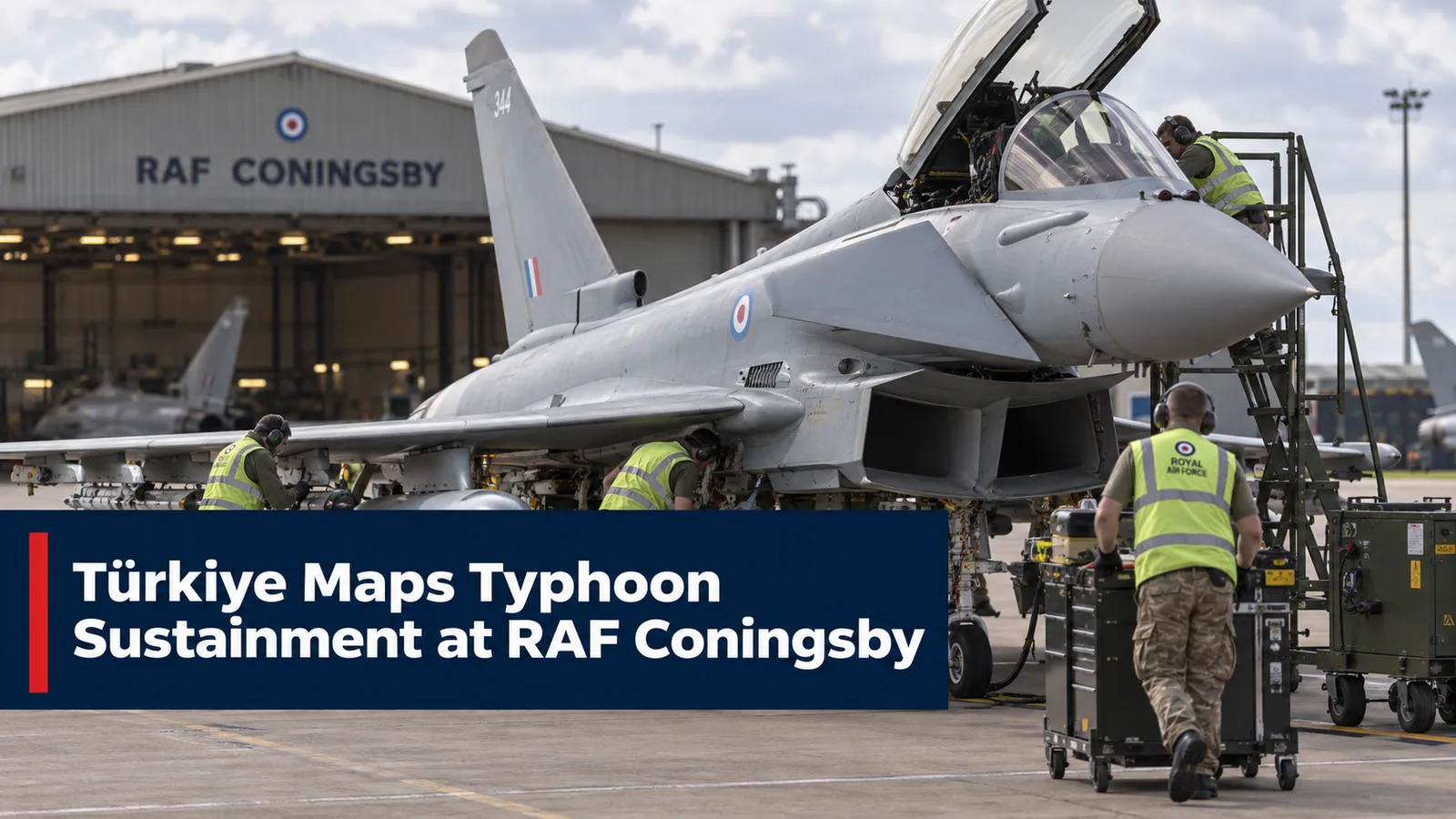
Turkish defence specialists inspected Royal Air Force maintenance facilities at RAF Coningsby from 15 to 17 September 2026 as Türkiye continued preparations for the introduction of Eurofighter Typhoon. The visit is a sustainment milestone rather than a delivery event: it indicates that the bilateral programme is moving into the practical work of understanding maintenance processes, infrastructure requirements and the support model needed to operate the fighter fleet.
Coningsby visit moves the programme into sustainment planning
The Turkish Ministry of National Defence said a delegation visited RAF Coningsby in England, where the Royal Air Force operates Typhoon. Reporting on the visit said the group included personnel from the ministry, the Turkish Air Force maintenance community and the General Directorate of Military Factories. The purpose was to examine aircraft-maintenance facilities and support practices as work continues on Türkiye’s Typhoon acquisition.
That distinction is important. An inspection of an operational RAF base does not mean Turkish aircraft have been delivered, accepted or fielded. It is a preparatory activity that can inform hangar design, ground-support equipment, maintenance workflows, training requirements and the interfaces between Turkish organisations and the British industrial support chain. These are often less visible than the aircraft contract itself, but they directly affect fleet availability after entry into service.
Training and support are already part of the bilateral deal
The United Kingdom announced on 25 March 2026 that the two countries had signed a multi-billion-pound training and support agreement linked to the Typhoon export deal reached in October 2025. The UK Ministry of Defence said Turkish pilots and technicians would be trained in the United Kingdom and that the package included long-term maintenance support for the Turkish Air Force. The British government also linked the export programme to the sustainment of approximately 20,000 UK jobs.
RAF Coningsby is therefore a logical location for technical familiarisation because it is one of the RAF’s principal Typhoon operating bases and contains mature maintenance experience. For Türkiye, the immediate task is not simply to copy an RAF support model. The more consequential question is how training, spares, technical support, depot work and national maintenance capacity will be divided over time, particularly as the Turkish Air Force seeks to maintain operational control of its fleet and integrate Typhoon alongside F-16s and future KAAN aircraft.
Sustainment will determine the value of the acquisition
Modern fighter availability is constrained by far more than the number of airframes purchased. Engine support, avionics repair, software configuration, test equipment, trained maintainers, spares holdings and infrastructure capacity all influence how many aircraft can be generated for operations. Early planning at Coningsby can reduce the risk of discovering support gaps only after the first aircraft arrive.
The Typhoon programme also creates an industrial question for Türkiye. Public statements confirm UK training and long-term support, but they do not yet disclose a complete workshare for Turkish depots or industry. Any later agreement covering deeper maintenance, local repair capability, component support or technology transfer would therefore represent a separate programme milestone and should not be assumed from the Coningsby visit alone.
Implications / Next
The next indicators to watch are the formal training sequence for Turkish pilots and ground personnel, infrastructure preparations in Türkiye, the allocation of maintenance responsibilities and any disclosed schedule for aircraft handover. Each will show how the acquisition is progressing from contract execution toward an operational support system.
Until those steps are confirmed, the Coningsby inspection should be described precisely as sustainment preparation. It strengthens the implementation pathway for Türkiye’s Typhoon fleet, but it is not evidence of aircraft delivery, operational acceptance or initial operational capability.
The support architecture also has a sequencing dimension. Training personnel, preparing facilities and defining maintenance authority must advance before the fleet is expected to generate routine sorties, otherwise aircraft can arrive faster than the support system can absorb them. For programme offices, the Coningsby visit is useful precisely because it brings maintainers and infrastructure stakeholders into the acquisition cycle early. Public reporting still leaves several details open, including the depth of depot-level work to be performed in Türkiye, the long-term spares model and how national industry will participate beyond the initial UK-backed support package.