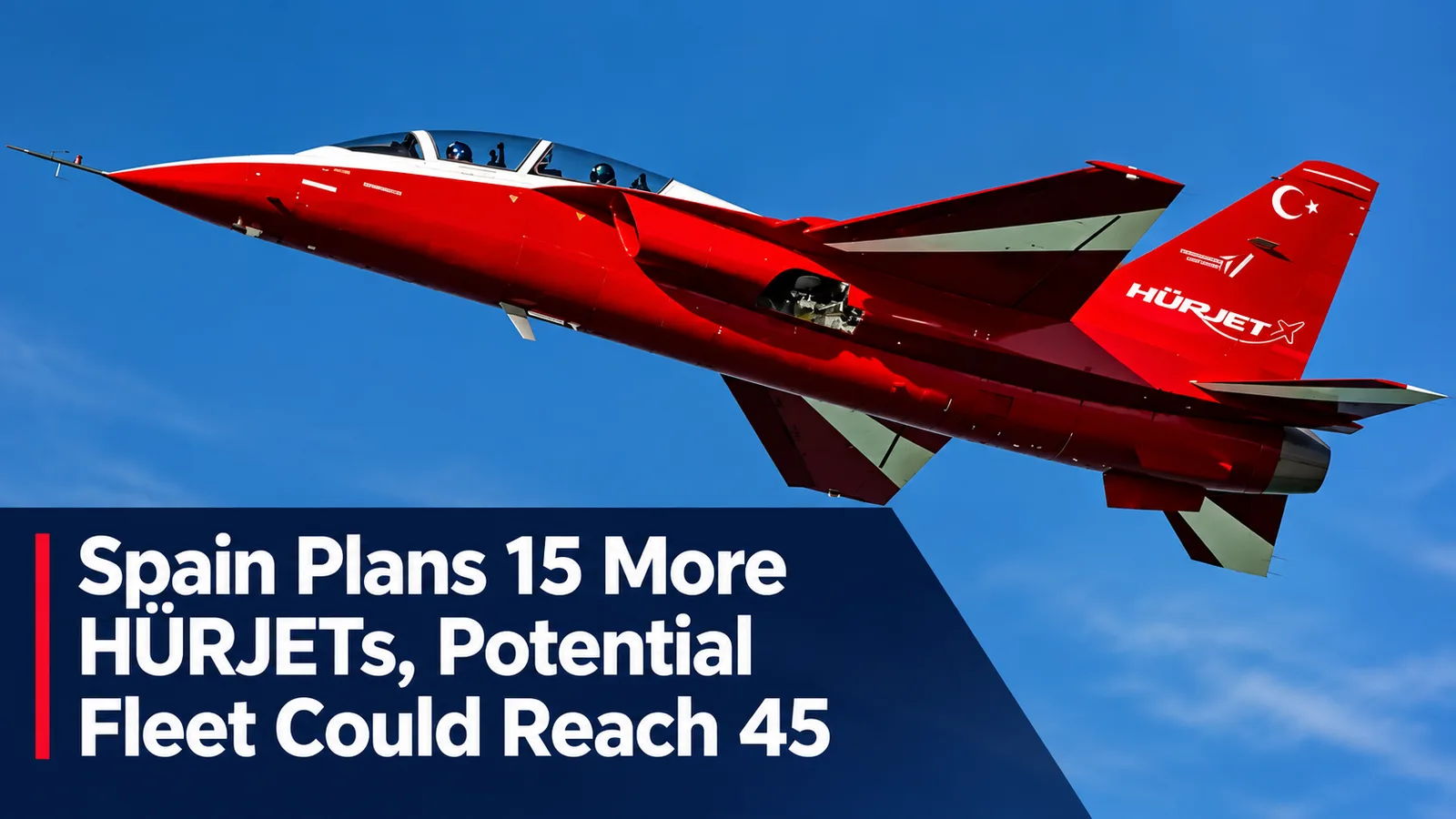
Spain is planning a potential follow-on acquisition of 15 additional HÜRJET advanced jet trainers, according to Turkish Aerospace CEO Mehmet Demiroğlu. Spain already has a confirmed 30-aircraft HÜRJET-based programme under its Integrated Combat Training System, meaning a follow-on order would increase the planned fleet to 45 aircraft.
Demiroğlu said Spain is working toward additional aircraft even before deliveries of the first 30 have begun. Turkish Aerospace is targeting the start of deliveries to Spain in 2028.
The Current Contract Covers 30 Aircraft — Not 45
The most important procurement distinction is that Spain’s existing programme covers 30 HÜRJET aircraft. Airbus officially confirmed the 30-aircraft fleet as part of Spain’s Integrated Combat Training System, or ITS-C, with the aircraft designated nationally as SAETA II.
The additional 15 aircraft described by Demiroğlu remain a planned follow-on acquisition. No separate contract for those aircraft has been publicly announced. The potential 45-aircraft figure should therefore be treated as a future fleet scenario rather than a firm contracted quantity.
A Follow-On Order Would Expand the Programme by 50%
If Spain proceeds with all 15 additional aircraft, the fleet would rise from 30 to 45 — a 50% increase over the current contracted aircraft quantity. Such an expansion would materially increase production demand for Turkish Aerospace and create additional integration, sustainment and training-system workload for Airbus and Spanish industry.
The timing is notable because the potential expansion is being discussed before Spain receives its first aircraft. That suggests the Spanish Air and Space Force may already be evaluating a larger long-term training requirement than the initial 30-aircraft fleet alone.
Spain’s Aircraft Will Operate as SAETA II
Spain’s HÜRJET-based system is being integrated under the SAETA II designation. Airbus is the Spanish prime contractor and national coordinator, while Turkish Aerospace provides the HÜRJET airframe.
Airbus says the programme covers far more than aircraft procurement. It includes Spanish-specific aircraft customisation, an integrated training environment, operation and maintenance services, and modernisation of the Fighter and Strike School Training Centre at Talavera la Real Air Base.
The Programme Is Structured Around 60% Spanish Industrial Participation
Airbus says Spain’s new combat-training system is designed around approximately 60% national industrial participation. Spanish companies are expected to contribute to aircraft conversion, mission-system integration, training infrastructure and support.
This localisation model is strategically important for HÜRJET’s export prospects. Rather than selling a standard Turkish aircraft with limited local involvement, Turkish Aerospace and Airbus are using the platform as the basis for a customer-specific European training system.
HÜRJET Will Replace Spain’s F-5 Advanced Trainers
The Spanish programme is intended to replace the country’s ageing F-5 advanced training fleet. HÜRJET will therefore sit at the centre of the transition between basic jet training and operational conversion for future Spanish fighter pilots.
That requirement gives the platform a role beyond simple aircraft replacement. SAETA II is being integrated as part of a complete combat-training architecture intended to prepare pilots for modern fighter operations.
Deliveries Are Targeted From 2028
Turkish Aerospace has repeatedly stated that deliveries to Spain are planned to begin in 2028. Demiroğlu reiterated that schedule in the latest remarks while discussing the possible 15-aircraft expansion.
The delivery timetable places pressure on the HÜRJET test, certification and serial-production programme. Turkish Aerospace is simultaneously preparing aircraft for the Turkish Air Force and expanding prototype flight-test activity as it moves toward higher production rates.
The Spanish Order Is Important for HÜRJET’s Wider NATO Ambitions
Turkish Aerospace has consistently described Spain as a strategic reference customer for HÜRJET. A successful SAETA II programme would place a Turkish-designed jet trainer inside a NATO air force and integrate the aircraft into a European industrial and certification framework.
A follow-on Spanish order would strengthen that reference value further. It would indicate that the customer is not only proceeding with the initial acquisition but considering fleet growth before first deliveries, potentially improving HÜRJET’s position in other advanced-trainer competitions.
What Is Still Unconfirmed
No public source has announced a signed follow-on contract for the additional 15 aircraft. The price, delivery schedule, configuration and industrial allocation for those potential aircraft have also not been disclosed.
The next meaningful milestone will therefore be formal confirmation from Spain, Airbus or Turkish Aerospace that the additional 15 aircraft have moved from planning into an option exercise, contract amendment or separate procurement. Until then, Defence Agenda treats the current firm quantity as 30 aircraft and the potential fleet ceiling as 45.