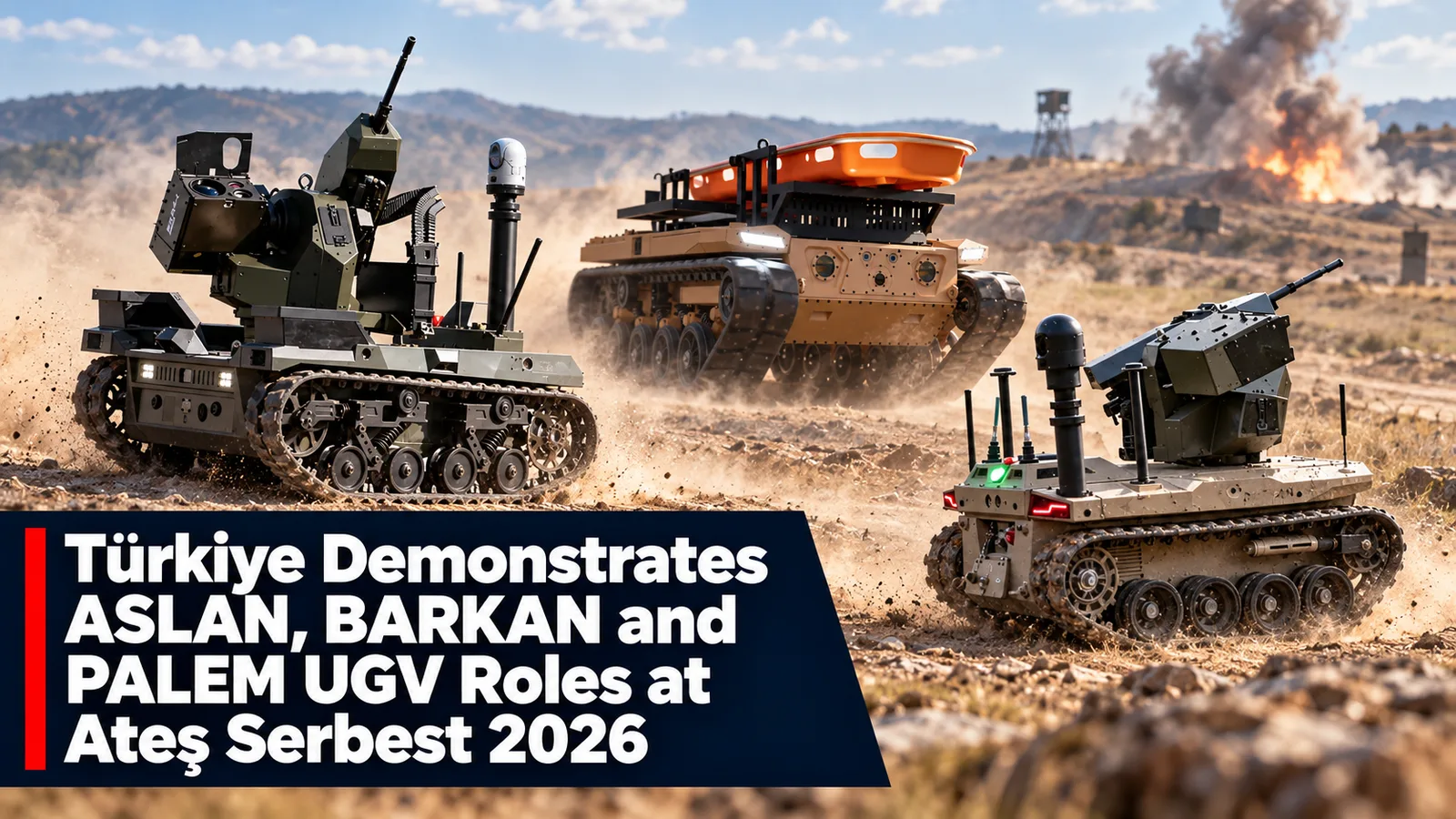
ASELSAN’s ASLAN, HAVELSAN’s BARKAN and Tekatron’s PALEM unmanned ground vehicles demonstrated different battlefield roles during Ateş Serbest 2026 at the General Nahit Şenoğul Firing and Exercise Area in Polatlı. The activity covered armed support, reconnaissance, logistics and casualty evacuation alongside conventional armour and artillery.
The demonstration is significant because the three platforms are not direct substitutes. ASLAN is a lighter modular UGV with weapon and sensor payload options, BARKAN is built around autonomous multi-role support and digital-force concepts, while PALEM is a heavier tracked platform intended to carry larger mission payloads and logistics loads.
ASLAN Demonstrated a Weaponised Reconnaissance Role
MilDefIn reported that ASELSAN’s ASLAN operated with a SARP-L remote weapon station during the activity. ASELSAN’s current ASLAN material describes the platform as a Medium Class Level 1 unmanned ground vehicle able to carry SARP-L, a tethered drone, long-range acoustic sensors, a mast-mounted surveillance system and an optional laser-guided miniature missile system.
ASELSAN’s published brochure lists a platform weight of up to 750 kg including payload, a maximum speed of 10 km/h, up to seven hours of operating time and autonomous navigation functions that include traversability assessment, dynamic route planning and movement during GNSS or communications loss. The brochure specifically identifies a 7.62 mm weapon for the SARP-L configuration, so broader calibre claims in event reporting should be treated as configuration-dependent rather than universal to the displayed vehicle.
ASLAN Has Already Moved Beyond Prototype Status
ASELSAN’s 2024 annual report states that ASLAN 150M1 LRAS and ASLAN 150M1/G configurations equipped with long-range acoustic and SARP weapon payloads entered the Turkish Land Forces inventory. Earlier company reporting also confirms integration work with the METE laser-guided mini missile and other mission payloads.
That gives the Ateş Serbest appearance greater significance than a pure technology demonstration. ASLAN is now being shown as part of a broader family in which mobility, autonomy and interchangeable payloads are intended to support reconnaissance, local security, electronic-warfare support and armed missions without exposing personnel directly at the engagement point.
BARKAN Provided Armed Support Inside HAVELSAN’s Digital-Force Concept
MilDefIn reported that HAVELSAN’s BARKAN fired on targets with a 12.7 mm remote weapon system during the event. HAVELSAN’s published technical material describes BARKAN as an approximately 500 kg autonomous UGV with an eight-hour operating time, autonomous patrol, GPS-independent task execution, return-on-link-loss and leader-following functions.
The platform has been developed as part of HAVELSAN’s wider “Digital Troops” concept, in which unmanned air and ground systems can operate under a common command architecture. HAVELSAN material also lists robotic-arm bomb disposal, CBRN detection, payload transport, day/night reconnaissance, 3D mapping and rescue among BARKAN’s mission options.
BARKAN’s Fielding History Shows a Gradual Transition Into Service
Anadolu Agency reported in July 2023 that BARKAN I and BARKAN II had been made available to Turkish security forces, while later HAVELSAN-linked reporting in 2024 said formal Turkish Armed Forces acceptance activities had been completed. The distinction suggests a phased path from user testing and limited field use into accepted operational service rather than a single one-day entry-into-inventory event.
The Ateş Serbest firing therefore represents a mature demonstration context for BARKAN, but it does not establish that every weapon, autonomy mode or payload shown in development over the years has been accepted in exactly the same configuration.
PALEM Focused on Heavy Support and Casualty Evacuation
Tekatron’s PALEM was used in one of the activity’s more operationally distinct scenarios: casualty evacuation from a tank crew after firing. The vehicle moved into the scenario to recover the simulated casualty and transport the person away from the immediate danger area, demonstrating the value of unmanned ground platforms in tasks where exposure risk may be high.
Tekatron’s current product page identifies PALEM as a Medium Class II UGV with a platform weight of 2,050 kg and a 1,000 kg payload capacity. Event reporting described a roughly three-tonne combat weight, which is compatible with the idea of a heavier mission-loaded configuration but should not be confused with the manufacturer’s current published bare-platform figure.
PALEM’s Modular Architecture Supports Heavier Mission Payloads
Tekatron describes PALEM as a tracked platform designed for surveillance, logistics and mission-specific payload integration, with RF, 4G/LTE and satellite communications options. Its current product page also lists STANAG 4569 Level 2 protection for critical components and road, rail, sea and air transportability, including CH-47 internal or external carriage.
MilDefIn reported that PALEM can also be configured with ASELSAN’s SARP DUAL remote weapon station and a ROKETSAN KARAOK turret infrastructure. Those options show the platform’s modularity, but their existence should not be read as confirmation that the casualty-evacuation vehicle at Ateş Serbest carried the same weapon configuration.
Three UGVs Point to a Layered Ground-Robotics Model
The combined appearance of ASLAN, BARKAN and PALEM highlights a broader Turkish approach to unmanned ground systems: field different vehicle classes against different mission burdens rather than searching for one universal robot. Lighter platforms can handle reconnaissance, surveillance and close armed support, while heavier platforms can take larger payloads, logistics loads or evacuation tasks.
This mirrors the way unmanned air systems evolved from small tactical platforms into families covering surveillance, strike, communications relay and heavy-payload missions. The main question for ground robotics is whether similar scale can be achieved while maintaining mobility, communications resilience, autonomy and survivability in terrain that is less predictable than the air domain.
Ateş Serbest Demonstrates Integration, Not Every Aspect of Maturity
Successful live-fire and support demonstrations confirm that the platforms can perform the shown tasks under exercise conditions. They do not automatically prove survivability against electronic warfare, mines, anti-armour threats or complex urban obstacles, nor do they confirm that every optional payload is already in serial operational use.
The next indicators to watch are repeat procurement quantities, unit-level fielding, autonomous teaming with crewed armour and UAVs, and evidence from larger exercises that UGVs can operate reliably under degraded communications and contested navigation conditions. Those milestones will determine whether Türkiye’s growing UGV portfolio becomes a routine part of manoeuvre formations rather than a specialised support capability.