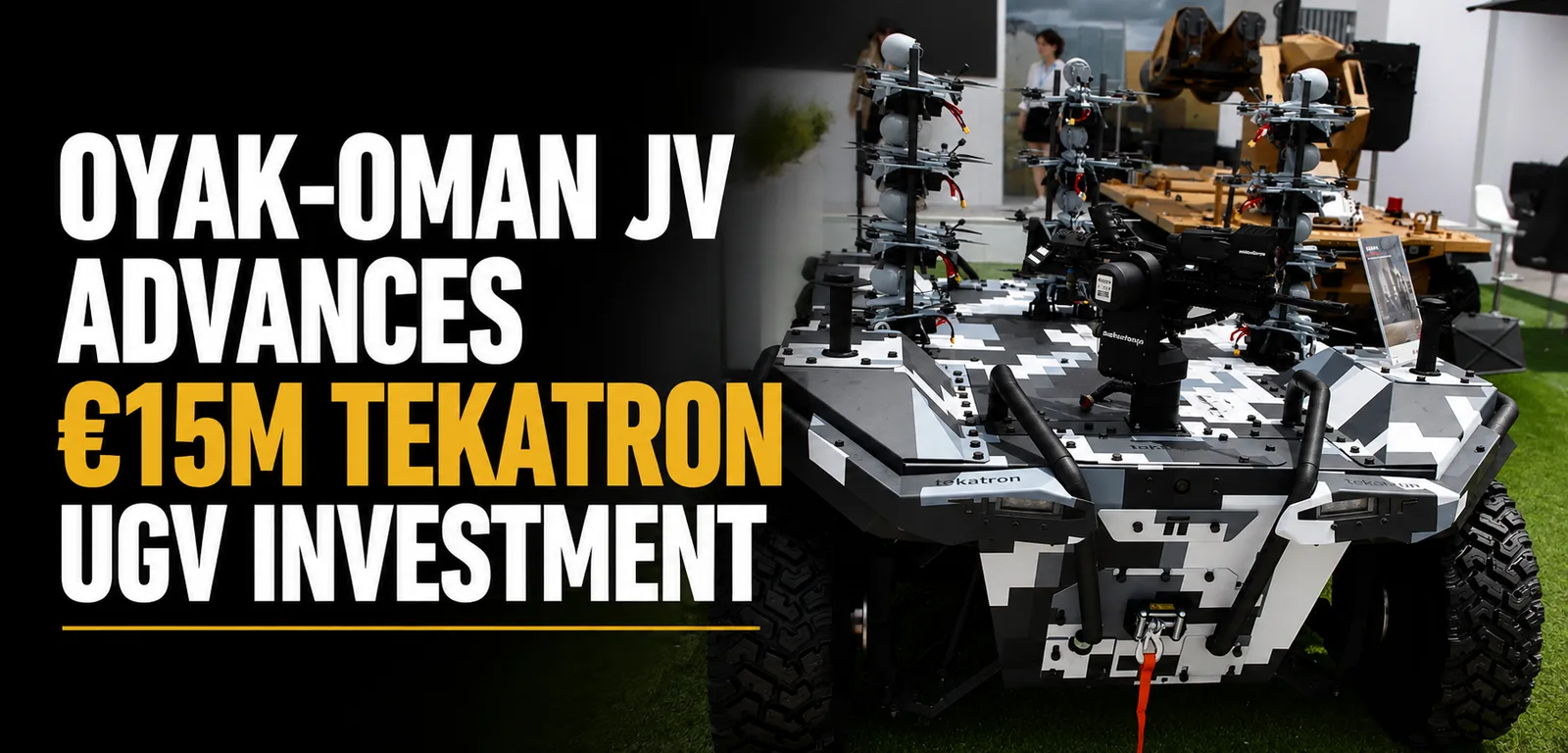
OYAK Turkoman Investment Inc. (TOI), the joint investment vehicle established by Türkiye’s OYAK and the Oman Investment Authority, has moved forward with a €15 million investment linked to Tekatron, an Ankara-based developer of unmanned ground vehicles and dual-use robotic systems.
The latest step follows a non-binding memorandum of understanding signed with Tekatron during SAHA 2026 in May. OYAK confirmed on 24 August 2026 that TOI’s board had approved a €15 million investment in a Türkiye-based dual-use technology company, while Demir Çelik Store identified the target as Tekatron. The public record does not yet disclose the shareholding ratio, company valuation, closing timetable or confirmation that final binding transaction documents have been executed.
Key Facts
- Investment amount: €15 million
- Investor: OYAK Turkoman Investment Inc. (TOI)
- TOI shareholders: OYAK and Oman Investment Authority
- Target identified by supplied source: Tekatron Teknoloji A.Ş.
- Sector: Unmanned ground systems / dual-use technology
- Initial Tekatron MoU: May 2026 at SAHA 2026
- Latest TOI board decision: August 2026
- Share ratio / valuation / closing date: Not publicly disclosed
From SAHA 2026 MoU to Investment Decision
The investment process became public during SAHA 2026, when TOI and Tekatron signed a non-binding memorandum of understanding for a potential share acquisition. OYAK’s 7 May 2026 announcement explicitly named Tekatron, described the company as a producer of unmanned ground vehicles and linked the prospective €15 million foreign-capital injection to capacity expansion, research and development and possible overseas production investments.
That May announcement also made clear that capital provision remained conditional on the fulfilment of specified conditions and the signing of final agreements. The transaction therefore began as a structured investment process rather than a completed equity acquisition.
On 24 August, OYAK announced that the third board meeting of TOI had approved a €15 million investment in a Türkiye-based company developing dual-use products. OYAK’s latest release did not name the company. Demir Çelik Store subsequently identified the company as Tekatron and described the decision as the next stage of the process launched at SAHA 2026.
That source distinction matters. The investment amount and approval of a dual-use technology investment are confirmed by OYAK. The identification of the August target specifically as Tekatron is supported by Demir Çelik Store and is consistent with OYAK’s earlier May announcement, but OYAK’s 24 August release itself does not repeat the Tekatron name.
What TOI Is
TOI was established as a joint investment structure between OYAK and the Oman Investment Authority. OYAK has described the broader Türkiye-Oman framework as a $500 million investment platform, with the two institutions each expected to contribute $250 million.
The partnership is intended to pursue investments in strategic sectors including high technology, value-added manufacturing, energy, mining, logistics and related industrial activities. Earlier OYAK-Oman cooperation has also included investment discussions in mining, food, agriculture and information technology.
The Tekatron process is significant because it brings defence-adjacent autonomous systems into that broader bilateral investment architecture. It indicates that the Türkiye-Oman vehicle is not confined to conventional industrial or resource assets and is willing to consider growth capital for high-technology companies operating in areas with both military and civilian applications.
Tekatron’s Unmanned Ground Systems Portfolio
Tekatron is based in Ankara and lists engineering, R&D and manufacturing activities spanning mechanical design, electronics, embedded systems, vehicle systems and unmanned ground vehicles. The company’s current product portfolio includes PALEM, W-UGV-I, M-UGV I and UGAV platforms.
On its official product page, Tekatron describes PALEM as a Medium Class II unmanned ground vehicle designed for modular mission payloads and protected subsystems, with a stated payload capacity of 1,000 kg. W-UGV-I is listed with a 300 kg payload, M-UGV I with a 250 kg payload and the hybrid ground-air UGAV with a 600 g payload.
Tekatron has also publicly positioned PALEM as a multi-mission platform. Company-associated material describes an approximately 3-tonne tracked, fully electric vehicle with a stated range of about 100 km and maximum speed of 25 km/h. The modular architecture has been shown with different weapon configurations, including a Roketsan turret carrying KARAOK and configurations using remote weapon stations.
Those performance figures are manufacturer or company-associated claims and should not be treated as independently verified military acceptance data. Public sources reviewed for this article do not disclose current Turkish Armed Forces procurement quantities for PALEM or Tekatron’s other platforms.
Why €15 Million Matters for a UGV Developer
For a defence-technology SME or mid-sized autonomous-systems company, equity-style growth capital can have a different impact from a conventional product order. A procurement contract finances delivery of a defined system. Strategic capital can instead fund engineering staff, test infrastructure, tooling, production equipment, supply-chain inventory, software development and international expansion before a specific customer order is booked.
OYAK’s May statement said the Tekatron investment was intended to accelerate R&D, increase production capacity and finance potential overseas manufacturing facilities. Tekatron’s own public communication similarly linked the planned capital to UGV R&D, new-generation unmanned systems, capacity expansion and international growth.
If completed on those terms, the transaction could give Tekatron more capacity to move from prototype and low-rate manufacturing toward repeatable production. That is increasingly important in the unmanned-ground-vehicle market, where customers are moving beyond demonstrations and asking suppliers to prove production scale, maintainability, software maturity, payload integration and field support.
Defence-Industrial Significance
Türkiye has developed a broad unmanned-systems ecosystem across air, land and maritime domains. The ground segment is becoming more competitive as companies pursue reconnaissance, logistics, engineering, direct-fire, anti-armour, counter-UAS and manned-unmanned teaming missions.
Tekatron’s potential capital increase therefore sits inside a wider industrial transition. The strategic question is not simply whether a company can demonstrate an autonomous vehicle, but whether it can industrialise the platform, qualify payloads, secure production suppliers, integrate command-and-control systems and support users over a full lifecycle.
Foreign capital can accelerate that process, but it also introduces governance and strategic-control questions that become more important in defence-related companies. Public information reviewed for this article does not disclose the prospective TOI share ratio, board rights, reserved matters, technology-access provisions or export-control arrangements.
Those terms will determine whether the €15 million functions mainly as minority growth capital or gives TOI a broader strategic role in Tekatron’s future direction.
Türkiye-Oman Industrial Cooperation
The investment also has a bilateral dimension. OYAK and OIA have been building a formal investment architecture since 2025, using TOI to identify projects capable of generating industrial and financial value in both markets.
OYAK’s public statements emphasise high technology and value-added manufacturing alongside energy, mining and other strategic sectors. From Oman’s perspective, technology investment aligns with a broader sovereign-investment strategy that spans manufacturing, logistics, energy, ICT and other sectors.
A successful Tekatron transaction could therefore create a pathway for more than a passive financial investment. OYAK’s May announcement explicitly referenced possible overseas production-facility financing. Oman could become one of the locations examined for manufacturing, regional assembly, support or market access, although no specific overseas site has been publicly confirmed.
Any claim that Tekatron will build a factory in Oman would therefore be premature. The public record supports only the broader objective of financing potential international production facilities.
Commercial and Export Implications
Unmanned ground vehicles are increasingly attracting defence customers because they can move sensing, logistics, weapons and other tasks away from personnel in high-risk areas. The commercial challenge is that the market remains fragmented: armed forces differ substantially in autonomy doctrine, communications architecture, payload standards, safety requirements and acceptable levels of human control.
For Tekatron, international expansion will therefore depend on more than manufacturing capacity. Export growth will require local partnerships, certification, customer demonstrations, integration with third-party weapons and sensors, secure communications and long-term support.
TOI may provide a useful bridge into Gulf and other markets if the investment closes and the partners use OYAK and OIA networks to support market access. That is a strategic possibility rather than a publicly announced sales programme.
Limitations and Counterpoint
The transaction should not yet be described as a completed €15 million acquisition. OYAK’s May announcement referred to a non-binding memorandum for Tekatron, and its August announcement confirms an investment decision in an unnamed dual-use technology company rather than publishing final Tekatron transaction documents.
The share ratio, pre-money or post-money valuation, governance rights, capital-transfer schedule and final closing conditions remain undisclosed. There is also no public confirmation reviewed for this package that TOI has transferred the full €15 million to Tekatron as of 27 August 2026.
Similarly, the investment does not by itself establish new defence orders or export contracts. Increased production capacity is commercially meaningful only if it is matched by qualified products and sustained customer demand.
Implications / Next
The next material milestone is publication of final binding transaction terms. Confirmation of the equity percentage, capital increase, governance structure and closing date would establish the economic substance of TOI’s investment.
For Tekatron, the operational indicators will be new production capacity, expansion of engineering staff, additional PALEM or other UGV qualification milestones, export announcements and evidence that the capital is supporting repeatable serial manufacture rather than only product development.
A decision on an overseas production facility would be particularly significant. If such a project is located in Oman or another regional market, it would move the relationship from portfolio investment toward cross-border defence-industrial manufacturing.
Conclusion
The €15 million TOI decision represents a potentially important growth-capital step for Tekatron and a new defence-technology dimension in the OYAK-Oman investment partnership. It builds on the non-binding Tekatron MoU signed at SAHA 2026 and is intended to support R&D, production capacity and international expansion.
The transaction, however, remains only partially transparent. OYAK’s latest official announcement confirms the investment decision but does not name Tekatron, while final equity terms and closing details remain undisclosed. The next phase should therefore be judged by binding transaction documentation, capital transfer and measurable increases in Tekatron’s production and export capacity.