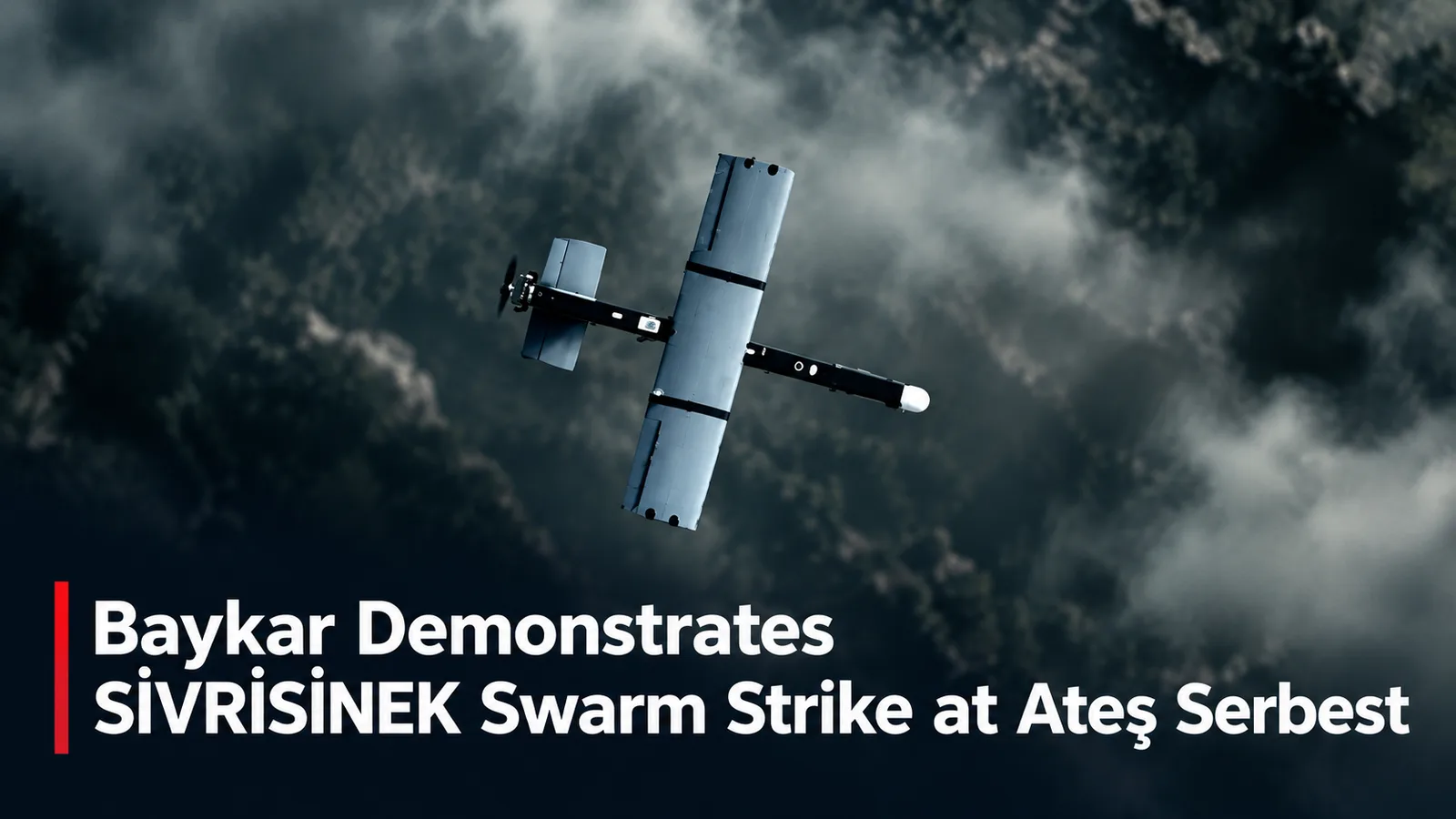
Baykar demonstrated a coordinated SİVRİSİNEK loitering-munition swarm during Türkiye’s Ateş Serbest 2026 activity in Polatlı, with 20 aircraft reported in autonomous swarm flight and ten separating to hit targets. Baykar chief Haluk Bayraktar supplied the figures reported by Anadolu Agency on 13 October 2026. The event gives a visible example of coordinated unmanned mass but is not, on its own, confirmation that a 20-round swarm package has entered routine military service.
The Demonstration Combined Formation and Target Attack
Anadolu Agency reported that 20 SİVRİSİNEK smart loitering munitions flew autonomously in a swarm, after which ten separated from the group and struck designated targets. The available account is therefore more specific than an ordinary multi-aircraft flypast: it describes a division between group movement and individual terminal attacks. Yet the public report does not disclose the complete mission plan, degree of operator supervision or electronic-warfare conditions during the engagement.
The firing occurred within Ateş Serbest 2026, the Turkish Armed Forces activity intended to demonstrate inventory weapons and newer battlefield technologies. The Ministry of National Defence had framed the exercise around joint fire support, autonomous systems, artificial intelligence and electronic warfare. This context helps explain why Baykar presented a coordinated strike rather than simply demonstrating the speed or manoeuvrability of one munition.
Swarm Autonomy Changes the Command Problem
The technical significance lies in commanding several expendable aircraft while they retain coherent movement and execute separate terminal tasks. Such operations require navigation, deconfliction, mission timing and target allocation that differ from a single remote-controlled drone strike. Public descriptions of autonomy do not, however, establish the exact onboard algorithms, communications dependencies or authority delegated to individual aircraft in this demonstration.
Baykar had already reported tests of SİVRİSİNEK and the larger K2 platform in April 2026, describing AI-supported coordination, navigation independent of satellite positioning and automated target functions. Those earlier trials form useful background, not proof that the October event used the same configuration or resisted every form of jamming. A proper assessment would need repeated trials, scenario documentation and results across different levels of network degradation.
The Economics of Mass Depend on More Than Aircraft Count
For military planners, the attraction of a swarm is not simply putting a larger number of air vehicles in the sky. A coordinated group can offer multiple attack axes and reduce the time available for a defender to assign countermeasures. Against that, launch logistics, mission preparation, reliable target identification, communications discipline and replenishment all affect whether mass can be generated consistently on deployed operations.
The 20-aircraft figure describes the demonstration and cannot be reinterpreted as a procurement lot, launcher capacity or declared combat-unit structure. No public contract value, recurring production rate or military acceptance record accompanies the 13 October report. In procurement terms this is a demonstrated technical event, with fielding and production scale requiring separate documentary milestones.
What a Swarm Demonstration Does Not Resolve
A swarm demonstration compresses several technical problems into one observable sequence: simultaneous flight, distributed timing, mission updates, collision avoidance and terminal target assignment. The event account identifies a coordinated group and a subset that carried out strikes, but it does not publish the communications architecture or the degree of autonomy exercised at each stage. Those distinctions are consequential for military planning. A formation following a centrally planned route is not necessarily equivalent to a swarm dynamically redistributing targets after losing aircraft or data links.
Evidence from an exercise must also be interpreted against the trial conditions. Repeated performance against moving targets, jamming, poor weather and an adversary adapting its defences would require separate campaigns. Acquisition decisions would additionally have to establish unit cost, warhead effects, storage life, operator workload and replenishment capacity. Nothing in the announced event specifies such acceptance results. The immediate significance is a publicly observed capability demonstration rather than a disclosed fielding order.
Implications / Next
Further evidence should address repeatability, launch tempo, autonomous task allocation, command links and target discrimination in more demanding conditions. Named operator acceptance and production awards would establish a different maturity stage from this exercise. The announcement nevertheless indicates that Türkiye’s unmanned-strike industry is using public exercises to show coordinated employment concepts, not merely individual platform specifications.