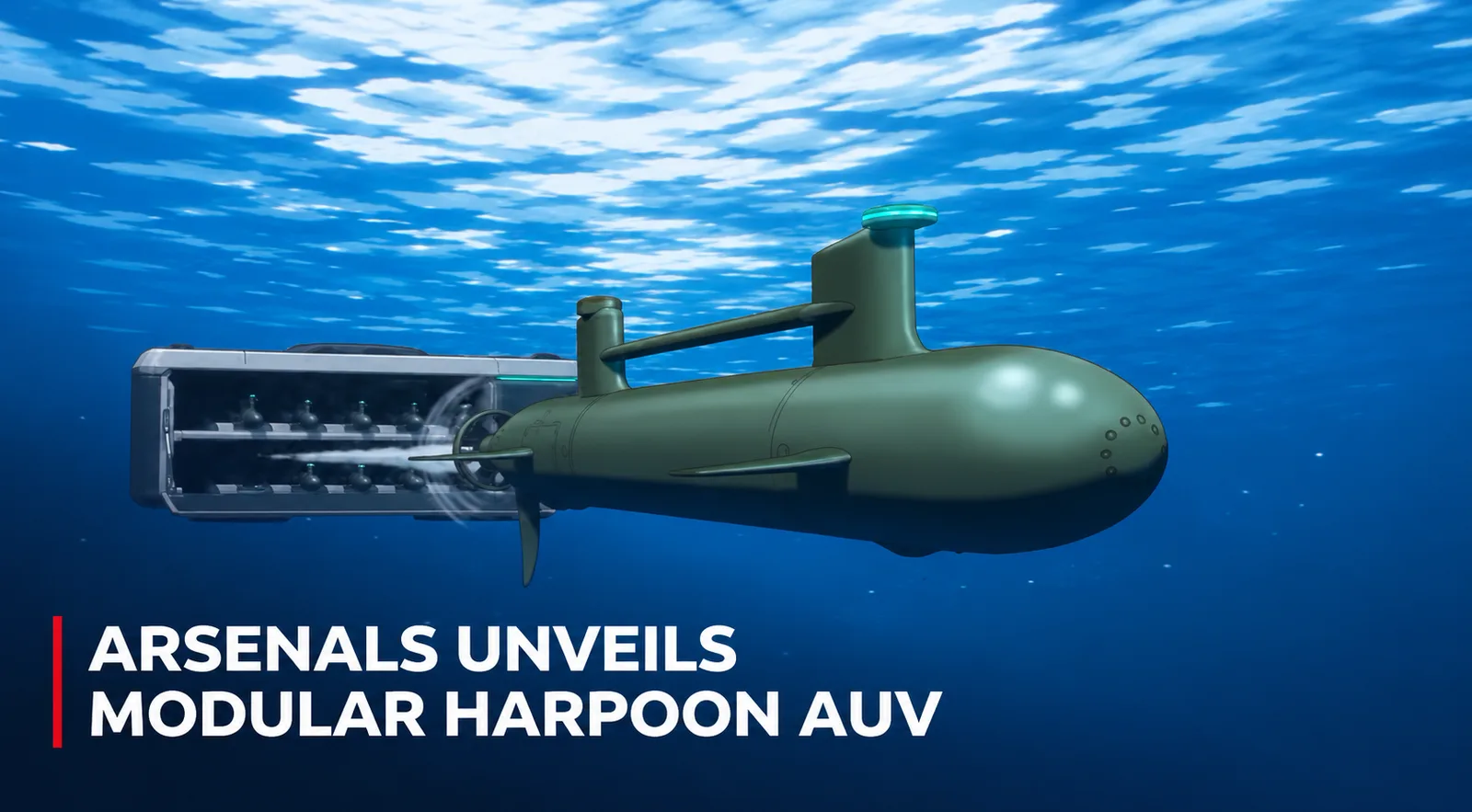
French defence technology startup Arsenals presented its Harpoon AUV, a modular autonomous underwater vehicle programme, at Euronaval 2026 in Paris. The project illustrates the growing role of emerging maritime robotics suppliers in European defence procurement, with an emphasis on adaptable equipment and industrial scalability. Its public presentation does not, however, establish operational acceptance or a confirmed production order.
Harpoon AUV: an emerging French maritime robotics programme
The unveiling was covered by Naval News in November 2026. The company’s public Harpoon programme description identifies the platform as its first maritime product and places modularity and autonomy at the centre of its business proposition. The publicly available company description is promotional in nature and should be read as an account of intended capabilities rather than independent evidence of performance.
Euronaval took place in Paris from 3 to 6 November 2026. A public announcement by the company’s head of business also identified Harpoon as the startup’s initial AUV and confirmed its planned exhibition presence. The product therefore enters public discussion as a development programme, rather than a proven fleet acquisition. Neither a customer acceptance certificate nor an independently verified production total was available in the material reviewed.
For the defence and aerospace industry, the broader significance is the participation of new suppliers in a market historically associated with established shipbuilders and specialist marine engineering firms. Smaller enterprises can introduce different business models and shorter product development cycles, but entering the maritime sector involves qualification requirements that extend beyond the initial presentation of a prototype or a digital rendering.
The exhibition also placed the project within a wider French industrial policy discussion. The French Ministry of the Armed Forces highlighted a naval drone industry pact among the outcomes of Euronaval 2026. This provides relevant context for the startup ecosystem, although it does not establish that Arsenals has received funding or a procurement commitment under that initiative. Reuters likewise reported on the wider European naval industry exhibition on 3 November 2026, describing growing interest in fleet modernisation and autonomous platforms.
Modularity is not unique to Harpoon. French maritime technology firm Arkeocean announced its M Platform on 2 November 2026, citing sea trials in Portugal before the exhibition. In another example, Janes reported that Euroatlas displayed the first series-production Greyshark AUV at Euronaval. These programmes provide useful industrial context because they illustrate different stages of maturity. They should not be treated as direct performance comparisons, given the absence of a common verified test basis.
Industrial maturity, procurement risks and next milestones
For procurement authorities, the distinction between a product announcement and a qualified capability remains essential. An exhibition presentation may establish market visibility and demonstrate a supplier’s intentions, but procurement decisions require a separate assessment of programme governance, safety assurance, contractual responsibilities and long-term support. A startup’s ability to sustain these commitments can be as consequential as the initial attractiveness of its product concept.
Commercial transparency is equally important. Publicly available material does not establish a binding Harpoon order, a confirmed unit price or a customer delivery schedule. Buyers would need to distinguish between development expenditure, recurring acquisition costs and through-life support commitments before a credible value-for-money comparison could be made. A lower initial acquisition price, if eventually established, would not necessarily translate into lower lifetime expenditure.
Related European activity includes France’s Naval Group UCUV demonstrator programme, previously covered by Defence Agenda. That government-backed development effort and the Arsenals startup presentation should be understood as separate initiatives. No evidence reviewed establishes a contractual connection between them. The SCX 26 warship concept offers further context on how the broader naval industry is considering uncrewed equipment, without implying Harpoon has been selected for that platform.
Outside France, Defence Agenda has also examined HAVELSAN’s AVISTA underwater research platform. The example reinforces the distinction between research activity and a fielded procurement programme. Comparisons across these projects are most useful when they focus on documented milestones and institutional commitments rather than unverified claims of superiority.
Implications / Next: Future disclosures to watch include published qualification results, an identifiable customer contract, confirmed delivery dates and documented support arrangements. Until such evidence becomes public, Harpoon is best understood as an emerging maritime robotics programme with an industrial proposition rather than a demonstrated operational capability. Its appearance at Euronaval is nevertheless a useful indicator of the widening participation of smaller firms in the European naval supply chain.
Further Reading
- Naval News — Arsenals modular AUV report
- Arsenals — Harpoon programme
- French Ministry of the Armed Forces — Euronaval 2026 outcomes
- Arkeocean — M Platform announcement
- Janes — Greyshark series-production display
- France Orders Naval Group UCUV Demonstrator for 2028 Trials
- HAVELSAN Unveils AVISTA Underwater R&D Platform
- Naval Group Unveils SCX 26 Drone-Focused Warship