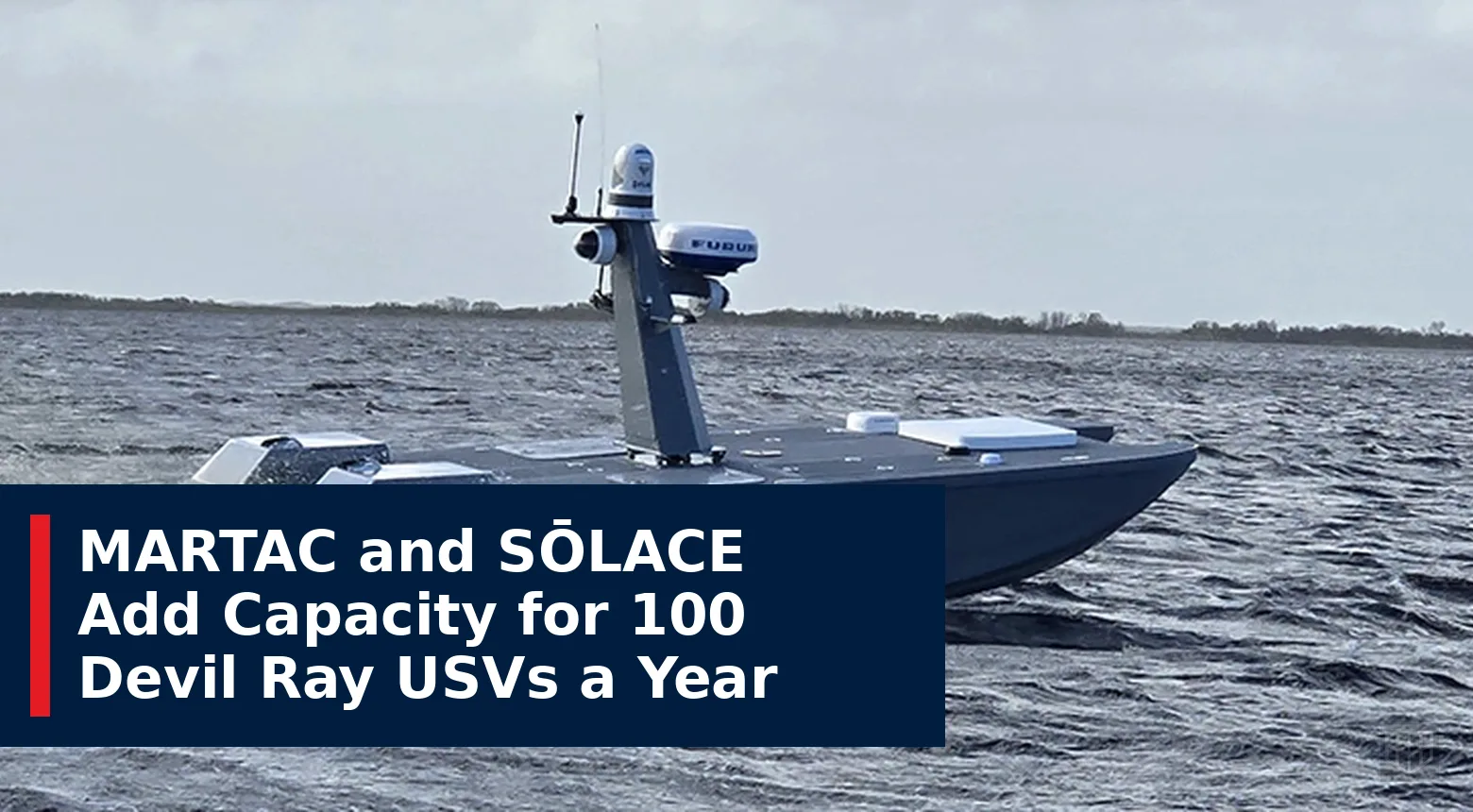
MARTAC and SŌLACE Boats have formed a production partnership intended to add capacity for more than 100 Devil Ray USVs annually.
A second production partnership
MARTAC and SŌLACE Boats have agreed to manufacture Devil Ray unmanned surface vessels through a partnership announced on 15 September 2026. MARTAC says the arrangement will create capacity for more than 100 vessels a year. SŌLACE brings a 200,000-square-foot facility and experience with vacuum infusion and catamaran hulls, techniques relevant to repeatable composite construction at higher rates.
The capacity figure requires precise wording. It describes what the industrial arrangement is intended to support, not a disclosed backlog or annual order. Neither company announced a customer, funded vessel quantity, contract value or delivery schedule with the partnership. Actual output will depend on orders, configuration mix, long-lead components, acceptance testing and the rate at which trained workers and suppliers can be brought into the line.
Scaling the Devil Ray family
Devil Ray is a family of high-speed unmanned surface vessels offered in multiple sizes for missions such as intelligence, surveillance and reconnaissance, communications relay, payload transport and other modular tasks. The catamaran form provides deck and internal volume for mission equipment, while remote or autonomous control allows the craft to operate without an embarked crew. Exact performance and payload vary by model and configuration.
A family approach can complicate production because hulls, propulsion, electrical systems and mission payloads do not all share the same bill of material. It can also create resilience by allowing common control, manufacturing and support practices across several sizes. The partnership will be most useful if it combines standardised base craft with mission modules that can be integrated without extensive redesign for each customer.
Why composite manufacturing matters
Vacuum infusion controls resin flow through composite reinforcement under vacuum, supporting consistent structures with lower void content than less controlled manual processes. For military USVs, repeatability affects weight, hydrodynamic performance, durability and the ability to mount sensors or weapons safely. At higher volumes, tooling discipline and quality records become as important as the speed with which a hull can be laid up.
SŌLACE’s facility adds physical space and boatbuilding labour, but naval production involves more than hulls. Engines, waterjets, navigation units, secure communications, autonomy software and payload interfaces must arrive in sequence and pass configuration control. Cyber security and government acceptance can be pacing elements even when the composite shop has spare capacity.
Demand signal rather than booked volume
MARTAC linked the expansion to growing US and allied interest in unmanned maritime systems. Naval experimentation has demonstrated uses for distributed sensing, logistics and force protection, while operational commanders increasingly ask how unmanned craft can be sustained and controlled at scale. Converting demonstrations into programmes of record requires reliable vessels, trained operators, communications architecture and doctrine for missions in contested waters.
The SŌLACE agreement follows a separate co-production relationship with Mystic Powerboats, suggesting that MARTAC is building more than one route for additional output. Multiple partners can reduce dependence on a single facility, although common quality standards and design authority are essential if craft from different lines are to remain interchangeable and supportable.
The key follow-on evidence will be firm contracts, completed qualification of the additional line and delivered vessels accepted by customers. Production-rate reporting should distinguish theoretical capacity from funded annual output. For now, the partnership is a credible industrial-readiness move: it increases the space, skills and composite-manufacturing options available to Devil Ray, while leaving the scale of future procurement to government and commercial decisions that have not yet been announced. Trials should also show whether boats from the new line meet the same endurance, signature, payload and sea-state requirements as existing craft. That equivalence is essential if customers are to treat expanded capacity as usable fleet output rather than merely additional hull fabrication.