TCG Anadolu Tests 5G-Supported Robotic Surgery
TCG Anadolu 5G robotic surgery testing has connected the Turkish Navy’s largest warship with specialists at Kocaeli University through a dedicated 5G network slice, demonstrating how high-bandwidth, low-latency communications could extend advanced medical expertise to naval forces operating far from shore.
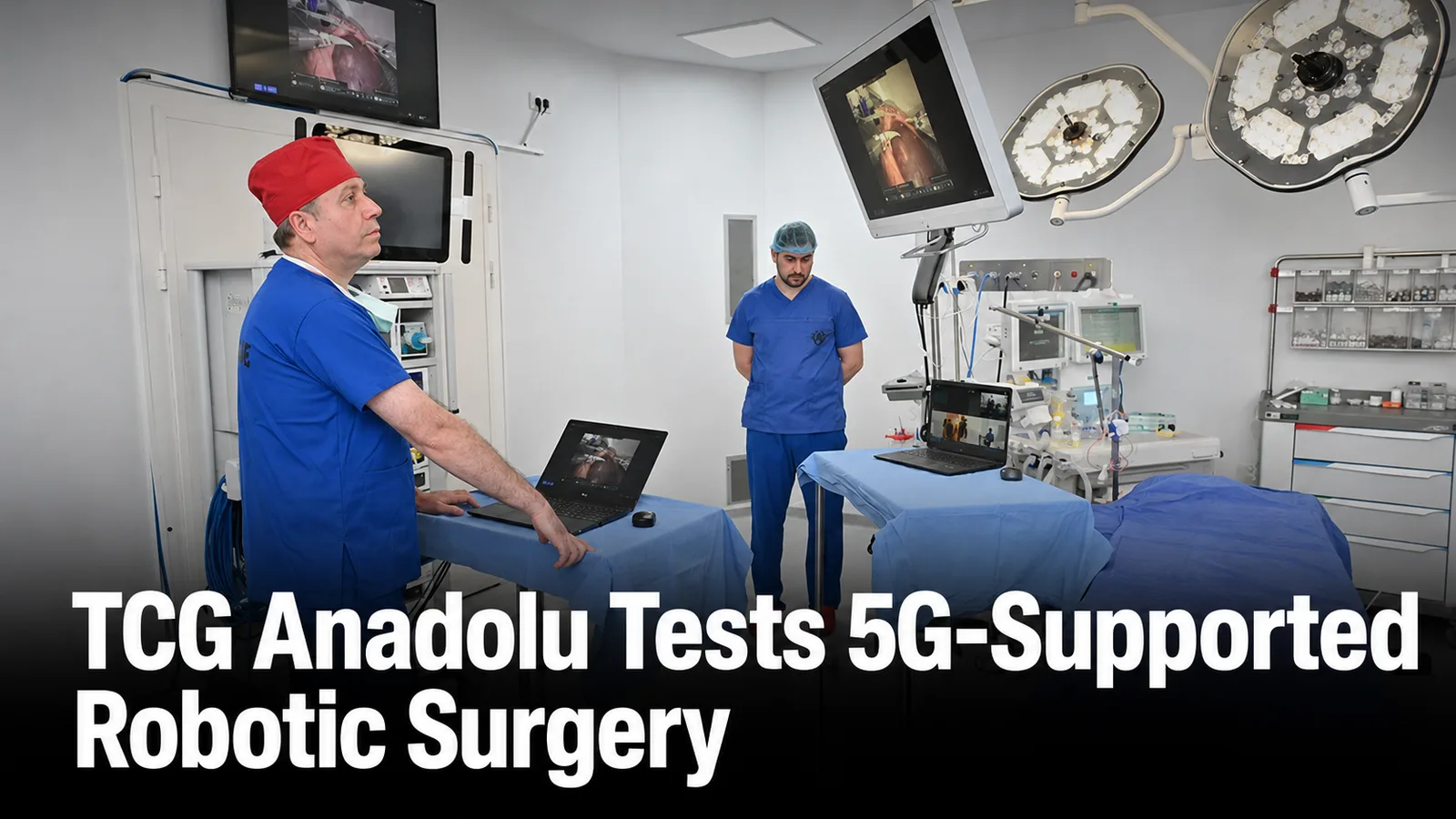
During TEKNOFEST Mavi Vatan at Gölcük Naval Shipyard Command, high-quality video and audio from a Da Vinci robotic surgery system aboard TCG Anadolu were transmitted to university physicians through Turkcell’s 5G infrastructure. The remote specialists followed the procedure in real time and provided guidance to the surgeon operating the robot on the ship.
The technical distinction is important. The 21–22 August 2026 activity was a telementoring demonstration on a natural organ model, not a remotely controlled operation on a human patient. The project team says its next phase is intended to progress toward true telesurgery using two robotic consoles, first through further experimental work and later, subject to medical and regulatory requirements, in a live clinical environment.
Key Facts
- Demonstration: 5G-supported robotic surgery telementoring aboard TCG Anadolu during TEKNOFEST Mavi Vatan.
- Date: The principal demonstrations and public disclosures took place on 21–22 August 2026.
- Network: Turkcell 5G with network slicing and 5G Superbox connectivity.
- Medical system: Da Vinci robotic surgery platform installed aboard TCG Anadolu for the demonstration.
- Remote medical partner: Kocaeli University physicians provided real-time specialist guidance.
- Current maturity: Telementoring on a natural organ model; not yet human telesurgery.
- Ship medical capability: TCG Anadolu has a Role 2 medical facility with two operating theatres and a fully equipped hospital capability.
TCG Anadolu Links Shipboard Surgery to Shore Over 5G
Anadolu Agency reported on 22 August 2026 that Turkcell established a 5G-supported medical link between TCG Anadolu and Kocaeli University during TEKNOFEST Mavi Vatan.
Video and audio generated by the Da Vinci robotic surgery system aboard the ship were transmitted to Kocaeli University using Turkcell’s live 5G infrastructure, network slicing and 5G Superbox devices. Physicians at the university monitored the procedure in real time and provided immediate guidance and consultation to the surgeon aboard the ship.
The architecture was also used to display the activity on the main TEKNOFEST screen at Gölcük Naval Shipyard Command, but its defence relevance lies in the dedicated communications path between the ship and the remote medical specialists.
The Demonstration Was Telementoring, Not Full Telesurgery
A separate Anadolu Agency report published on 21 August 2026 provides the clearest description of the medical configuration.
TCG Anadolu Commander Navy Staff Colonel Nadir Kılınç said the team conducted a robotic procedure on a natural organ model while Kocaeli University specialists connected through a telementoring system. The surgeon aboard the ship therefore retained direct control of the robot.
Kocaeli University Prof. Dr. Önder Kara described the next step as bringing two robotic consoles into the architecture so that the programme can move from telementoring toward telesurgery. He said the planned development path includes an animal model before a future live human model and described the work as the first step of an approximately 18-month project.
This distinction prevents the current milestone from being overstated. The demonstration proved a real-time remote-support architecture; it did not yet prove that a surgeon ashore can safely control a robot aboard a moving military vessel during a live human operation.
Network Slicing Creates a Dedicated Medical Data Path
The core telecommunications technology was 5G network slicing.
Turkcell describes network slicing as the creation of an end-to-end isolated network segment extending from the radio-access network through the core network. The purpose is to reserve communications resources and service characteristics for a defined application rather than forcing mission-critical traffic to compete directly with general public usage.
For the TCG Anadolu demonstration, Turkcell said the dedicated slice provided a high-speed and secure connection that was separated from general internet traffic. That characteristic is more operationally relevant than peak download speed alone.
Robot-assisted medical support requires stable two-way video, audio and control-related information. Sudden congestion, packet loss or unstable latency can degrade a surgeon’s ability to interpret the operating environment. A dedicated network slice is therefore intended to provide more predictable service quality than an undifferentiated commercial connection.
Why This Matters for Military Medicine
Large naval platforms can carry advanced medical facilities, but they cannot carry every specialist required for every possible emergency.
Long deployments may place a ship hundreds or thousands of kilometres from a major military hospital. A patient may require specialist expertise in urology, trauma, vascular surgery or another discipline that is unavailable among the embarked medical staff.
A resilient telemedicine architecture can partially close that gap by moving expertise rather than personnel. Specialists ashore can review high-resolution imagery, advise a shipboard surgeon and potentially support increasingly complex procedures as the technology matures.
This is particularly relevant for expeditionary naval operations, humanitarian assistance and disaster-relief missions, where TCG Anadolu can operate as both a military platform and a large medical-support node.
TCG Anadolu Already Has a Role 2 Medical Capability
TCG Anadolu is unusually well suited to this type of experiment because medical support was designed into the ship from the beginning.
Türkiye’s Presidency of Defence Industries confirms that TCG Anadolu includes a fully equipped hospital and two operating theatres and can provide medical support during disaster relief, humanitarian assistance and evacuation operations.
During the 21 August demonstration, the ship’s commander provided additional detail: a 32-bed patient unit, an eight-bed intensive-care unit, advanced burn treatment, dental treatment, imaging systems, a blood bank and laboratory capability.
The combination of physical surgical infrastructure and high-capacity communications is what makes the 5G trial significant. Connectivity alone does not create a deployable medical capability; it becomes valuable when connected to an equipped clinical environment and trained medical personnel.
The Trial Builds on Turkcell’s Earlier Remote-Surgery Work
The TCG Anadolu activity was not Turkcell’s first medical 5G demonstration in 2026.
Turkcell announced an earlier 5G-supported remote medical operation in May 2026 linking Istanbul University Faculty of Medicine and Muş State Hospital across approximately 1,500 kilometres.
That terrestrial demonstration provided experience with high-bandwidth medical communications over distance. The TCG Anadolu project adds a maritime operating environment and a military medical use case.
The engineering challenge is consequently different. A ship introduces motion, vibration, changing radio geometry, operational-security requirements and a more complex path toward continuous connectivity once it moves beyond a controlled harbour environment.
Harbour Demonstration Does Not Equal Blue-Water Connectivity
The largest limitation of the current demonstration is also straightforward: TCG Anadolu was at Gölcük during TEKNOFEST Mavi Vatan.
A live 5G connection close to terrestrial infrastructure does not by itself establish the communications architecture required for a ship operating hundreds of nautical miles offshore.
Future operational use would need a resilient combination of communications methods. Depending on mission and geography, these could include shore-based 5G when available, military or commercial satellite communications and other secure naval data links.
The medical application therefore should be viewed as a use-case demonstration for networked expertise rather than proof that conventional terrestrial 5G alone can support global naval telesurgery.
Defence 5G Is About Service Assurance, Not Consumer Speed
The experiment also provides a concrete dual-use example of why 5G matters to defence organisations.
Defence Agenda’s analysis of 5G military communications argues that the military value of next-generation mobile networks lies in connecting data-intensive sensors, autonomous systems, command tools and edge-computing functions with predictable performance.
Medical video is a useful non-combat example of the same requirement. The network must prioritise critical information, maintain continuity under load and provide measurable service quality to the application that depends on it.
For combat use, however, the resilience threshold would be substantially higher. Military networks must continue operating under jamming, cyberattack, spectrum congestion and physical infrastructure disruption. The TCG Anadolu demonstration should therefore not be treated as proof that a commercial 5G configuration is ready for contested tactical operations.
Network Integration Is Already Central to TCG Anadolu
The medical demonstration also fits a wider digital transformation aboard Türkiye’s largest warship.
Defence Agenda previously reported that HAVELSAN completed ADVENT Combat Management System integration on TCG Anadolu, including bidirectional data exchange with Bayraktar TB3 and the ability to share UAV-derived information with other naval assets.
The medical and combat applications are technically distinct and should remain separated for cybersecurity and safety. But they illustrate the same broader trend: a large naval platform increasingly depends on digital networks to connect onboard systems with expertise, sensors and decision-makers beyond the ship.
TCG Anadolu is consequently evolving not only as an aviation and amphibious platform but also as a communications and data node for several mission areas.
Cybersecurity and Clinical Safety Will Be Decisive
Moving from telementoring to true telesurgery raises a much higher assurance requirement.
A video-consultation interruption is undesirable; an interruption during remote robotic control can create immediate clinical risk. Future systems will therefore require strong authentication, encryption, network segmentation, fail-safe behaviour and defined procedures for loss of communications.
Clinical governance will be equally important. Medical teams must define which procedures are appropriate for remote support, who holds surgical authority, how the operation continues if the remote connection fails and how the system is validated before human use.
The current project has not publicly disclosed detailed cybersecurity architecture, latency measurements, availability targets or clinical certification thresholds. Those should not be inferred from commercial 5G performance claims.
Counterargument: Expert Reach Does Not Replace Onboard Capability
Remote specialist access can improve care, but it cannot eliminate the requirement for trained medical personnel aboard the ship.
Trauma and emergency surgery can demand immediate intervention before a remote specialist becomes available. Communications may also be degraded precisely when the ship is operating in the most dangerous environment.
The most credible military-medical model is therefore additive: robust onboard Role 2 capability first, remote specialist support where communications permit, and evacuation when the patient requires a higher level of care.
In that model, 5G and network slicing expand the medical team’s reach rather than replacing the embarked team.
Implications / Next
The first milestone is the transition from telementoring to genuine telesurgery. The project team has identified a two-console architecture and experimental progression through animal-model work before any live human application.
The second is operation away from the pier. Demonstrating comparable service quality aboard a moving ship and at greater distance from terrestrial infrastructure would materially strengthen the military relevance of the concept.
The third is multi-network resilience. An operational system will require seamless use of different secure communications paths rather than dependence on one access technology.
The fourth is clinical and cyber certification. Remote robotic control requires a much higher level of safety, authentication, continuity and fail-safe validation than a demonstration video link.
The fifth is fleet applicability. TCG Anadolu has unusually extensive medical facilities; future work should clarify whether parts of the architecture can support smaller Turkish Navy vessels through teleconsultation even when they cannot embark a robotic surgical suite.
Conclusion
The TCG Anadolu demonstration is best understood as a communications-and-medical integration milestone rather than a completed remote-surgery capability.
Turkcell used 5G network slicing to create a dedicated high-quality link between a Da Vinci robotic surgery activity aboard the ship and specialists at Kocaeli University. The remote physicians could follow the procedure and guide the onboard surgeon in real time.
That is already operationally relevant. It demonstrates how a large naval platform can reach medical expertise ashore without physically carrying every specialist.
The harder milestone comes next: moving from telementoring to remote robotic control while maintaining clinical safety, cybersecurity and communications resilience at sea.
If those requirements can be met, the programme could turn TCG Anadolu’s existing Role 2 hospital into a more networked expeditionary medical capability and provide a practical dual-use case for 5G service assurance in Türkiye’s wider defence communications ecosystem.
Further Reading
- Anadolu Agency: Turkcell 5G and Network Slicing Support Robotic Surgery on TCG Anadolu
- Anadolu Agency: TCG Anadolu Begins Robotic Surgery Telementoring Trials
- Presidency of Defence Industries: TCG Anadolu Medical and Platform Capabilities
- Turkcell: Earlier 1,500 km 5G Medical Operation
- Defence Agenda: 5G Military Communications Power Next-Generation Systems
- Defence Agenda: ADVENT CMS Integration on TCG Anadolu
- Defence Agenda: TCG Anadolu - Türkiye’s Flagship for Modern Naval Warfare