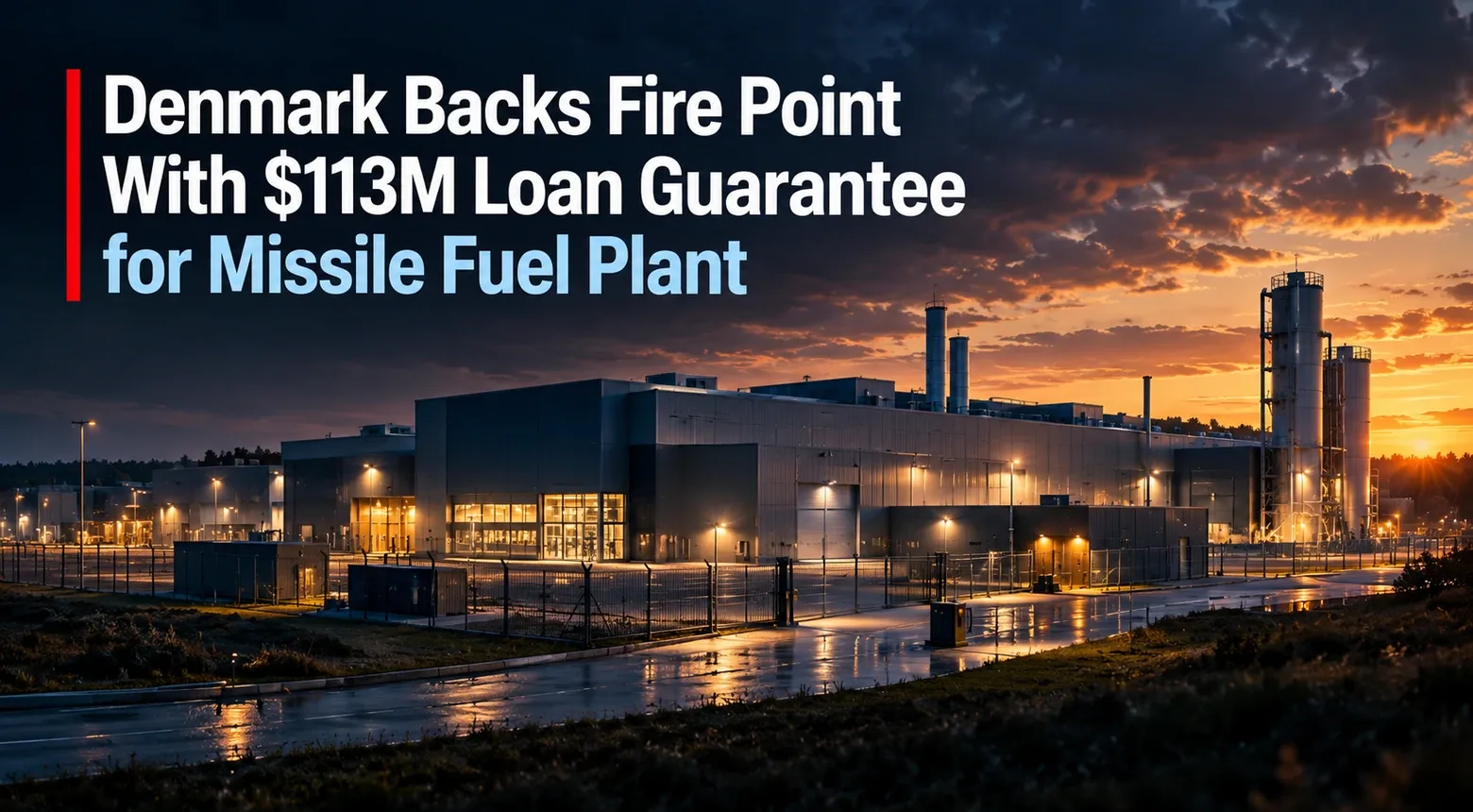
Denmark has approved a DKK 750 million ($113 million) state-backed loan guarantee for the Danish subsidiary of Ukrainian drone and missile producer Fire Point, advancing plans for a solid rocket propellant manufacturing facility in Vojens, southern Denmark. The government announced the financing on 21 October 2026, with Denmark's Export and Investment Fund (EIFO) providing the financial arrangement. The guarantee is intended to overcome borrowing constraints associated with the war in Ukraine; it is not a direct DKK 750 million grant or evidence that the plant is already operating.
The planned facility has wider significance for European defence production. It could help move a sensitive part of Ukraine's missile supply chain outside the reach of attacks on domestic factories, while bringing a Ukrainian manufacturer into an established NATO member's industrial and regulatory environment. According to contemporaneous reporting, production is now expected in late 2027, not immediately following the announcement.
Key Facts
- 21 October 2026: Denmark announced a DKK 750 million state loan guarantee for Fire Point's Danish subsidiary, equivalent to approximately $112.6 million at Reuters' quoted exchange rate.
- Financial channel: The financing is being arranged through Denmark's Export and Investment Fund (EIFO); the state guarantees the loan because wartime conditions obstruct normal commercial borrowing.
- Project location: Fire Point is establishing an operation in Vojens, southern Jutland, near Skrydstrup Air Base.
- Industrial scope: The Danish site is planned for solid rocket propellant production for Ukraine's defence needs, rather than a publicly confirmed complete-missile assembly line.
- Schedule: The plant is not confirmed operational; October reporting places the expected start of production in late 2027.
- Previous milestones: Denmark and Ukraine signed a defence-industrial cooperation arrangement in July 2025, and Danish authorities marked the Vojens project's first ground-breaking in December 2025.
- EIFO context: EIFO says it is involved in nearly 40 Ukraine-related projects, a figure covering its broader portfolio rather than 40 Fire Point projects.
What Denmark's DKK 750 Million Guarantee Actually Covers
The Danish Ministry of Industry, Business and Financial Affairs said the state will guarantee financing for Fire Point's subsidiary in Denmark. The underlying constraint is commercial: a Ukrainian defence company operating during a major war may struggle to obtain conventional local debt on standard terms. A government guarantee can help a lender or public financing institution take on a credit exposure that would otherwise be difficult to arrange.
The distinction matters. A loan guarantee is not the same as an unconditional budget transfer to the manufacturer. The DKK 750 million figure defines the announced financing support; it does not establish that Fire Point has already received the entire amount as cash, nor does it quantify the state's eventual cost. The public announcement does not provide a detailed drawdown calendar, interest rate, repayment structure or guarantee fee. Those terms would be needed to assess the transaction's full financial risk and cash-flow impact.
EIFO's English-language announcement independently confirms the DKK 750 million financing package and identifies Fire Point's Danish subsidiary as the beneficiary. Reuters reported the state guarantee at approximately $112.6 million using the exchange rate cited on 21 October. The dollar figure is therefore an approximate translation of the same Danish-currency commitment, not a second funding award.
Danish Business and Competitiveness Minister Martin Lidegaard framed the decision as part of longer-term support for Ukrainian and European security and industrial capacity. Defence Minister Jeppe Bruus emphasised supply-chain resilience and opportunities for cooperation between Fire Point, Denmark's armed forces and domestic manufacturers. Those arguments are the government's stated rationale; they are not evidence that particular future production, technology-transfer or procurement targets have already been achieved.
Vojens Factory Will Focus on Rocket Propellant
Fire Point's proposed Danish operation is situated near Skrydstrup Air Base, outside Vojens. The government has described the production objective as solid rocket fuel, a critical input for missile programmes. This is more specific than a general announcement that finished missiles will be manufactured in Denmark. The publicly described facility should not be characterised as an operational missile-assembly plant without additional evidence.
The production effort predates the new loan guarantee. In July 2025, Denmark and Ukraine signed a cooperation document intended to help Ukrainian defence companies establish operations on Danish territory. Later that year, authorities established a regulatory framework for Fire Point's project, and in December 2025 officials attended the ceremonial first ground-breaking in Vojens.
That sequence shows an industrial project progressing through policy authorisation, site preparation and financing. It does not establish that the production line has been commissioned, that output has passed qualification, or that propellant shipments to Ukraine have begun. Reporting on 21 October indicated that the factory was expected to start production at the end of 2027, following construction delays. The forecast remains subject to execution, commissioning and regulatory milestones.
Timeline: From Bilateral Agreement to Financing
| Date | Announced development | What it establishes |
|---|---|---|
| 4 July 2025 | Denmark and Ukraine sign a framework for Ukrainian defence companies to produce in Denmark | Bilateral industrial cooperation pathway |
| September 2025 | Denmark publicly identifies Fire Point as a prospective Danish-based producer | Site and production concept, not operational output |
| 7 November 2025 | Danish government issues a regulation enabling the Vojens establishment process | Administrative route for progressing the project |
| 1 December 2025 | Officials mark the project's first ground-breaking in Vojens | Start of visible site-development phase |
| 21 October 2026 | Denmark announces DKK 750 million state-backed financing through EIFO | Financing milestone, not proof of production |
| Late 2027, expected | Reported target for production to begin | Forward-looking timetable, not confirmed commissioning |
The difference between these steps is central to the story. Government invitations, construction milestones, financing commitments and qualified manufacturing output are separate achievements. Each reduces a different category of project risk, but none automatically completes the others.
Why Production Outside Ukraine Matters
Russia's attacks on Ukrainian infrastructure have made production continuity a major wartime concern. The Danish defence ministry argues that locating parts of Ukraine's industrial capacity outside the country can reduce exposure to attacks on Ukrainian facilities. In principle, this could make supply chains more dependable and create additional options for production planning and industrial collaboration.
Yet geographic relocation does not eliminate all vulnerabilities. A cross-border industrial supply chain must coordinate raw-material procurement, export controls, production quality, safe storage, transport logistics and customer acceptance. The capacity to produce a strategic input abroad only becomes a measurable advantage once the facility operates reliably and the material can be incorporated into qualified systems.
Denmark also sees possible domestic benefits. The ministry has pointed to technical learning, business partnerships and potential access to experience developed by Ukrainian firms during the war. These are legitimate programme objectives, but the October announcement did not specify signed Danish procurement orders or measurable technology transfers resulting from the Fire Point arrangement.
The investment therefore illustrates a broader European defence-industrial shift: Ukraine is not only receiving equipment; it is also seeking manufacturing partnerships that can protect supply, diversify production locations and connect its wartime engineering expertise with European industrial networks.
EIFO Financing Fits a Wider Ukraine Portfolio
EIFO said it is currently involved in almost 40 Ukraine-related projects. These cover areas beyond defence manufacturing, including infrastructure, energy and commercial reconstruction. In its 21 October statement, the fund placed the Fire Point financing alongside its wider cooperation with Ukrainian and Danish partners.
That broader portfolio matters when interpreting the headline. The 750 million kroner Fire Point package is a distinct financial arrangement, not the value of EIFO's entire Ukraine activity. Equally, the count of nearly 40 projects should not be read as a tally of defence factories or guaranteed missile-related programmes. Different investments can involve different risk-sharing structures and implementation periods.
For policymakers, the financing mechanism signals an effort to use investment and credit capacity as part of security policy. Instead of relying solely on donations or immediate arms transfers, Denmark is supporting a factory project that could supply critical defence inputs over time. Whether it delivers the intended industrial return will depend on the operational timetable, production reliability and downstream procurement demand.
Fire Point's Wider Missile Ambitions Remain Separate
Fire Point is associated with Ukrainian drone and missile development, while Reuters also described the company's work with European defence suppliers on a Freyja missile-defence initiative. Such cooperation could broaden Ukraine's industrial relationships, but it should not be conflated with the Vojens funding decision. The Danish government's 21 October statement does not say the 750 million kroner guarantee is specifically earmarked for Freyja interceptors or for a complete air-defence system.
For readers following the wider missile-industrial landscape, Defence Agenda has separately covered European cooperation around Freyja, Ukraine's licensed missile-production roadmap with France and European interceptor production constraints. Those projects are relevant industrial comparisons, but they involve different agreements, actors and maturity levels.
The most immediate implication of the Danish guarantee is therefore not a newly fielded weapon. It is a change in how a Ukrainian defence company may finance and organise production of a critical input within a European partner country. The eventual contribution to Ukraine's military supply depends on what the plant can manufacture, when it qualifies output, and how that output is incorporated into downstream programmes.
What Is Still Unconfirmed?
As of 22 October 2026, the publicly cited sources do not establish a complete plant cost, a disclosed loan amortisation schedule, a precise production capacity, a confirmed commissioning date, or a published list of end-user contracts associated with the facility. The DKK 750 million announcement should not be presented as evidence of delivered missiles, installed capacity or immediate battlefield effect.
The next verifiable milestones are likely to be construction progress, financing execution, safety and regulatory approvals, commissioning, and evidence of sustained production. Danish authorities previously described regulatory steps intended to let the project move ahead while maintaining safe conditions locally. Future milestones will need to show how those arrangements translate into approved industrial operation.
Another open question is the extent of supply-chain localisation. A factory based in Denmark could still rely on imported inputs, specialised equipment or foreign downstream production. Public statements about a facility's location should therefore not be treated as proof of a completely domestic Danish or European missile supply chain.
Implications / Next
Denmark's Fire Point guarantee is a noteworthy financing step in Europe's defence-industrial response to the war in Ukraine. It links public credit support with an industrial project aimed at moving sensitive production capability into a partner country and potentially reducing vulnerability to attacks on Ukraine-based infrastructure.
The test will be operational rather than rhetorical. The government has announced financial backing; the factory is not yet confirmed as producing rocket propellant. If construction, qualification and deliveries proceed as planned, the initiative could offer a practical example of cross-border industrial resilience. If the timetable slips or production remains constrained, the headline guarantee alone will not substitute for manufacturing output.