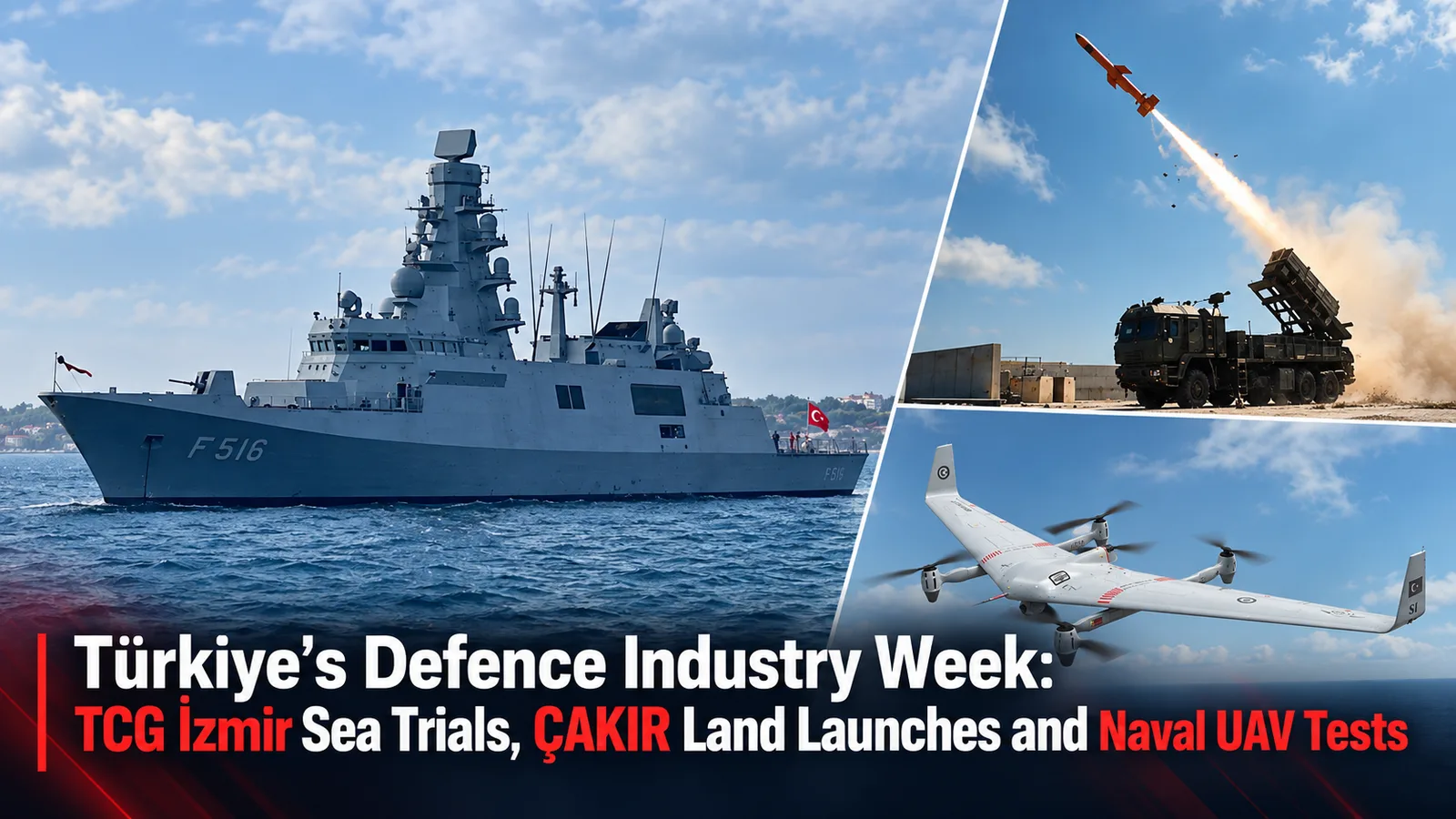
Türkiye’s defence industry closed the 24–30 August 2026 period with a cluster of naval, missile, uncrewed-aircraft and communications milestones, led by the start of sea acceptance trials for the future TCG İzmir, new land-launched ÇAKIR cruise-missile firings and shipboard tests of Bayraktar KALKAN DİHA.
The Presidency of Defence Industries’ weekly roundup also highlighted the first Turkish Air Force flight-crew training for T625 GÖKBEY, helicopter qualification of MKE’s MMT-76 machine gun, operational acceptance of ASELSAN’s NATO VLF monitoring upgrade and factory acceptance of HAVELSAN’s FLEETSTAR systems for MİLGEM ships 10 and 11.
TCG İzmir Moves Into Sea Acceptance Trials
The future TCG İzmir (F-516), the second İSTİF-class frigate and sixth MİLGEM vessel, entered its sea acceptance test phase in August 2026.
Anadolu Shipyard announced the milestone on 26 August, while independent naval reporting states that the ship first put to sea for the trials on 10 August. Sea acceptance testing moves the vessel beyond harbour activity into propulsion, manoeuvring, navigation, electrical, communications and other platform-system validation under operating conditions.
The milestone advances the first privately built follow-on İSTİF-class frigates toward delivery while expanding Türkiye’s serial warship-production model beyond the lead TCG İstanbul.
ÇAKIR Demonstrates a Land-Launched Strike Path
ROKETSAN conducted two separate land-launched ÇAKIR cruise-missile firings, striking one ground target and one maritime target.
The missile used a new-generation imaging-infrared seeker, while the test campaign also validated a new fuel system and an extended-range configuration.
The exact firing ranges were not disclosed. Defence Agenda therefore does not equate the August test with earlier catalogue figures or assume the shots were conducted at maximum published range.
KALKAN DİHA Moves From Inventory Entry to Shipboard Evaluation
Bayraktar KALKAN DİHA conducted successful shipboard flight tests on TCG Anadolu and the Ada-class corvette TCG Burgazada.
The tests came only days after the compact VTOL UAV was formally accepted into Türkiye’s inventory during TEKNOFEST Mavi Vatan.
Testing on two very different ships suggests that the Turkish Navy is evaluating a distributed maritime-ISR concept in which compact VTOL aircraft could be used across multiple ship classes.
The tests should not yet be treated as fleet-wide operational qualification. No public source confirms permanent ship assignments, procurement quantities or a completed Navy-wide certification process.
GÖKBEY Air Force Crew Training Reaches a New Milestone
The first flight crew assigned to the Turkish Air Force’s T625 GÖKBEY general-purpose helicopter completed training at Turkish Aerospace facilities.
The Ministry of National Defence said the aircraft was preparing to enter Air Force inventory in October 2026.
The training milestone shows programme activity moving beyond aircraft production and test toward force generation.
MKE MMT-76 Clears Helicopter Qualification
MKE’s 7.62×51 mm MMT-76 machine gun completed helicopter qualification after a campaign covering vibration simulation, reliability and durability, low- and high-temperature testing and air-to-ground firing.
Test footage shows the weapon firing from an AS532 Cougar operated by the Turkish Land Forces.
No fleet-wide procurement quantity, contract value or standardised aircraft allocation was disclosed.
ASELSAN’s NATO VLF Upgrade Enters Service
ASELSAN completed the “Upgrade and Refresh of Very Low Frequency Over the Air Monitoring Equipment” project for the NATO Communications and Information Agency ahead of schedule.
The project integrated ASELSAN-developed equipment into NATO’s VLF over-the-air monitoring infrastructure and included installation, verification, acceptance testing and user training.
The operational user is Allied Maritime Command. The project should be described as an OTAM monitoring-system modernisation rather than as replacement of NATO’s entire VLF communications network.
FLEETSTAR Passes Factory Acceptance for MİLGEM Ships 10 and 11
HAVELSAN’s FLEETSTAR Ship Data Distribution System completed factory acceptance testing for the 10th and 11th MİLGEM ships.
FLEETSTAR functions as a platform data backbone, managing data exchange among sensors, weapon systems, mission systems and other shipboard subsystems.
The factory acceptance milestone does not itself mean the ships have completed installation, harbour acceptance or sea acceptance of the integrated system.
One Week, Multiple Maturity Stages
The most useful way to interpret the SSB roundup is by programme maturity rather than by counting announcements.
TCG İzmir moved into sea acceptance testing. ÇAKIR expanded its demonstrated launch architecture. KALKAN moved from inventory acceptance into shipboard testing. GÖKBEY advanced force-generation readiness through crew training. MMT-76 completed a new platform qualification. ASELSAN’s VLF project reached operational acceptance. FLEETSTAR completed a factory-level acceptance milestone.
These are different stages of the acquisition lifecycle and should not be presented as equivalent deliveries.
Naval Industrial Momentum Is the Dominant Theme
Four of the week’s most consequential developments were directly tied to maritime capability: TCG İzmir sea trials, KALKAN shipboard tests, ASELSAN’s NATO maritime VLF monitoring project and FLEETSTAR work for follow-on MİLGEM ships.
This aligns with a broader expansion in Türkiye’s naval industrial base. Defence Agenda previously reported that Türkiye has more than 60 warships under construction for domestic and export customers, while MİLGEM-derived platforms increasingly combine indigenous sensors, combat-management systems, weapons and data-distribution infrastructure.
Limitations and Counterpoint
The SSB weekly roundup is a government summary and compresses a large number of programme updates into short statements.
Several details require source separation. TCG İzmir’s sea trials were announced in late August, but reporting indicates the vessel first went to sea on 10 August. ÇAKIR’s exact test ranges were not disclosed. KALKAN’s successful shipboard flights do not yet establish fleet-wide qualification. GÖKBEY crew training does not itself constitute aircraft delivery. MMT-76 qualification does not reveal procurement quantity. FLEETSTAR factory acceptance is not the same as shipboard acceptance.
Implications / Next
The next milestones to watch are completion of TCG İzmir’s sea acceptance programme, further land-launched ÇAKIR qualification, additional KALKAN shipboard trials, the planned Turkish Air Force GÖKBEY inventory entry, operational fielding of helicopter-qualified MMT-76, follow-on NCIA work for ASELSAN and shipboard integration of FLEETSTAR on MİLGEM ships 10 and 11.
Conclusion
The 24–30 August period showed Türkiye’s defence industry advancing multiple programmes at different maturity levels rather than producing a single headline event.
The dominant pattern was transition: ships moving to sea trials, weapons moving to new launch platforms, UAVs moving aboard warships, helicopter programmes moving into crew preparation, weapons moving into airborne qualification and electronics moving through acceptance into operational use.