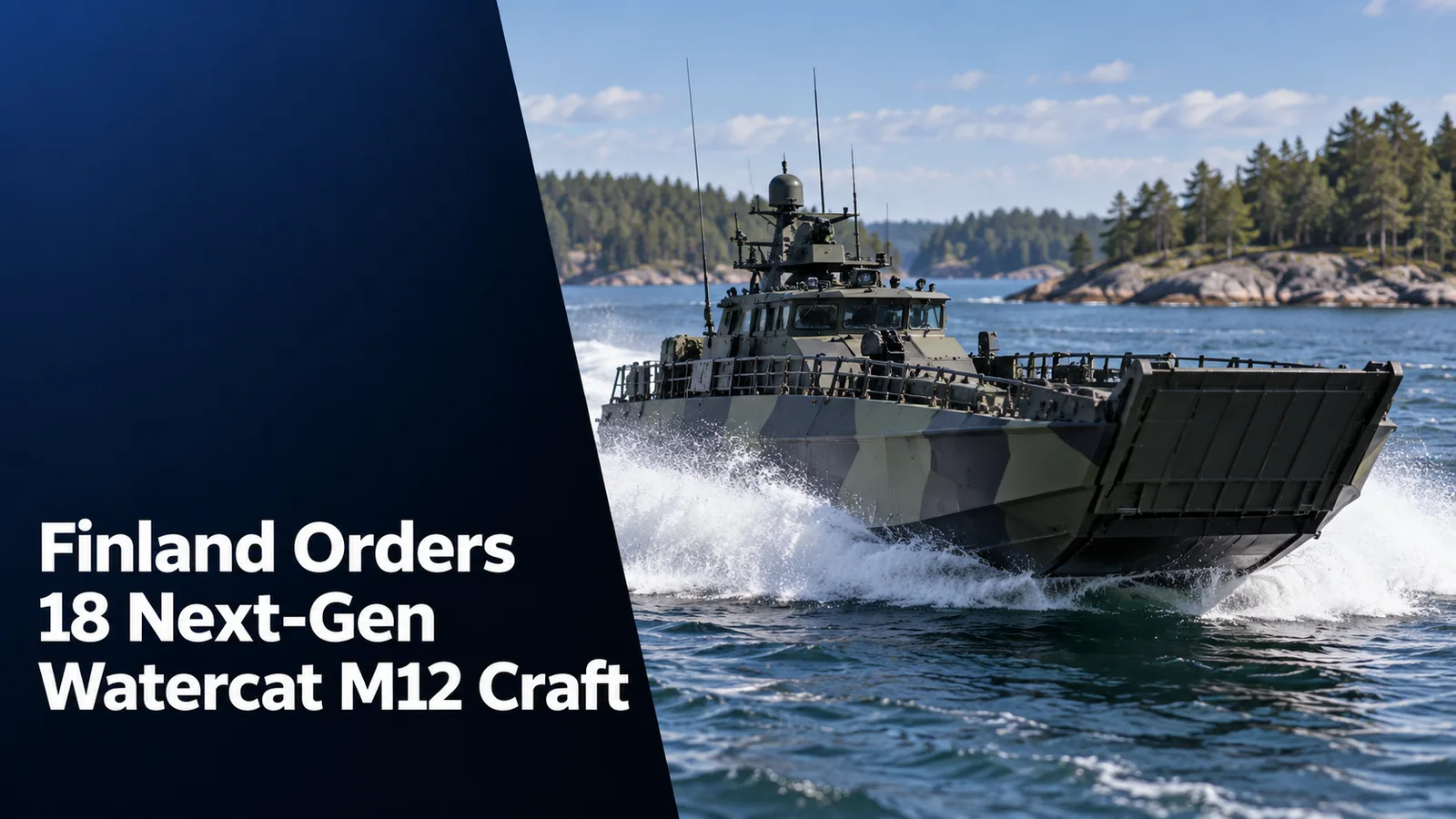
Finland has ordered 18 next-generation Jurmo-class landing craft from Marine Alutech, which markets the family as the Watercat M12. Nordic Defence Sector, citing the Finnish Defence Forces Logistics Command, reports a contract value of €25.2 million and a delivery period running from 2027 through the end of 2029. Marine Alutech also announced the 18-vessel agreement on 1 September 2026, establishing the quantity and the builder independently of later trade reporting.
Finland Is Refreshing a Proven Coastal Mobility Fleet
The procurement is best understood as a renewal of an established coastal-mobility capability. Jurmo craft have been used to move troops and materiel through Finland's archipelagic operating environment, where shallow water, narrow routes and dispersed islands impose different requirements from blue-water naval operations. The new order therefore prioritises tactical mobility and sustainment close to shore rather than a large-ship combat role.
The Next-Generation Variant Builds on the Existing M12 Family
Marine Alutech's baseline Watercat M12 family uses waterjet propulsion and a bow-ramp configuration designed for rapid loading and unloading in shallow coastal waters. Current reporting on the new Jurmo-NG variant describes an evolved design that retains the basic operational concept while incorporating updates based on service experience and modern requirements. Because the new craft are described as next-generation boats, older M12 specifications should not automatically be treated as exact contract specifications for every new vessel.
That distinction is important for technical reporting. Public sources provide the order quantity, value, builder and delivery period more clearly than they provide a complete final configuration. Weapon fit, electronic suite, protection level and detailed dimensions should therefore be attributed only when confirmed for the new production standard rather than copied from an earlier Watercat M12 data sheet.
Archipelagic Warfare Puts a Premium on Distributed Logistics
Finland's coastline and island geography reward small craft that can disperse, move quickly and use locations inaccessible to larger ships. In a high-threat environment, the ability to move troops, ammunition and supplies between dispersed positions can be as important as the combat systems carried by larger naval platforms. Landing craft also provide commanders with more routing options when fixed infrastructure is vulnerable or congested.
A fleet of 18 new craft gives the Finnish Navy a meaningful replacement and reinforcement package rather than a one-off demonstrator. It also sustains domestic shipbuilding competence at Marine Alutech, which has decades of experience with Finnish military and security customers. The industrial value lies not only in hull construction but in maintaining design, integration, support and repair knowledge inside Finland.
Delivery Performance Will Define the Programme's Near-Term Value
The reported 2027–2029 delivery window gives the programme a clear schedule against which progress can be measured. The €25.2 million figure should be treated as the reported procurement value for the 18-vessel package, not as a simple per-boat price, because support, spares and associated services can affect contract composition. Public reporting does not provide enough detail to isolate a clean flyaway-equivalent vessel cost.
The next milestones are production start, first-vessel acceptance and the rate at which the Finnish Navy receives the remaining craft. Configuration disclosure will also matter, especially if the next-generation boats introduce new communications, protection or weapon features. Until then, the strongest confirmed story is a domestic 18-vessel renewal programme with a defined multi-year delivery schedule.
Implications / Next
The next publication-grade milestone will be the first independently verifiable event that changes the programme status described above, such as a delivery, acceptance event, production start, exercised option, operational test or formal fielding decision. Defence Agenda will continue to separate these maturity stages and will not treat an announcement, contract or first test as proof that the full capability has already entered operational service.