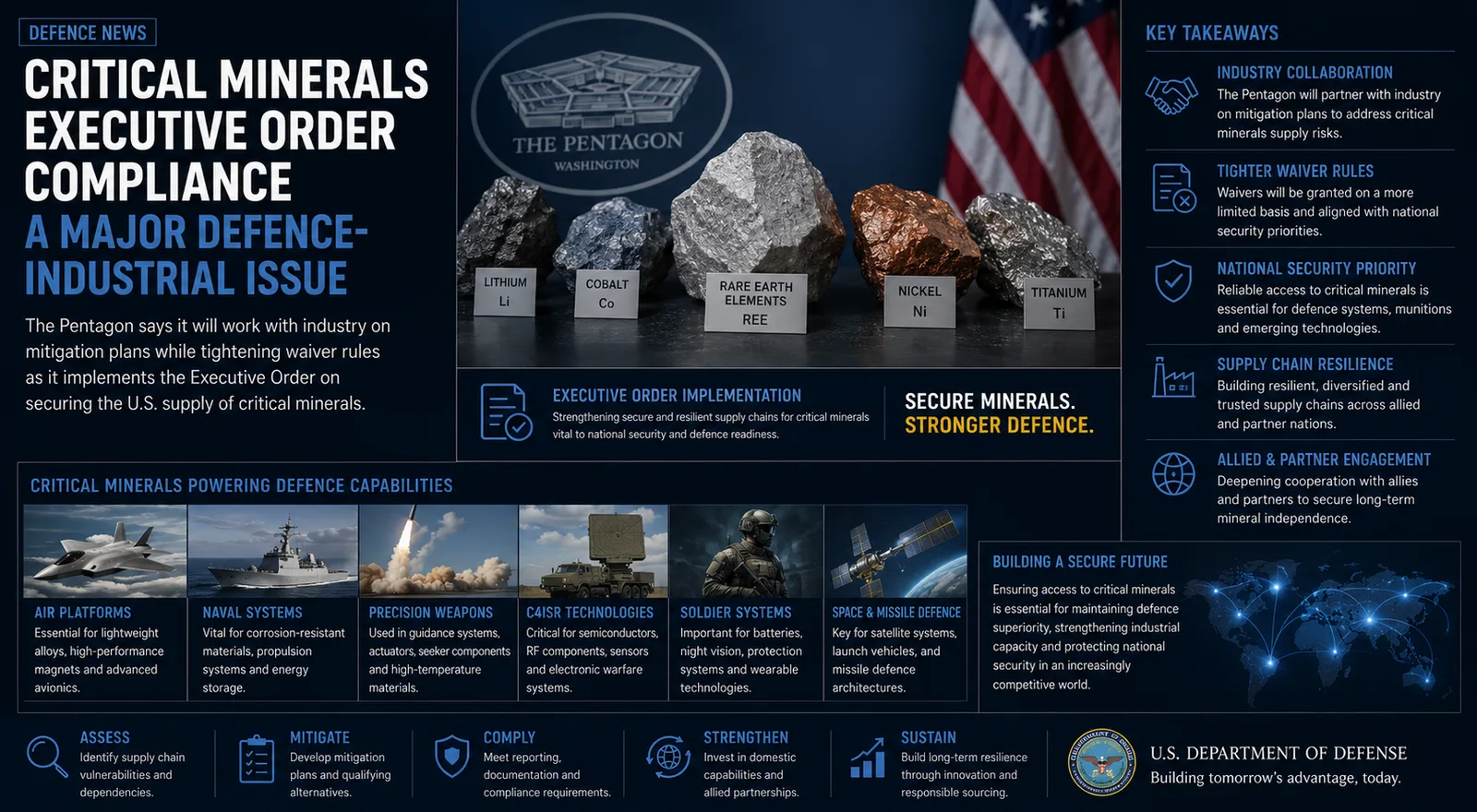
Critical minerals executive order compliance is becoming a major test for the U.S. defence industrial base as the Pentagon signals that it is willing to work with companies facing realistic supply-chain transition challenges.
Breaking Defense reported that Michael Cadenazzi, the assistant secretary of defense for industrial base policy, said the department wants to understand how companies plan to resolve critical-mineral sourcing problems through domestic sourcing, friendshoring or supplier changes.
The message is important because the new White House order tightens the use of waivers for covered materials and pushes contractors toward deeper supply-chain transparency. For defence companies, the issue is no longer only whether a final product is compliant. It is whether the entire chain can be traced back to the origin of raw materials.
Critical Minerals Executive Order Moves Supply Chain Risk Upstream
The strategic shift is clear. The executive order moves defence supply-chain security upstream from finished systems and major components to raw materials, processing, sub-tier suppliers, software, equipment and parts.
The White House order requires policy and implementation guidance for prime contractors and subcontractors at any tier to map and illuminate critical supply chains for national-security-related acquisitions from raw materials to end-use products.
This is a major expansion of the compliance burden. It turns supply-chain visibility into a national-security requirement and makes lower-tier transparency a central part of defence procurement.
The Pentagon Is Asking for Mitigation Plans
Cadenazzi’s comments suggest that the Pentagon is not looking for a sudden industry shock. Instead, it wants companies to show credible plans.
The practical question for contractors will be whether they can identify supply-chain gaps, explain why those gaps exist, show what alternatives are being pursued and define how long a bridge period may be needed.
This makes mitigation planning central. A company that cannot immediately eliminate a risky source may still need to prove that it understands the problem and has a realistic pathway to domestic or allied sourcing.
Waivers Become Harder After January 2027
The most direct pressure point is the waiver timeline. The order pushes the Pentagon toward stopping waivers from the start of 2027 unless a contractor submits an acceptable formal mitigation plan.
This changes the logic of compliance. Waivers can no longer be treated as a routine way to keep legacy supply chains operating. They become exceptional tools tied to documented transition plans.
For companies that rely on minerals, magnets, alloys, electronics or processing chains linked to China or other prohibited suppliers, the next months could become a supply-chain audit sprint.
Industry Says the Timeline Is Difficult
Industry concern is centred on feasibility. Breaking Defense reported that the Aerospace Industries Association warned the order could disrupt efforts to strengthen supply-chain security if implemented without workable pathways.
The concern is not opposition to supply-chain resilience. The concern is that domestic sources may not yet exist for some minerals, while available sources may lack the scale, purity or processing capacity required by aerospace and defence systems.
This is why the timeline matters. A mine, processing plant or qualified defence supplier cannot usually be created in months. Qualification, certification and reliability testing can take far longer than policy deadlines.
The Real Problem Is Processing and Traceability
The hardest part of critical-mineral security is often not the mine. It is processing, refining and traceability.
Critical minerals may be mined in one country, processed in another, mixed with inputs from multiple sources and then incorporated into components several tiers below the prime contractor. At that point, origin data can become difficult to verify.
This creates a “black box” problem for defence companies. They may know a direct supplier, but not always the true origin of the refined material embedded in a magnet, sensor, alloy, battery, circuit or actuator.
Friendshoring Becomes a Defence Procurement Tool
The Pentagon’s preferred solution is not only domestic sourcing. Cadenazzi also pointed to friendshoring, meaning supply-chain movement toward trusted allies and partners.
This is important because the United States may not be able to build every required mineral and processing capacity domestically at the speed defence programmes need.
Trusted allied supply chains could therefore become essential. Countries with mining, refining, magnet production, materials science, aerospace manufacturing or semiconductor capacity may gain new strategic value in U.S. defence procurement.
Costs Could Rise Before Resilience Improves
The order could increase costs in the near term. China has built large-scale mineral processing and rare-earth capacity over many years. Replicating or replacing that capacity in the United States and allied countries will require investment.
New suppliers may be more expensive. Qualification may add time. Documentation requirements may increase administrative burden. Some companies may need to redesign sourcing strategies for complex weapon systems already in production.
However, the strategic argument is that higher near-term costs may be preferable to wartime supply disruption. Defence systems that depend on adversary-controlled materials can create hidden operational risk.
The Order Is About More Than Rare Earths
Public debate often focuses on rare earths. Yet the defence supply-chain issue is broader. Modern military systems depend on critical minerals, speciality alloys, magnets, energetic materials, electronics, software, sensors, batteries and advanced manufacturing inputs.
A fighter aircraft, missile, radar, satellite, drone or armoured vehicle may contain thousands of parts sourced through many tiers of suppliers. Even a small hidden dependency can become a production bottleneck if geopolitical conditions change.
This is why raw-material traceability has become a procurement issue. The Pentagon wants to understand not only what a prime contractor delivers, but what the entire industrial chain depends on.
Prime Contractors Will Need Deeper Sub-Tier Visibility
Prime contractors are likely to face the largest reporting burden. They will need to collect, verify and update data from subcontractors and suppliers across multiple tiers.
This may require new digital tools, supplier declarations, contractual clauses, risk-scoring systems and bill-of-materials traceability processes.
Smaller subcontractors may face the hardest adjustment. They may lack compliance teams, supply-chain software or leverage over their own upstream suppliers. Pentagon flexibility will therefore be important if the policy is to strengthen rather than disrupt production.
Supply Chain Mapping Becomes Strategic Intelligence
Supply-chain mapping is not only a compliance exercise. It is also strategic intelligence for the defence acquisition system.
Once the Pentagon can see lower-tier dependencies, it can identify bottlenecks, single points of failure, concentration risks and areas where government investment may be required.
This could influence future industrial-base policy, Defence Production Act investments, stockpiling, allied agreements and supplier qualification programmes.
The Policy Could Create New Allied Opportunities
Allied suppliers could benefit from the new sourcing pressure. Companies in countries with trusted mineral resources, processing capabilities, magnet manufacturing, battery materials, advanced metallurgy or semiconductor inputs may become more attractive to U.S. primes.
This could support friendshoring partnerships with Canada, Australia, Japan, South Korea, the United Kingdom, European Union countries and other trusted partners.
However, allied suppliers will also need to prove traceability. Being located in a friendly country may not be enough if upstream processing still depends on prohibited or high-risk sources.
The Qualification Challenge Is Serious
Defence supply chains cannot always switch suppliers quickly. New materials and components may need qualification, certification, testing and integration approval before they can be used in military systems.
This is especially true for aerospace, missiles, space systems, naval systems and high-reliability electronics. A material substitution that looks simple on paper can create performance, durability, safety or certification issues.
Therefore, the order’s success will depend on whether policy timelines align with engineering and certification realities.
A Practical Compliance Roadmap for Defence Firms
Defence companies should begin with supply-chain segmentation. They need to identify which programmes, materials, subsystems and suppliers fall under the highest national-security and critical-material risk.
The second step is supplier mapping. Firms should trace critical inputs beyond direct suppliers and identify where mining, refining, processing and component manufacturing actually occur.
The third step is risk classification. Companies should distinguish between prohibited suppliers, single-source dependencies, processing bottlenecks, quality risks, documentation gaps and surge-capacity limitations.
The fourth step is mitigation planning. This should include domestic alternatives, allied alternatives, qualification timelines, stockpiling needs, redesign options and cost impacts.
The fifth step is engagement with the Pentagon. Companies that show credible plans are more likely to receive constructive support during the transition.
What the Pentagon Needs From Industry
The Pentagon will need more than broad statements of concern. It will need evidence-based mitigation plans that show where the problem is, what alternatives exist and what government support may be required.
Companies should be ready to explain whether a gap is caused by missing domestic production, inadequate allied processing, purity requirements, qualification delays, cost barriers or lack of supplier visibility.
This level of detail can help the department decide where to use policy flexibility, financing, supplier qualification support or industrial-base investment.
The Main Risk Is Disruption Without Capacity
The main risk is that tighter rules move faster than replacement capacity. If companies are pushed away from prohibited sources before alternatives are qualified, production could slow or costs could rise sharply.
That risk is especially serious at a time when the United States and allies are trying to expand production of munitions, air defence, missiles, drones, naval systems and space capabilities.
The policy challenge is therefore balance. The Pentagon must reduce adversary dependence without creating short-term production bottlenecks that weaken readiness.
The Main Opportunity Is Industrial Visibility
The main opportunity is better visibility. If implemented well, the critical minerals executive order could give the Pentagon a much clearer view of where defence production is vulnerable.
That visibility could help the government target investment, build allied supply chains, reduce single-source dependencies and improve surge readiness.
For industry, the same visibility could support better supplier management, stronger resilience planning and more credible export and procurement positioning.
Conclusion
The critical minerals executive order is turning supply-chain visibility into a defence procurement requirement. It pressures contractors to map critical inputs, reduce dependence on prohibited suppliers and build credible mitigation plans before waiver rules tighten.
The Pentagon’s willingness to work with companies is important. The transition will require domestic sourcing, friendshoring, supplier qualification, cost management and government-industry coordination.
The strategic direction is clear: defence supply chains are becoming part of the battlespace. The companies that understand their material dependencies, trace their upstream risks and build allied alternatives will be better positioned for the next phase of defence-industrial competition.
For further Defence Agenda coverage, read our defence industry, defence procurement and defence technology sections. Related analysis includes ITAR-free defence products and export-control pressure, dual-use defence technologies and innovation and defence export event calendar and industrial outreach.
Further Reading
- Breaking Defense: Pentagon willing to work with industry over critical mineral EO concerns
- White House: Securing America’s Defense Supply Chains and Ensuring Domestic Acquisition of Critical Materials
- White House Fact Sheet: Defense supply chains and critical materials
- Reuters: Trump orders tightening of defense supply-chain waiver rules
- Aerospace Industries Association: News and policy statements