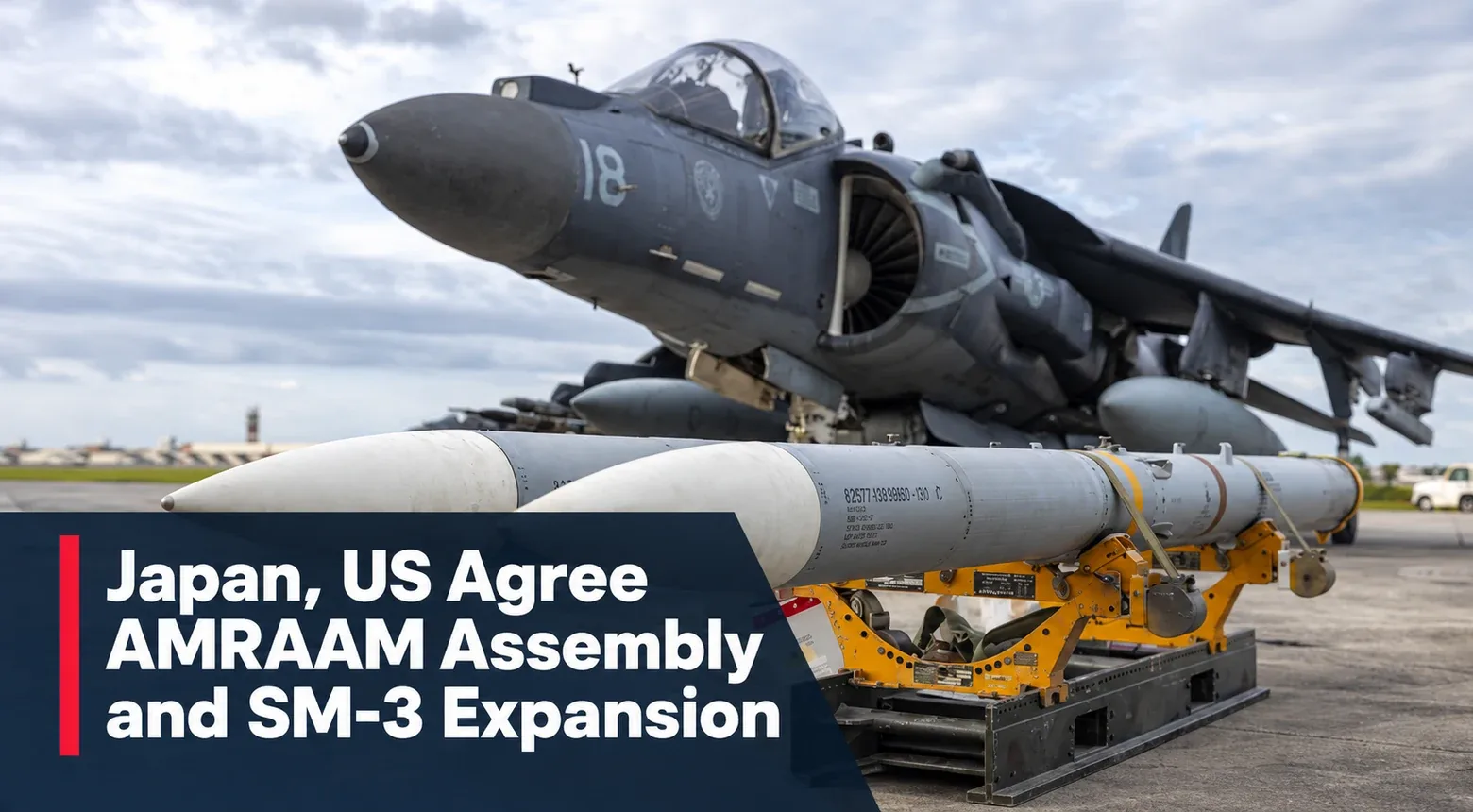
Japan and the United States have agreed to establish an AMRAAM final assembly and checkout (FACO) facility in Japan and share technical information intended to increase production of the SM-3 Block IIA ballistic-missile interceptor. The agreement was reached during talks on 28 October 2026 between Japanese Defence Minister Shinjiro Koizumi and US Secretary of War Pete Hegseth in the Philippines. The Japan US AMRAAM assembly decision matters because it moves a long-discussed industrial proposal into an agreed workstream while linking air-to-air missile supply and naval missile defence to the wider resilience of the alliance's munitions base.
Japan–US Missile Production Agreement: What Was Decided
The two ministers met for about 30 minutes from 08:30 local time on 28 October 2026 while attending meetings associated with the ASEAN Defence Ministers' Meeting Plus. In its official English-language summary, Japan's Ministry of Defence confirmed two separate industry measures under Operation Supercharge, an initiative aimed at accelerating bilateral defence equipment and technology cooperation.
First, Japan and the United States agreed to establish a facility in Japan for the final assembly and checkout of Advanced Medium-Range Air-to-Air Missiles (AMRAAMs). Secondly, they agreed to share the technical information needed to enable increased production of the SM-3 Block IIA interceptor. These are related but distinct programmes: the AMRAAM facility concerns air-to-air weapons, while the SM-3 arrangement concerns a sea-based ballistic-missile defence interceptor.
The announcement does not disclose the future AMRAAM facility's location, selected industrial operator, production rate, cost or start-of-operation date. Nor does it quantify the additional SM-3 Block IIA missiles that will result from the information-sharing agreement. The official statement should therefore be understood as a programme and industrial-cooperation milestone, not evidence that a new Japanese production line is already delivering missiles.
From Feasibility Study to AMRAAM Assembly Agreement
The decision builds on work undertaken earlier in 2026. At the fourth Japan–US Defence Industrial Cooperation, Acquisition and Sustainment meeting in April, both countries reported progress on a feasibility study involving Mitsubishi Electric and Raytheon. They identified circuit-card assemblies as a potential co-production area and committed to continue examining a final assembly and checkout facility in Japan.
The October announcement advances the latter proposal from discussion to agreement on establishing the facility. However, identifying companies involved in the feasibility study is not the same as formally awarding a contract for its construction or operation. Neither the October ministerial summary nor the referenced earlier work names a confirmed prime contractor for the new Japanese FACO installation.
The industrial distinction also matters. Final assembly and checkout typically represent the latter stages of the production chain, including completion, inspection and acceptance-related processes. They do not, by themselves, establish that rocket motors, seekers, guidance electronics and all other components will be made domestically. Any claim of fully indigenous Japanese AMRAAM production would require separate evidence.
Why AIM-120 AMRAAM Matters to Japan's F-35 Fleet
AMRAAM is a beyond-visual-range air-to-air missile used by US and allied combat aircraft. Japan's minister described the weapon as essential to the F-35 in his 28 October press conference. A domestic final-assembly and checkout capability could potentially improve supply-chain resilience, shorten selected logistics processes and develop local manufacturing expertise. Those benefits will depend on production arrangements, export controls, component origin and the eventual division of responsibilities between the partners.
The planned Japanese facility sits alongside a much larger US-led production effort. On 28 September 2026, RTX's Raytheon announced a multi-year AMRAAM contract valued at up to $20.7 billion, comprising a five-year term and two option years. The company said the associated industrial framework supports an annual output target of at least 1,900 missiles.
That 1,900-per-year target is not a Japanese facility production target. It describes the wider Raytheon production expansion. No comparable rate has been published for the prospective Japanese assembly installation, and the value of the Raytheon contract must not be described as the budget for the new facility.
SM-3 Block IIA Production: Technology Sharing, Not a Delivery Announcement
The second agreement covers the SM-3 Block IIA, the US–Japan co-developed interceptor intended for ballistic-missile defence. Unlike AMRAAM, which is designed to engage airborne targets, the SM-3 family forms part of the Aegis ballistic-missile defence architecture and intercepts ballistic threats in the midcourse phase of flight.
The 28 October joint decision is specifically about sharing technical information required to expand SM-3 Block IIA production. It does not announce a newly completed interceptor, a specific batch delivery or an immediately operational additional inventory. Japan and the United States will still need to translate shared technical data into manufacturing throughput, supplier qualification and accepted deliveries.
An April 2026 defence-industry cooperation statement had already described measures aimed at increasing SM-3 Block IIA production by approximately four times. This earlier ambition provides context, but it must not be misrepresented as a new, independently confirmed output figure for the October agreement. The October summary itself gives no updated production timetable or independently measured rate.
As Defence Agenda previously reported in its analysis of Raytheon's SM-3 Block IB production agreement, Block IB and Block IIA are separate variants with different industrial and acquisition arrangements. The October US–Japan development concerns Block IIA, not a transfer of the separate Block IB contract to Japan.
Operation Supercharge and Alliance Deterrence
The meeting went beyond industrial measures. According to the Japanese ministry, the ministers agreed to accelerate cooperation on integrated air and missile defence, more flexible and distributed aircraft operations, wider reciprocal facility access and an increased combined presence in Japan's southwestern region. They also welcomed the progress of Keen Sword 27 exercises during October 2026.
These actions are linked by a common planning problem: deterrence depends not only on advanced weapon designs but also on having enough munitions available, sustaining aircraft dispersal and ensuring forces can train and operate together. Missile production is therefore an enabling industrial issue rather than an isolated procurement headline.
Japan's official statement frames the talks against regional military expansion and the build-up of nuclear and missile capabilities. It does not announce a specific combat deployment or an agreed military response to any particular country. The Defence Agenda review of US–Japan missile-defence development provides additional context on the distinction between development agreements, testing and fully deployed interceptors.
Procurement and Industrial Risks
There are at least four unresolved areas. First is governance and contracting: the partners have not disclosed who will operate the FACO facility or how responsibility for quality assurance and final acceptance will be allocated. Second is component supply: local final assembly cannot remove bottlenecks in foreign-sourced subassemblies unless production and export permissions also support the required flow.
Third is cost and funding. Neither government disclosed a capital budget, yearly operating allocation, or Japan-specific production quantity with this announcement. The proposal should not be treated as a completed investment simply because the ministerial agreement was reached. Fourth is programme scheduling: a site decision, industrial contract, workforce training, certification and acceptance process remain potential milestones to monitor.
For the US industrial base, the FACO arrangement could complement a broader drive to increase production rates. RTX said in its September AMRAAM announcement that it was investing in facilities and suppliers to meet US and allied demand. But commercial and operational benefits depend on contracts being executed and deliveries accepted, not merely on the stated size of an agreement.
Implications / Next
The next verifiable developments will be the selection of a Japanese facility and industrial partner, the publication of an implementation schedule, the scope of any locally manufactured components, and the first reported production and acceptance milestones. For SM-3 Block IIA, relevant evidence will include agreed production-rate milestones, funded manufacturing changes and completed missile deliveries.
The 28 October 2026 agreement establishes an important direction for US–Japan missile-industrial cooperation. It does not establish that Japan has begun manufacturing complete AMRAAMs or that SM-3 Block IIA output has already risen. The strategic test will be whether the partners can translate industrial policy into qualified, scalable and deliverable military capability.
Further Reading
- Japan Ministry of Defence — Japan–US Defence Ministerial Meeting, 28 October 2026
- Japan Ministry of Defence — Defence Industrial Cooperation, April 2026
- RTX Raytheon — AMRAAM production agreement, 28 September 2026
- Breaking Defense — Japan–US AMRAAM and SM-3 production agreements, 29 October 2026
- Defence Agenda — Raytheon SM-3 Block IB production agreement
- Defence Agenda — US–Japan missile-defence development
- Defence Agenda — RTX Q3 2026 defence backlog