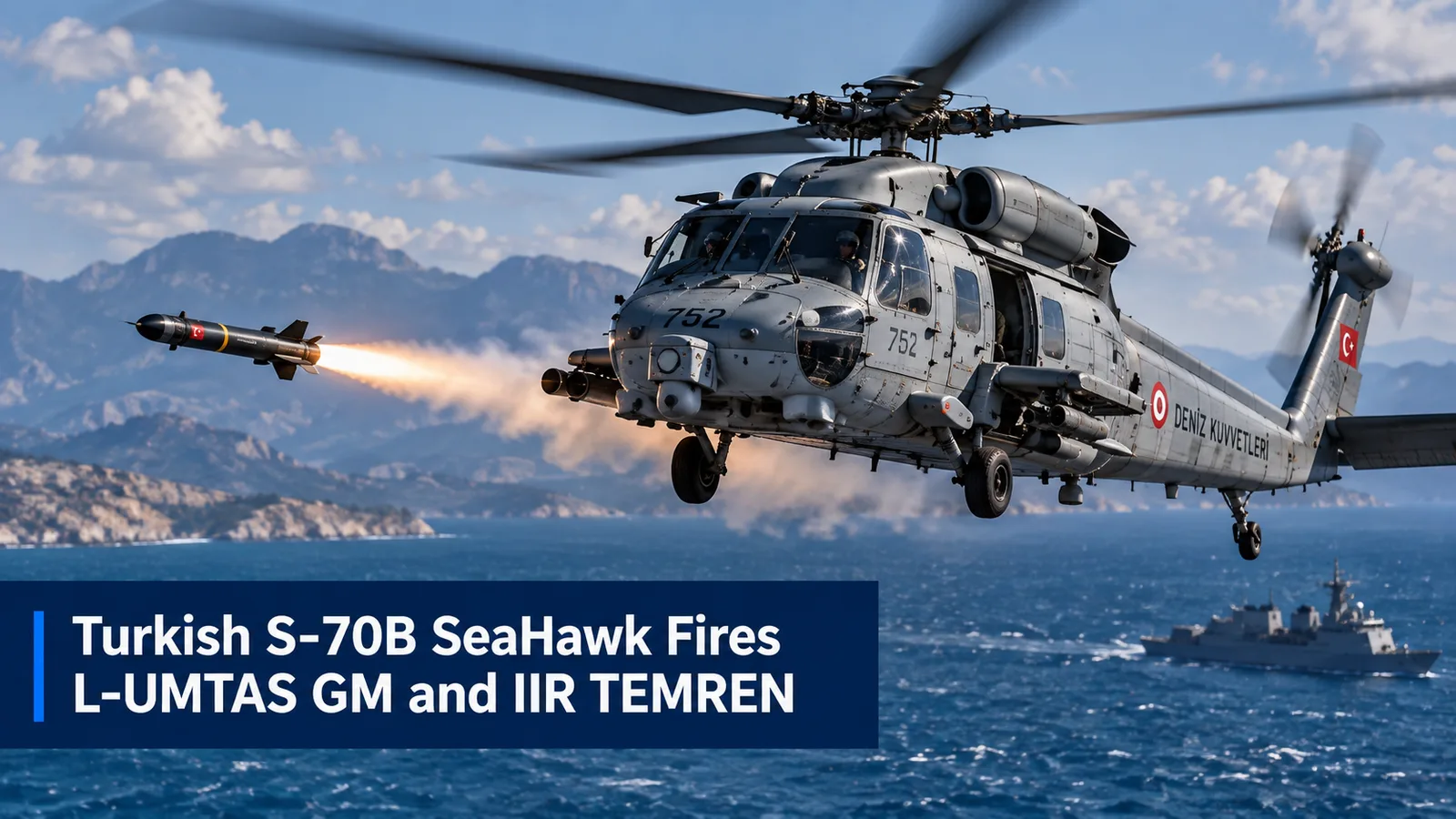
Türkiye has conducted air-to-surface and air-to-air firings of ROKETSAN L-UMTAS GM and IIR TEMREN munitions from S-70B SeaHawk helicopters, according to footage released by the Ministry of National Defence on 13 September 2026. The ministry characterises the activity as alternative-configuration development work, so the event is a live-fire integration milestone rather than proof that the new weapon configurations have completed qualification or entered fleet-wide service.
MSB confirms air-to-surface and air-to-air firing activity
The Ministry of National Defence said the firings were conducted within ROKETSAN’s Laser-Guided Long-Range Anti-Tank Extended-Range Project and specifically referred to alternative-configuration development. Anadolu Ajansı’s summary of the ministry statement confirms that L-UMTAS GM and IIR TEMREN were used in air-to-surface and air-to-air firings. Separate specialist reporting places the activity in the Beşadalar/Antalya area during 8–10 September.
The wording should be preserved carefully. A development firing demonstrates that the weapon, aircraft interfaces and engagement chain have reached a level suitable for live testing, but it does not establish that the Turkish Navy has formally accepted the configuration. No publicly verified quantity, delivery schedule or operational-unit fielding declaration accompanied the footage.
L-UMTAS GM extends the anti-armour family into longer-range roles
ROKETSAN’s published L/UMTAS-GM brochure describes a 160 mm, 42 kg missile available with imaging-infrared or semi-active laser guidance. The company states ranges of 15 km from land platforms and 20 km from air platforms for the configuration covered by that brochure, with fire-and-forget and fire-and-update modes. Those figures are official product data, but they should not be extended to an undisclosed test profile or treated as the measured range of the September firing.
The missile family’s relevance to naval aviation is its ability to give helicopters a precision stand-off weapon against surface and land targets without relying solely on legacy imported weapons. The latest test also shows that ROKETSAN is continuing to adapt the UMTAS architecture beyond its original anti-armour role.
IIR TEMREN adds another seeker and target-set pathway
ROKETSAN’s TEMREN material identifies the system as a SeaHawk-integration and guided-missile procurement project, with imaging-infrared and semi-active laser seeker options in the published baseline. Earlier public demonstrations have shown SeaHawk-launched TEMREN against surface targets. The September 2026 ministry statement is notable because it explicitly includes an air-to-air firing profile alongside air-to-surface activity.
That does not automatically make TEMREN an operational air-to-air missile. The test demonstrates an evaluated engagement mode, while the final target set, launch envelope and rules for service use require qualification and user acceptance. The air-to-air element is nevertheless technically significant because it points to a possible indigenous option against slow or low-manoeuvrability airborne targets, including some unmanned systems or helicopters, if validated through further trials.
Implications / Next
The next milestones should be additional firings across the intended engagement envelope, completion of qualification work, confirmation of the selected production configuration and an explicit service-acceptance or procurement statement. Integration with SeaHawk mission computers, sensors and fire-control procedures will also be important to watch. Until those steps are confirmed, the latest event should be reported as development testing that broadens the demonstrated mission set of Turkish naval aviation, not as a completed fleet upgrade.
The test is particularly relevant because rotary-wing anti-surface warfare depends on more than missile range. Sensor cueing, target hand-off, safe carriage, launch-envelope validation and post-launch guidance behaviour all have to work within the helicopter's mission system and operating procedures. A successful firing therefore removes part of the integration risk, but it does not by itself establish a fleet-wide configuration. Future disclosures on qualification standards, ammunition procurement and which SeaHawk airframes receive the integration will be necessary to judge the scale and timing of operational adoption.