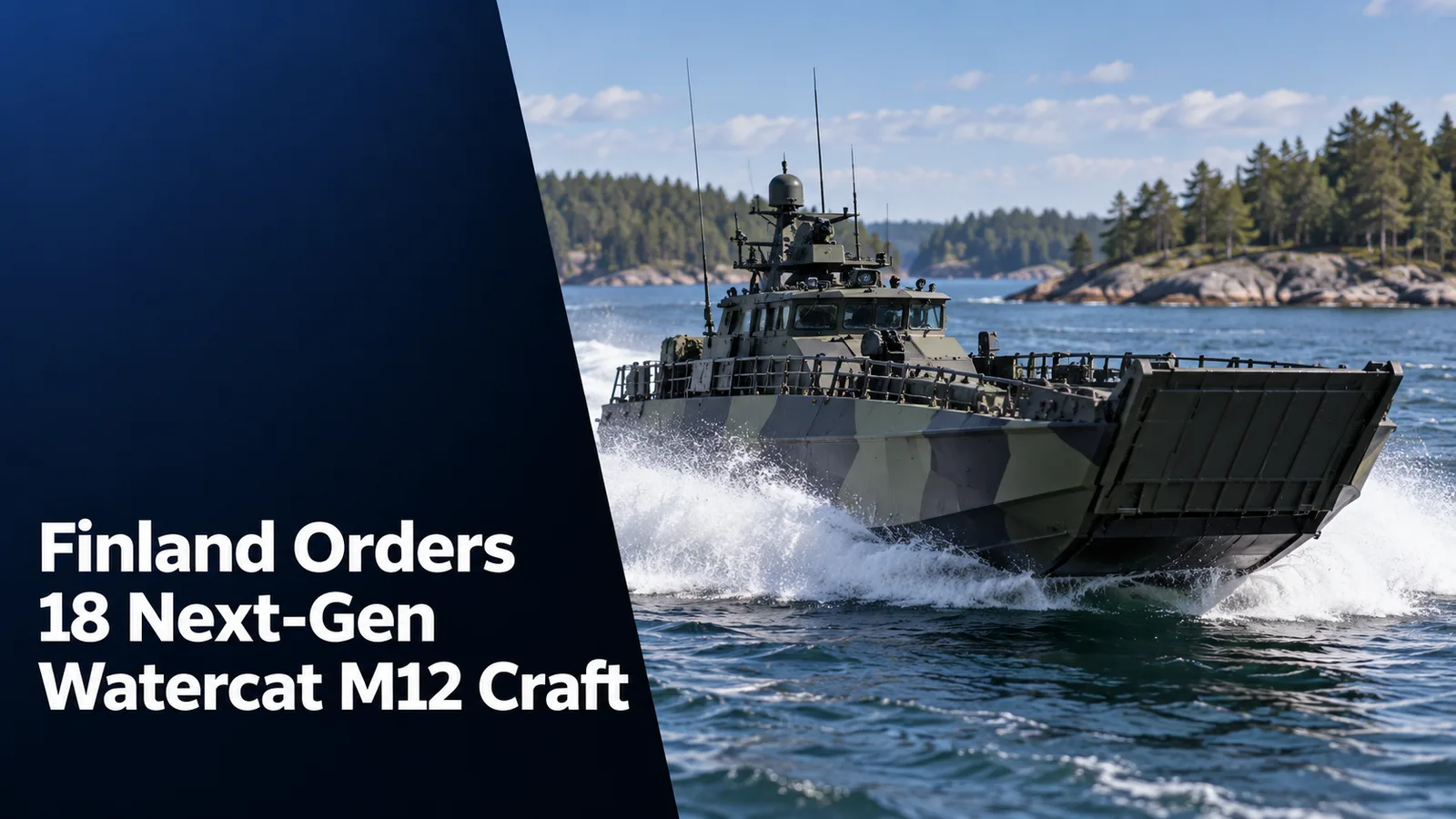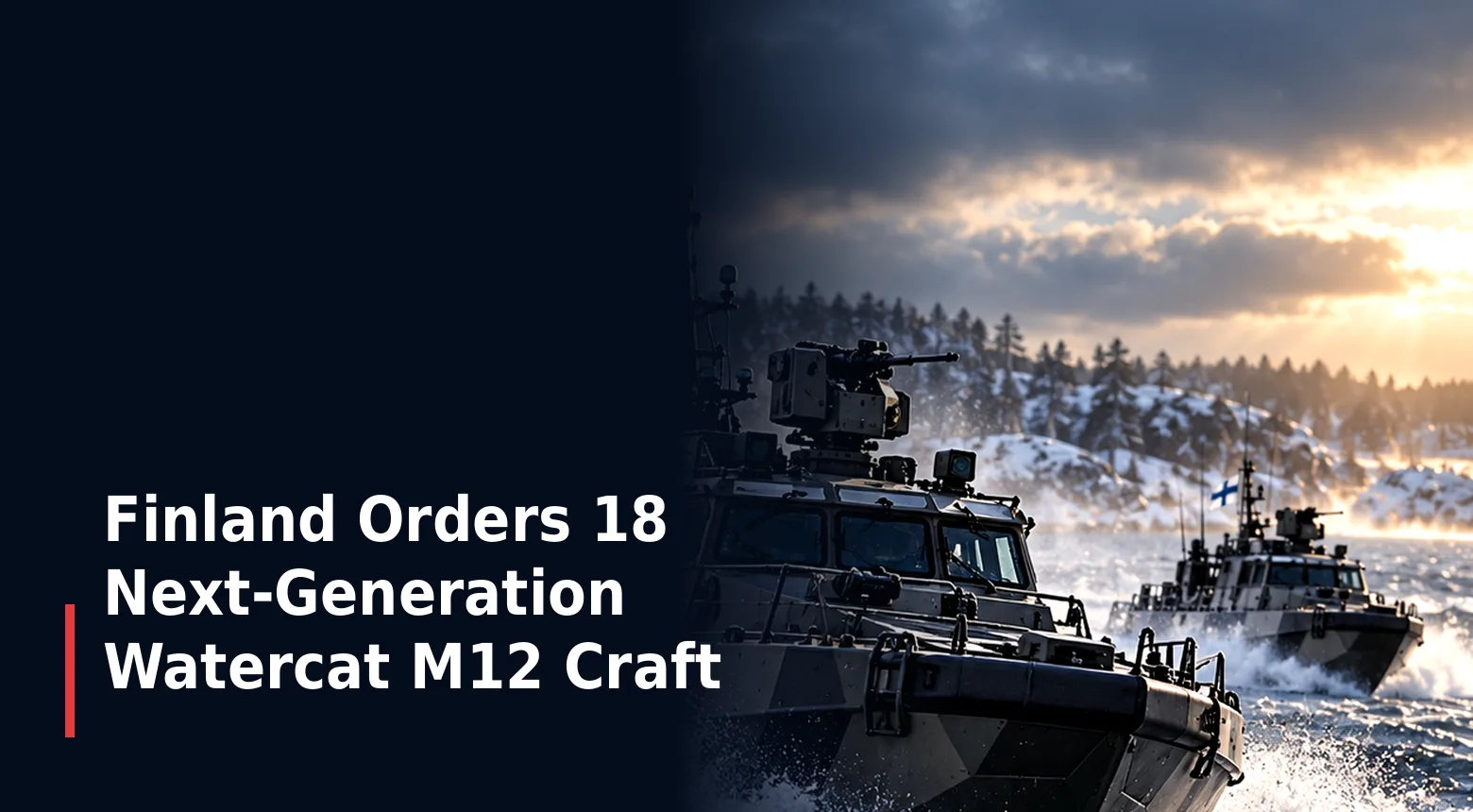
Finland has ordered 18 next-generation Watercat M12 landing craft from domestic builder Marine Alutech, according to the shipyard's 1 September 2026 announcement. The award extends the Finnish Navy's Jurmo coastal-mobility capability and supports maritime transport in shallow, island-dense waters where larger vessels have limited access.
The 18-craft award updates an established Finnish fleet
Marine Alutech announced that the Finnish Defence Forces Logistics Command had signed for 18 next-generation M12 vessels. The type belongs to the Jurmo family used for troop and equipment movement in Finland's coastal environment. This is a procurement commitment, not merely an exhibition demonstration or a request for information. Public reporting has described deliveries running between 2027 and 2029, although annual milestones and the precise customer-acceptance schedule require confirmation against the final contract.
Finland's requirement is driven by a distinctive geography. The country's Baltic coast and island approaches reward shallow-draught vessels capable of using dispersed routes and austere landing sites. A fleet of small craft can increase tactical choice when harbours or predictable transit corridors are threatened, but their utility depends on weather, navigation, situational awareness and protection provided by the wider force.
Waterjet propulsion and load handling define the role
The established Watercat M12 design uses waterjet propulsion, a bow ramp and protected seating for troops. Marine Alutech describes a hull designed to operate close to shore and to support rapid personnel or cargo transfer. Those features are relevant to archipelagic manoeuvre, where a vessel may need to approach shallow areas, disembark troops and withdraw before an adversary can respond.
Technical caution is necessary when discussing the next-generation boats. The manufacturer's existing M12 product page describes earlier variants, but legacy dimensions, equipment and weapon fits should not be copied automatically into an unspecified newer production configuration. The contract's confirmed quantity and shipbuilder are better established than its exact electronics, armament, armour or speed characteristics. Additional verified configuration data should be added only after manufacturer or Finnish Defence Forces documentation is available.
Coastal logistics creates wider operational value
Distributed maritime operations place heavy demands on tactical supply chains. Small craft can move ammunition, casualties, maintenance teams and equipment along routes where fixed infrastructure is exposed or where road access is limited. They can also help commanders shift coastal troops between islands without tying up larger warships. Nevertheless, vessel survivability depends on communications security, weather forecasting and coordination with air and coastal defence assets.
The fleet's value will therefore be measured not only by delivered hull count but by the number of boats available for training and tasking, the maintenance hours needed to sustain them, and the ability to operate with shore-based command networks. For Finland, the ability to support the craft domestically may be particularly important during a prolonged crisis when imported parts or specialist repair services face disruption.
Domestic production supports continuity and readiness
Marine Alutech's selection retains industrial work in Finland and builds on an existing customer and supplier relationship. That reduces some design and support uncertainty compared with a wholly unfamiliar platform, although any next-generation upgrade still requires testing and integration. The programme also demonstrates how comparatively modest naval systems can matter at force level when local conditions favour dispersion and fast logistics more than large single platforms.
The next credible milestone will be production progress and customer acceptance of the first new craft. Delivery should then be assessed alongside training, spares availability and fleet maintenance arrangements. Contract signing confirms an industrial commitment, but it does not mean all 18 boats are already built, accepted or operationally fielded.
Implications / Next
Monitor the first new-build Watercat M12 delivery, formal acceptance and disclosure of its actual configuration. Treat figures from earlier Jurmo variants as background rather than guaranteed specifications for the 18 contracted craft. Procurement observers should also distinguish the contracted hull quantity from the number of vessels available for a particular exercise or operation. Crew training, specialised spare parts, harbour infrastructure and maintenance capacity determine how quickly ordered craft become sustainable operational assets. Because the M12 serves a dispersed littoral mission, successful programme evaluation will involve transport reliability, access to austere landing sites and lifecycle cost alongside the vessel's advertised design characteristics.