ROKETSAN naval weapons are expanding across almost every major guided-effect requirement of the Turkish Naval Forces, from anti-ship missiles and heavyweight torpedoes to submarine-launched strike, ship-based air defence and missile-armed unmanned surface vessels.
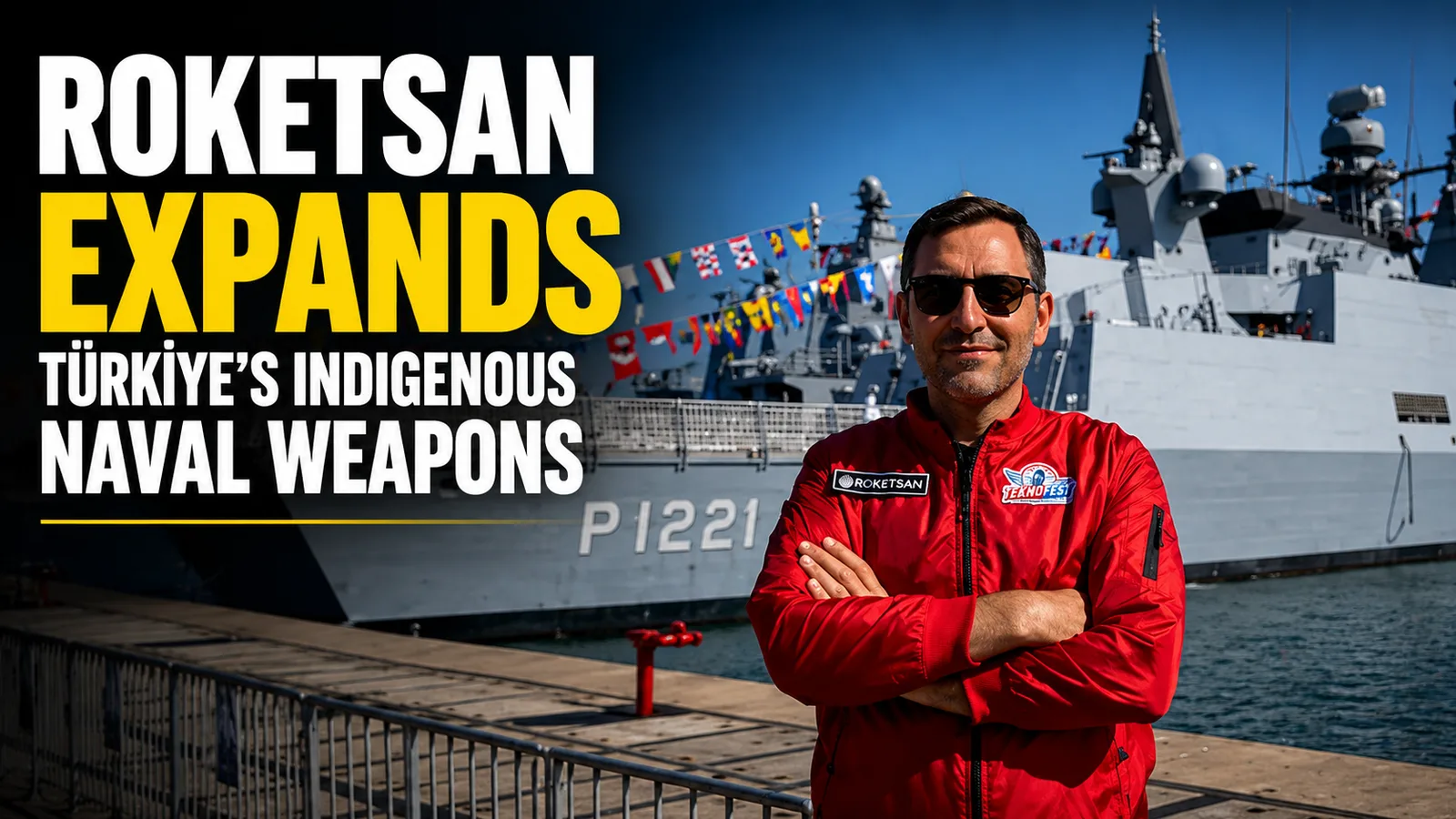
ROKETSAN General Manager Murat İkinci said during TEKNOFEST Mavi Vatan on 21 August 2026 that the company is pursuing the objective of meeting the Navy’s guided-munition requirements through domestic systems. He highlighted ATMACA, AKYA, the encapsulated AKATA missile architecture, MİDLAS, LEVENT and missile integration onto armed unmanned surface vessels as central elements of this effort.
The strategic significance is the emerging breadth of the portfolio. Türkiye is no longer localising one isolated naval weapon at a time; it is building an interconnected family of surface-strike, underwater-strike and defensive effectors intended to accompany the simultaneous expansion of its domestic warship, submarine and unmanned-platform programmes.
Key Facts
- Statement: ROKETSAN General Manager Murat İkinci spoke to Anadolu Agency at TEKNOFEST Mavi Vatan on 21 August 2026.
- ATMACA: Indigenous anti-ship missile in Turkish Naval Forces inventory and being integrated across new frigate and MİLGEM-class platforms.
- AKYA: Indigenous heavyweight torpedo already accepted into inventory; ROKETSAN publishes a range above 50 km and speed above 45 knots.
- AKATA: Encapsulated ATMACA architecture intended to give submarines a domestically developed guided-missile launch capability.
- MİDLAS: National vertical-launch architecture for ship-launched HİSAR and SİPER-family air-defence weapons.
- LEVENT: Close-in naval air-defence missile remains in testing, with platform integration described by İkinci as approaching.
- Unmanned vessels: ROKETSAN is pursuing integration of CİRİT, SUNGUR, ÇAKIR and L-UMTAS-class weapons onto armed unmanned surface vessels.
ROKETSAN Targets a Sovereign Naval Guided-Weapons Stack
Speaking to Anadolu Agency on 21 August 2026, İkinci said ROKETSAN was continuing its work with the objective of meeting the Turkish Naval Forces’ guided-munition requirements through indigenous capabilities.
The statement reflects a broader transition in Türkiye’s naval industrial base.
Domestic shipyards are simultaneously building frigates, fast attack craft, submarines, an air-defence destroyer and an aircraft carrier, but hull sovereignty alone does not eliminate dependence if those platforms remain reliant on imported missiles, torpedoes and launch systems.
ROKETSAN’s naval portfolio is increasingly intended to address that second layer of sovereignty.
ATMACA Replaces a Foreign Anti-Ship Missile Dependency
ATMACA remains the central surface-strike weapon in that portfolio.
İkinci said the missile is being integrated onto Türkiye’s newly produced platforms, including frigates and MİLGEM-class corvettes, and argued that the programme has ended the Navy’s dependency on foreign systems in this mission area.
ROKETSAN currently publishes a 250 km range, active RF seeker and a 220 kg high-explosive fragmentation and penetration warhead for ATMACA.
The missile also incorporates a data link for target update, mission abort and re-attack functions.
ROKETSAN lists surface and underwater platforms among the ATMACA family’s launch options, reflecting the programme’s expansion beyond its original ship-launched configuration.
ATMACA Has Already Moved Into Fleet Use
The distinction between development and operational status is important.
ATMACA is no longer only a developmental missile.
Türkiye’s Presidency of Defence Industries has previously confirmed its acceptance into Turkish Naval Forces inventory.
During Denizkurdu-II/2026 in June, the missile again successfully struck a surface target as part of a major Turkish naval exercise.
This operational background separates ATMACA from newer ROKETSAN systems such as LEVENT, where integration and qualification activity remains underway.
AKYA Localises the Heavyweight Torpedo Layer
Below the surface, AKYA performs a comparable role for Türkiye’s submarine force.
ROKETSAN describes AKYA as an indigenous next-generation heavyweight torpedo designed to engage submarines and surface vessels.
The company publishes a range of more than 50 km and a speed exceeding 45 knots.
Its guidance architecture includes an active/passive sonar seeker, internal guidance and external guidance through a fibre-optic cable, as well as wake-homing capability against surface vessels.
The Presidency of Defence Industries confirmed AKYA’s entry into the Turkish Naval Forces inventory following a successful warshot firing.
During Denizkurdu-II/2026, AKYA also successfully engaged a designated target from a submarine, providing another current demonstration of the weapon inside fleet-level training.
AKATA Adds a Submarine-Launched ATMACA Path
ROKETSAN is also extending the ATMACA architecture into the submarine domain through AKATA.
İkinci said the AKATA system is giving submarines the ability to employ ATMACA-class cruise missiles.
ROKETSAN unveiled the encapsulated ATMACA configuration at IDEF 2025 and described it as having a range exceeding 250 km.
Türkiye’s Ministry of National Defence annual reporting confirms that the first launch of an encapsulated ATMACA ballistic test vehicle took place on 12 March 2025 as part of the submarine-launch development programme.
That milestone demonstrates progress in the launch architecture, but AKATA should still be distinguished from the already fielded ship-launched ATMACA configuration until submarine operational qualification is formally completed and announced.
Submarine Strike Broadens Beyond Torpedoes
The strategic effect of AKATA is broader than simply giving ATMACA another launch platform.
A submarine traditionally relies heavily on heavyweight torpedoes for anti-surface warfare. A guided missile launched from a torpedo tube can extend its engagement options well beyond conventional torpedo range.
It can also allow a submerged platform to contribute to a wider networked maritime strike without having to close to the same distance required for a torpedo attack.
The operational value will depend heavily on off-board targeting, communications and mission planning, because long-range missile engagement requires reliable target information beyond the submarine’s immediate sensor horizon.
MİDLAS Builds the Defensive Half of the Architecture
ROKETSAN’s naval strategy is not limited to offensive weapons.
İkinci said HİSAR and SİPER missiles had been integrated with Türkiye’s MİDLAS national vertical-launch architecture.
MİDLAS is strategically important because vertical-launch-system sovereignty affects which missiles can be introduced onto a warship and how easily the loadout can be modified during its service life.
Türkiye demonstrated a major part of this architecture in 2026.
The Presidency of Defence Industries reported that HİSAR-D RF missiles fired from TCG İstanbul through MİDLAS successfully struck targets flying at approximately 10 metres and 800 metres during May tests.
Defence Agenda covered that milestone in New Platforms Strengthen Navy with HİSAR-D Test.
LEVENT Addresses the Inner Missile-Defence Layer
LEVENT occupies another position in the defensive architecture.
The missile is intended to provide close-in naval defence against threats including aircraft, helicopters, UAVs and sea-skimming or diving anti-ship missiles.
ROKETSAN’s published LEVENT specification lists an 11 km range, a 75 kg missile mass and a 10 kg fragmentation warhead with proximity sensing.
The guidance architecture combines an imaging-infrared seeker with passive radio-frequency sensing.
İkinci said testing and trials were continuing and that platform integration would take place in the near term.
This language means LEVENT should not yet be described as a fully fielded fleet-wide system.
LEVENT Targets the Gap Between Missiles and CIWS
The requirement behind LEVENT is partly a question of engagement geometry and magazine economics.
Longer-range HİSAR and SİPER-family weapons can engage threats further from a naval task group, but ships also require an independent inner defensive layer if an attacker penetrates the outer envelope.
Gun-based close-in weapon systems remain valuable at very short ranges, while a compact missile such as LEVENT can create another engagement opportunity before the threat reaches the gun layer.
Defence Agenda’s TF-2000 Destroyer Capabilities analysis illustrates how Türkiye is moving toward precisely this type of layered ship and task-group air defence.
İkinci Sees Significant Export Potential for LEVENT
İkinci also framed LEVENT as an export opportunity.
He said close air defence had become one of ROKETSAN’s most active export topics and highlighted particularly strong interest from the Gulf region following recent regional conflict.
The commercial logic is straightforward.
Many navies operate ships whose point-defence systems depend on a small number of established foreign suppliers. An independently developed Turkish missile, launcher and fire-control architecture could provide another supply source if qualification and production maturity are demonstrated.
No specific LEVENT export customer or signed contract was disclosed in the 21 August interview.
ROKETSAN Is Extending Missiles Onto Armed USVs
The most forward-looking part of İkinci’s comments concerns armed unmanned surface vessels.
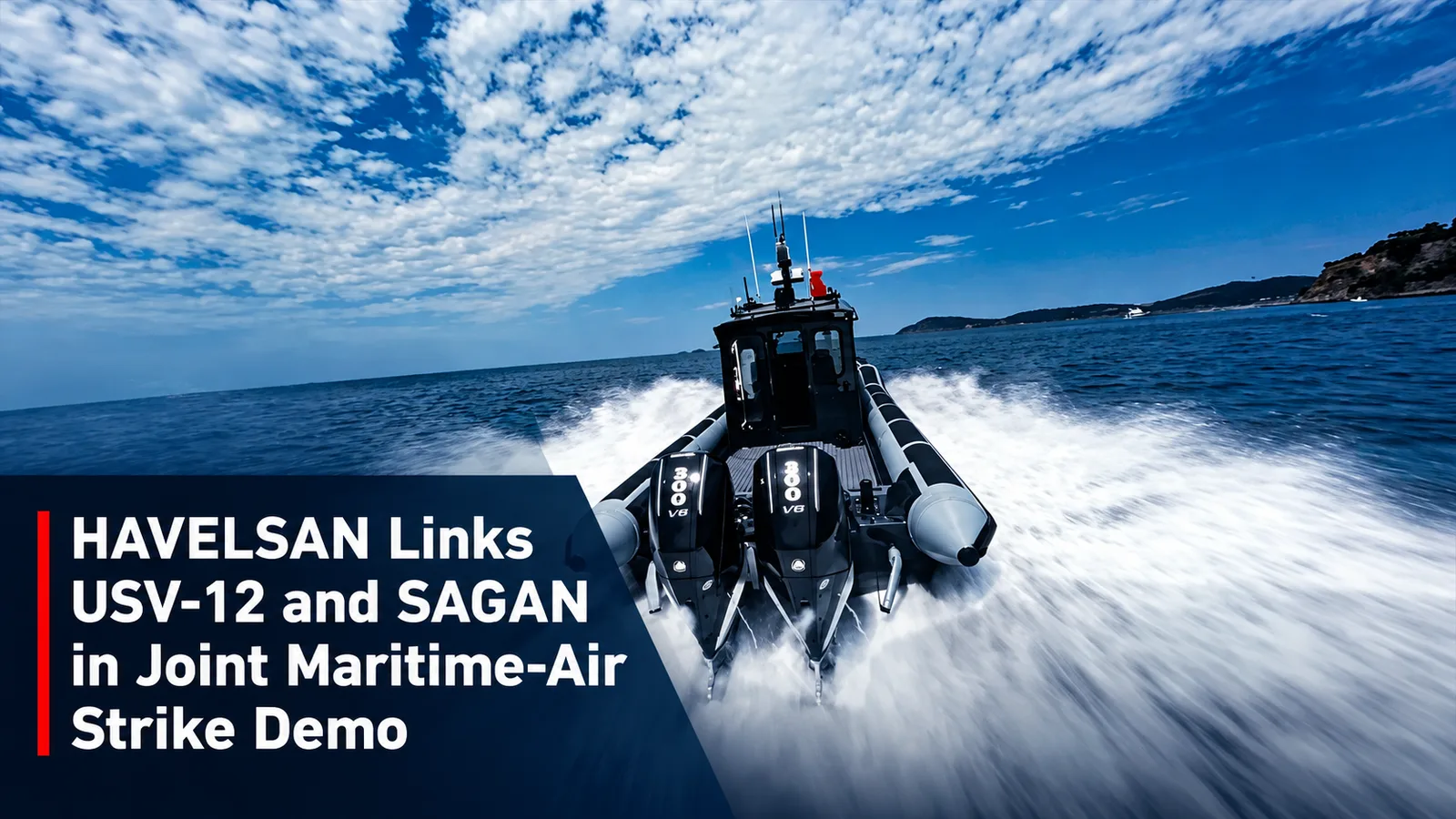
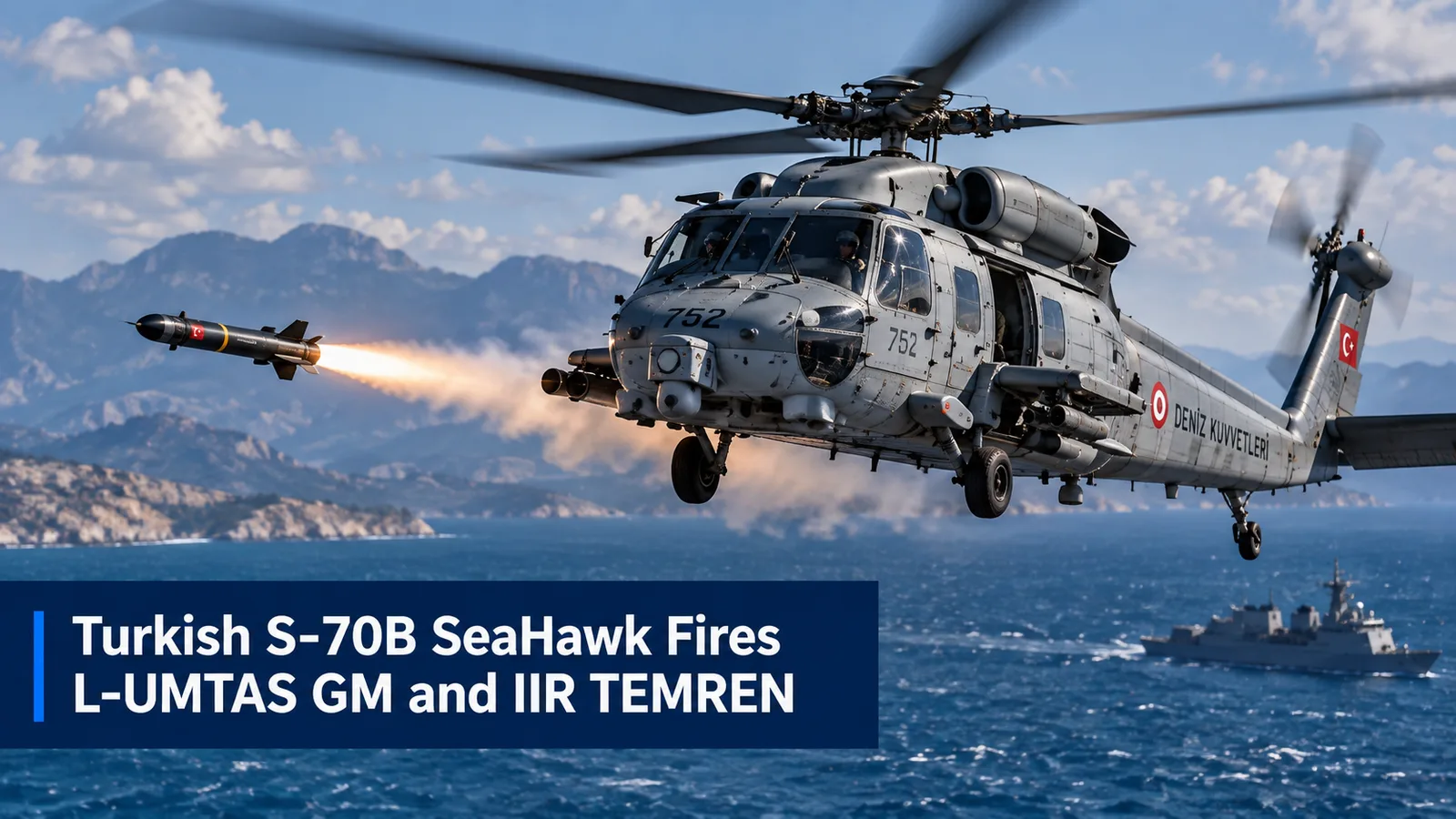
He said ROKETSAN is integrating CİRİT, SUNGUR, ÇAKIR and even L-UMTAS-class missiles onto SİDA platforms.
The statement should be interpreted as an integration and capability-development portfolio rather than evidence that every listed missile is already fielded operationally on every Turkish USV.
The weapons also address different target sets.
CİRİT and L-UMTAS derive from precision land-attack and anti-armour families, SUNGUR provides an air-defence option, while ÇAKIR gives an uncrewed surface platform a much longer-range cruise-missile capability.
ÇAKIR Gives SİDAs a 100+ km Strike Option
Of those weapons, ÇAKIR is particularly important for the future of missile-armed USVs.
ROKETSAN’s current surface-launched ÇAKIR specification lists a range above 100 km and explicitly identifies armed unmanned surface vessels among compatible platforms.
The surface-launched missile weighs approximately 350 kg and carries a 70 kg warhead, with hybrid RF/IIR seeker options and a data link supporting target update and man-in-the-loop functions.
This creates a different operational proposition from mounting a short-range precision missile on a USV.
A missile-armed unmanned vessel could operate as a distributed launcher connected to off-board sensors while a larger crewed warship remains outside the most exposed operating area.
Distributed Launchers Could Increase Naval Magazine Depth
The strategic value of missile-armed USVs lies partly in distribution.
A conventional frigate concentrates radar, command systems and many weapons on one expensive hull.
An uncrewed missile carrier can separate some launch capacity from that high-value platform.
This does not make the USV independent. Long-range engagement still depends on target identification, secure communications, command authority and integration with the wider naval operational picture.
But if those links are reliable, multiple unmanned launchers can increase the number and geographical distribution of available effectors without requiring a corresponding number of crewed combatants.
ROKETSAN’s Naval Portfolio Is Becoming Multi-Domain
The portfolio now spans several layers:
- Surface-to-surface: ATMACA and ÇAKIR.
- Submarine warfare: AKYA and the lighter ORKA family.
- Submarine-launched strike: AKATA encapsulated ATMACA.
- Fleet air defence: HİSAR and SİPER integration through MİDLAS.
- Close-in missile defence: LEVENT.
- Uncrewed surface strike: CİRİT, SUNGUR, ÇAKIR and L-UMTAS integration pathways.
The result is not yet a completely mature and simultaneously fielded system family. Different elements remain at different stages of inventory service, integration and testing.
It does, however, demonstrate how Türkiye’s missile-development effort is shifting from individual products toward an interconnected naval weapons ecosystem.
Warship Sovereignty Depends on Weapons Sovereignty
The timing is particularly relevant because Türkiye’s naval shipbuilding capacity is expanding rapidly.
New İ-class frigates, the National Fast Attack Craft, TF-2000/Kocatepe air-defence destroyer, MİLDEN submarine and MUGEM aircraft carrier all create future demand for domestic launchers, missiles, torpedoes and combat-system integration.
A nationally designed ship equipped predominantly with externally controlled critical weapons would still retain strategic dependencies in wartime replenishment and future integration.
ROKETSAN’s portfolio therefore has direct implications for Türkiye’s wider naval construction strategy.
For broader missile-development context, see Defence Agenda’s Roketsan’s Next-Gen Missiles and UAV Strategy.
The Next Challenge Is Production Depth
Developing indigenous weapons does not by itself guarantee wartime autonomy.
A naval force also needs sufficient production capacity, propellants, energetic materials, seekers, electronics, motors and warheads to replace weapons at operational consumption rates.
ROKETSAN has been expanding this industrial base.
On 7 April 2026, the company opened new fuel-production, warhead and advanced-technology facilities and began construction of an additional missile-integration facility while simultaneously conducting serial-production deliveries of 20 different defence systems.
The production side will become increasingly important if ATMACA, AKYA, HİSAR, SİPER, LEVENT and other systems are required across a growing Turkish fleet while exports also expand.
Counterargument: Indigenous Does Not Mean Every Dependency Is Gone
Claims of complete independence also require careful interpretation.
Indigenous design authority and domestic final production substantially improve strategic autonomy, but a complex missile contains numerous materials, electronics and manufacturing processes.
Public sources do not provide a component-by-component supply-chain audit for every ROKETSAN naval weapon.
It is therefore more precise to say that Türkiye has eliminated or is eliminating dependence on foreign finished weapon systems in key naval mission areas rather than asserting that every subcomponent has a completely domestic supply chain.
That distinction is particularly important when evaluating resilience under sanctions or prolonged high-intensity conflict.
Implications / Next
The first milestone to watch is LEVENT platform integration. İkinci says the programme is approaching this step, which would move the close-in missile system closer to operational naval qualification.
The second is AKATA submarine qualification. A successful operational submarine-launched ATMACA firing would materially expand the Turkish submarine force’s stand-off strike options.
The third is MİDLAS weapon expansion. Additional HİSAR and SİPER integration milestones will determine how broadly Türkiye can populate its national vertical-launch cells with indigenous air-defence weapons.
The fourth is SİDA missile testing. Public demonstrations involving CİRİT, SUNGUR, ÇAKIR or L-UMTAS on operationally representative uncrewed vessels would clarify which integration paths have moved beyond engineering work.
The fifth is production scale. The growing number of Turkish warships and potential export customers will place greater pressure on ROKETSAN to produce naval effectors in sufficient volume rather than merely maintain a broad catalogue.
Finally, integration with national combat-management, targeting and sensor networks will determine whether these missiles and torpedoes operate as independent weapons or as components of a genuinely networked Turkish naval kill chain.
Conclusion
Murat İkinci’s TEKNOFEST Mavi Vatan remarks show how far ROKETSAN’s naval portfolio has moved beyond the original ATMACA anti-ship missile programme.
ATMACA and AKYA are already inventory capabilities. AKATA is extending indigenous strike below the surface. MİDLAS is creating a national vertical-launch path for HİSAR and SİPER. LEVENT is approaching platform integration, while missile-armed SİDAs create a new distributed-launch layer.
The common objective is strategic control of the naval effector chain.
Türkiye’s domestic shipbuilding expansion can produce substantially greater military value if the missiles, torpedoes and launch systems aboard those vessels are also controlled by the national defence ecosystem.
The next phase will therefore be measured less by the number of missile names in ROKETSAN’s portfolio and more by fleet integration, serial-production depth and how effectively those weapons are connected to Türkiye’s expanding network of crewed and uncrewed naval platforms.
Further Reading
- Anadolu Agency: Murat İkinci on ROKETSAN’s Naval Weapons Strategy
- ROKETSAN: ATMACA Anti-Ship Missile
- ROKETSAN: AKYA Heavyweight Torpedo
- ROKETSAN: LEVENT Close-In Air Defence Missile
- Defence Agenda: ROKETSAN’s Next-Gen Missiles and UAV Strategy
- Defence Agenda: HİSAR-D and MİDLAS Naval Test
- Defence Agenda: TF-2000 Destroyer Capabilities
- Defence Agenda: Turkish-Made Missile-Armed Naval Drone in Azerbaijan