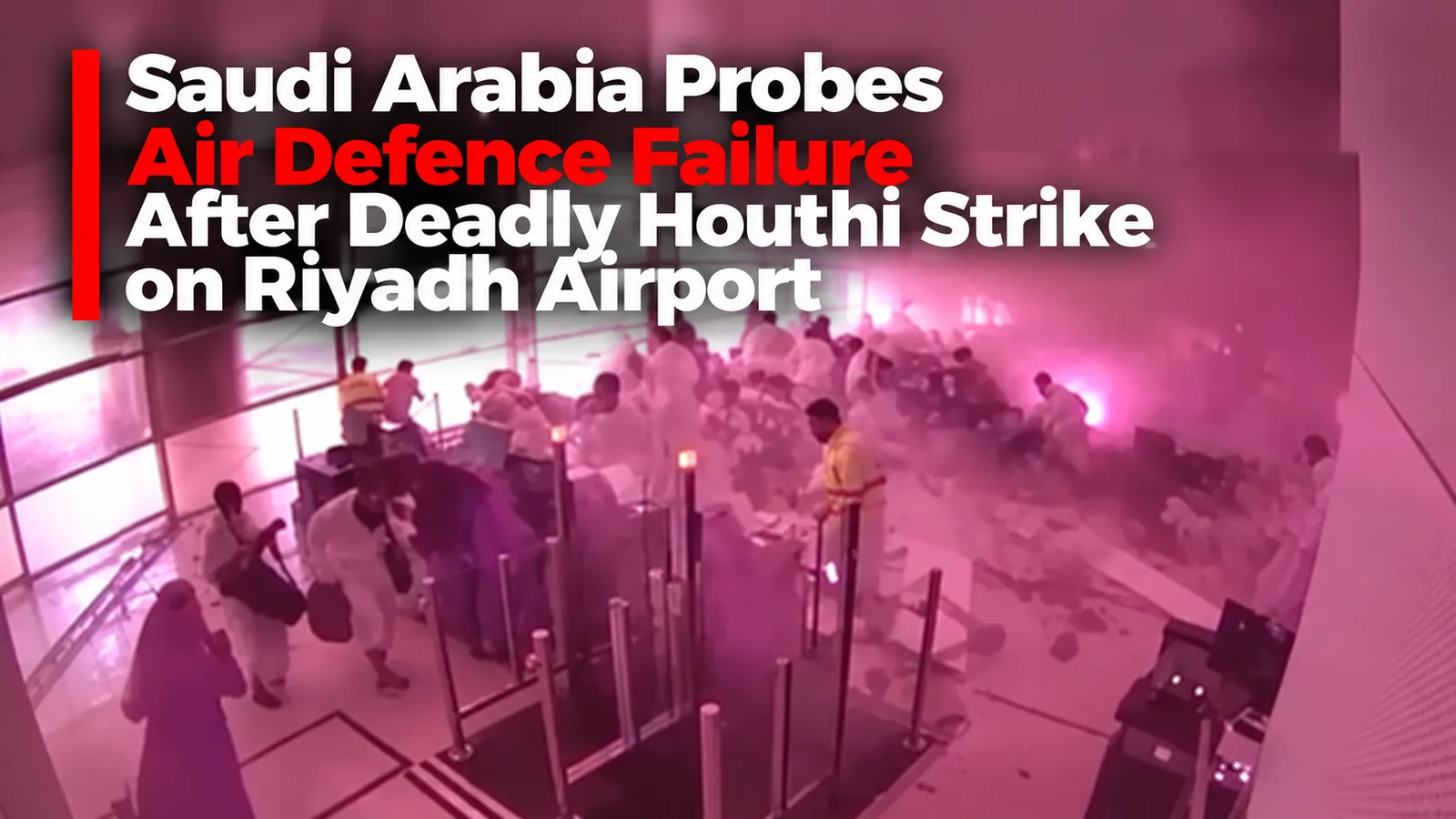
Saudi Arabia is investigating the failure of its air-defence network to prevent a deadly Houthi attack on King Khalid International Airport in Riyadh. The 10 October strike killed at least 13 people and wounded more than 300, according to the latest figures reported by Associated Press and Reuters. Two regional officials speaking anonymously to AP said the initial inquiry suggests the attackers used drones ahead of a combination of cruise and ballistic missiles.
The investigation is examining both the attempted interceptions and why Saudi Arabia did not receive an earlier warning as the incoming aircraft and missiles covered more than 1,000 kilometres from Yemen. No official forensic account of radar performance, missile allocation, intercept geometry or individual equipment failures has been released.
Investigators Are Examining the Drone-and-Missile Attack Sequence
AP reported on 12 October that two regional officials with knowledge of the investigation described an opening wave of multiple Houthi drones, followed by cruise and ballistic missiles. Their assessment is preliminary and has not been independently substantiated through a published Saudi incident report.
The combination matters because drones and missiles impose different detection, tracking and engagement demands. A defender must classify simultaneous contacts, provide warning to civilian infrastructure and assign interceptors without exhausting the response window. These are general operational challenges; they are not proof that the Houthis used a particular electronic-warfare technique or knowingly defeated a specific sensor.
The Main Unanswered Question Is Why Warning Came Too Late
One official told AP the inquiry specifically seeks to understand why the attack was not identified earlier, despite the long flight path from Yemen to Riyadh. The report does not establish whether the failure occurred in long-range surveillance, track correlation, communications, command decisions, engagement execution or some combination.
Such distinctions are important. A damaged target does not, on its own, show that Patriot launchers, missiles or radars malfunctioned. Nor does it demonstrate that every weapon evaded interception. The Saudi-led coalition separately reported destroying ballistic missiles launched toward Riyadh on 12 October.
At Least 13 Died as the Airport Faced Repeated Strikes
The attack on 10 October struck the airport's passenger-terminal complex. Reuters reported on 14 October that the strike killed 13 people and injured about 300, including travellers preparing for pilgrimage. Initial official accounts had put the death toll at 12; subsequent reporting placed it at at least 13.
The 10 October attack was part of a wider sequence of strikes against Saudi airports. AP reported that a further projectile hit a terminal on 11 October, killing one person and injuring 11. These successive incidents should not be conflated into a single attack or mechanically combined into an unsupported overall casualty total.
Civil Aviation Disruption Adds a Strategic Dimension
AP said King Khalid International Airport remained closed on 12 October. Reuters reported on 14 October that the attacks had disrupted travel arrangements and prompted some pilgrims, residents and business travellers to reroute journeys or postpone travel.
Civilian aviation hubs concentrate passengers, aircraft, fuel services, ground personnel and infrastructure in a limited area. The Riyadh attacks have therefore raised questions about protecting facilities where even a single successful strike can cause substantial human and operational consequences.
Patriot Is Part of the Discussion, but Failure Mode Is Not Established
AP noted that Houthi forces possess ballistic missiles and manoeuvring-warhead technologies that can pose difficulties for Patriot interceptors and other Saudi defences. However, no verified public evidence identifies the exact missile models used in the airport strike, the Saudi batteries engaged, the number of interceptors fired or the specific cause of any unsuccessful engagement.
The most useful analytical questions involve the completeness of the recognized air picture, coordination across counter-UAS and ballistic-missile-defence layers, target prioritisation and the protection of terminal areas. All remain lines of inquiry rather than established findings.
Riyadh Is Seeking Greater U.S. Involvement
AP reported that Saudi officials want more direct U.S. support against the Houthis. Washington has provided intelligence sharing, target identification and planning support to Saudi-led operations, while President Donald Trump had not publicly committed U.S. forces to new strikes against the group at the time of AP's report.
An expanded U.S. role could increase the risk of further attacks across the Red Sea region. AP also described concern over shipping through the Bab el-Mandeb Strait, while the wider conflict has already affected energy transit through the Strait of Hormuz. These are regional risk considerations, not announced U.S. operational plans.
The Latest Escalation Is Affecting More Than Airports
Reuters reported on 14 October that Houthi strikes had also hit Saudi Aramco's headquarters and that the security crisis was disrupting business, travel and public activity. The attacks create an additional infrastructure-protection burden beyond the immediate air-defence engagements.
The exchanges have also harmed civilians in Yemen. AP cited Houthi-run health officials alleging deaths in Saudi-led strikes on al-Jawf and Sanaa. These claims are attributed to the issuing authorities and have not been independently verified in the cited report.
What Remains Unconfirmed
Saudi Arabia has not released a completed investigation, a verified inbound-weapon inventory, an engagement timeline, system-level fault findings or a remedial procurement plan. The report therefore cannot support claims that specific Patriot interceptors were defective, that particular radars were disabled by jamming or that a single weapon type was responsible for defeating the wider network.
The next decisive information will be an official after-action assessment explaining the warning chain, defended sectors, number of incoming threats and interceptions, and any planned changes to the air-defence architecture. Until then, the verified development is the Saudi investigation into a deadly and disruptive mixed drone-and-missile attack, not a proven technical diagnosis.